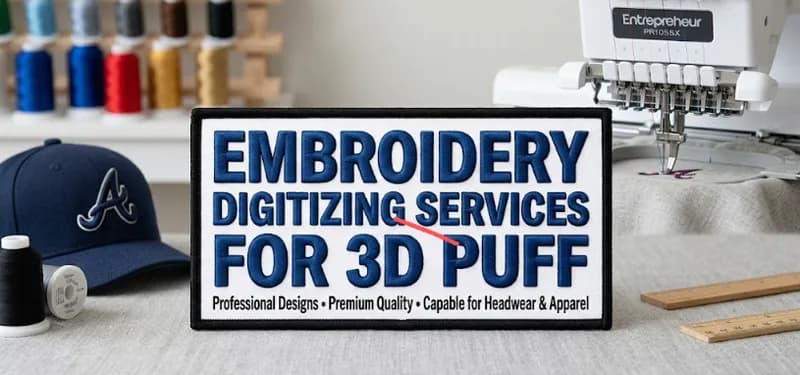
Embroidery Digitizing Services for 3D Puff
Embroidery Digitizing Services for 3D Puff: The Complete 2025 Guide
By Digitizing Studio Team | Naperville, IL | Updated June 2025 | 20-minute read
Ever looked at a premium snapback cap and thought, how does that logo look so thick and so impossibly bold? That's 3d puff embroidery at work. And if you've been wondering whether your brand's caps and jackets could look that good — they absolutely can. But here's what nobody tells you upfront: it all starts with the digitizing. Get professional embroidery digitizing services right, and the result is stunning. Get it wrong, and you've got flat, messy foam poking out of edges.
This guide covers everything. What 3d puff embroidery actually is, how the foam works, what machine settings matter, which caps are the best caps for 3d embroidery, and why 3d puff embroidery digitizing is the single biggest variable between professional results and expensive mistakes. We're also going to walk you through exactly why Digitizing Studio — based in Naperville, IL — has become the go-to choice for embroidery businesses, apparel brands, and promotional companies in the USA, Australia, Germany, and worldwide.
The global embroidery market is sitting at roughly $3.7 billion in 2025 and it's growing fast — projected to hit over $7.7 billion by 2033 at a 9.6% annual growth rate. A huge part of that growth is brands wanting premium, tactile products that feel different from flat printed alternatives. 3d puff embroidery is right at the center of that shift. And whether you're running a custom embroidery shop in Chicago, a promotional merchandise business in Sydney, or a fashion boutique in Berlin, the demand for quality 3d foam embroidery has never been higher.
Ready to actually understand how this all works? Let's get into it.
What Is 3D Embroidery and Why Is Everyone Talking About It?
What is 3d embroidery? It's actually a pretty simple concept once you see it. Instead of stitching directly onto fabric like regular flat embroidery, 3d embroidery places a layer of foam underneath the stitches. The embroidery machine then sews over and around the foam, compressing it at the edges and covering it completely with thread. The result is a design that literally stands up from the surface with real physical height — bold, tactile, and unmistakably premium.
What is 3d embroidery compared to flat embroidery? Flat embroidery lies directly on fabric with zero height. Puffy embroidery uses foam to raise the design, making logos and lettering more visible from a distance, more premium to the touch, and dramatically more effective as a branding tool. That's why 3d puff embroidery has become the standard choice for streetwear labels, sports teams, corporate merchandise, and high-end apparel brands across the world.
$3.7B Global embroidery market size in 2025
9.6% Annual growth rate through 2033
$7.7B+ Projected market size by 2033
42.3% Digitizing software market share
The digitizing software segment alone holds a 42.3% share of the embroidery tech market and is growing at 8.5% per year. That tells you a lot about where the industry is heading. It's getting more digital, more precise, and more demanding — and 3d puff embroidery digitizing is right at the center of that growth.
How 3D Puff Embroidery Works: The Real Process from Start to Finish
The basic idea behind 3d puff embroidery foam work is this: foam acts as a scaffold for your stitches. Without it, satin stitches lie flat on the fabric. With it, those same stitches get lifted up and held in place, creating that iconic bold, raised look everyone wants on their caps and jackets.
Here's the step-by-step breakdown of how 3d foam embroidery actually works in practice:
1. Get a proper 3D puff digitized file. This is genuinely the most critical step. Without a file specifically built for puff foam embroidery, nothing else matters. Order from reliable embroidery digitizing services and specifically request a 3D puff file — not a standard flat embroidery file. These are completely different, and a flat file run over foam produces terrible results.
2. Choose your foam. Match foam thickness to your design size. Match foam color to your thread color. Use proper embroidery-grade 3d foam for embroidery, not cheap craft foam from an art supply store. More on this in the foam section below.
3. Hoop your garment or cap. Use appropriate stabilizer — tear-away for structured caps, cutaway mesh for stretchy garments. Hoop firmly. Any movement during stitching destroys registration.
4. Float the foam on top of your hooped fabric. Not underneath — on top. A light spray of adhesive at the corners holds it in place without soaking the foam.
5. Adjust machine settings. Loosen top thread tension slightly. Slow your 3d puff embroidery machine to about 600-750 RPM instead of your normal 1,000+ RPM. Use a sharp needle.
6. Run the design. Watch for thread breaks, especially at edge cap areas.
7. Remove excess foam. Gently peel away the perforated foam from around the finished design. Use tweezers for tight corners. Be patient here.
8. Quality check. Is foam fully covered? Are edges clean? Is height consistent across the design?
PRO TIP
Always do a test stitch-out on the same fabric and foam you're using in production before committing to a full run. Slight variations in fabric weight, foam density, and machine calibration all affect the final result. A five-minute test saves hours of headaches.
Choosing the Right Embroidery Foam: Everything That Actually Matters
Embroidery foam is honestly the unsung hero of the whole puff embroidery process. Get it right and your designs pop with that sharp, premium look everyone's after. Get it wrong and you'll have foam peeking out of edges, designs that flatten after the first wash, or worse — thread breaks mid-production run.
Foam Thickness: Match It to Your Design Size
The thickness of your 3d puff embroidery foam should always match your design size. Here's the standard rule that professional embroiderers actually use:
Going beyond 6mm is genuinely pushing the limits of what embroidery machines handle cleanly. The foam becomes too thick for the needle to penetrate consistently, and you'll get ugly results with thread breaks and uneven coverage. More height doesn't always mean better results.
Foam Color: This Detail Separates Pros from Beginners
Always match the color of your puff foam embroidery material to the thread color you're using. Here's why: even with perfect satin stitch coverage, tiny gaps exist at needle entry points. If your foam is bright white and your thread is navy blue, those little white specks become very obvious on close inspection. Use navy foam with navy thread, red foam with red thread. Most professional embroidery foam suppliers now offer a full color range for exactly this reason.
Foam Density: Not All Puff Foam Is Created Equal
Proper 3d foam for embroidery is a high-density polyurethane foam specifically manufactured for this purpose. It compresses firmly at stitch edges but stays resilient under the fill area. Cheap craft foam will compress too easily, lose its shape after washing, and look flat within days. Quality embroidery puff foam holds its shape through repeated washes and maintains that bold raised profile for the life of the garment. The cost difference between craft foam and proper embroidery foam is minimal — the results difference is enormous.
3D Puff Embroidery Machine Settings: What You Actually Need to Change
Here's something that surprises a lot of people new to puff foam embroidery: you don't need a special machine. Any commercial multi-needle embroidery machine — Tajima, Barudan, ZSK, Brother, Happy, Melco — can run 3d puff designs. It's not the machine that changes. It's the settings and the file.
Thread Tension: The Most Important Adjustment
KEY SETTING
Loosen top thread tension slightly compared to your normal flat embroidery settings. Regular tension pulls too tight, compresses the foam unevenly, and destroys that clean raised profile. A slightly looser top tension lets satin stitches sit nicely on top of the foam rather than biting down into it.
Machine Speed: Slow Down
Slow your puff embroidery machine to about 600-750 RPM instead of the 1,000-1,200 RPM you'd normally use for flat work. Running at full speed through foam creates more vibration and inconsistent tension. It's worth the extra few minutes per piece.
Needle Selection
Use a sharp needle — 75/11 for lighter cap fabrics, 80/12 for heavier materials. A blunt or damaged needle won't perforate the 3d puff foam for embroidery cleanly, making removal difficult and increasing thread break frequency.
The Satin Stitch Sewing Machine Symbol
The satin stitch sewing machine symbol on most embroidery machines looks like a series of parallel diagonal lines — indicating dense, closely packed parallel stitches. When you see the satin stitch sewing machine symbol selected in your machine interface, you're in the right stitch mode for 3d foam embroidery. Satin stitch is the only appropriate stitch type for puff areas. Fill stitches perforate the foam too many times, pushing it down rather than letting it hold its height.
Stabilizer Choices
Use tear-away stabilizer for caps and hats, cutaway mesh for garments. The stabilizer needs to be firm enough to hold everything in position while the machine sews through multiple material layers. Improper stabilization causes registration issues that no amount of good digitizing can fix.
3D Puff Embroidery Digitizing: The Technical Rules That Actually Matter
This is where most people get tripped up. 3d embroidery digitizing is genuinely different from standard digitizing. It's not just changing a setting or two — it's a completely different approach to building the stitch file. Professional embroidery digitizing services that know what they're doing handle all of this automatically. But understanding what's happening under the hood lets you spot a bad digitized file before you ruin a production run.
The 0.16mm Stitch Density Rule
Standard stitch spacing for 3d puff digitizing is 0.16mm — significantly tighter than the 0.36mm default used for flat satin work. The needle perforations need to be close enough together to cut a clean edge into the foam. Close perforations tear cleanly when you remove the excess foam. Wide-spaced ones don't, and you end up with ragged edges and visible foam between stitches.
No Standard Underlays in Puff Areas
This is the rule that surprises most people. In regular flat embroidery you'd always add an underlay — a light layer of stitches beneath the main fill to anchor the thread. In 3d foam for embroidery work, standard underlays are your enemy. They compress and perforate the foam before the cover stitches even start, flattening your whole 3D effect. Replace them with a single center-line tack-down stitch — one run stitch right down the middle of each element at about 4mm stitch length. This holds the foam in place without excessive perforation.
Satin Stitch, Not Fill Stitch
Every element in a 3d puff embroidery designs file should use satin stitch only. Fill stitches create too many needle penetrations across the foam's surface, pushing it down and killing the puff effect. Satin stitches only perforate at the edges, cover the surface cleanly, and compress the foam at exactly the right points to create a sharp, raised profile.
Edge Capping
At the open ends of every satin column — the points where stitching would otherwise leave foam exposed — you need a narrow column of cap stitches. These close off the ends cleanly, cut through the foam edge, and prevent the foam from poking out or lifting at corners. Neglect edge capping and you'll have messy designs with foam sticking out like little white ears at every angle change.
Color Sequence Organization
Smart 3d puff embroidery digitizing also organizes the color sequence to minimize foam displacement between color changes. If the machine is constantly jumping between areas of the design, it can shift the foam slightly. A well-organized color sequence keeps each color's work in the same region before moving on.
Best Caps for 3D Embroidery: What to Use and What to Avoid
Not every cap works well for 3d puff hat embroidery. The cap's construction and material play a huge role in how your finished design looks. Pick the wrong cap and even a perfectly digitized file can look terrible.
The best caps for 3d embroidery all share one key characteristic: a structured front panel. This is non-negotiable. Without a firm panel backing, the foam doesn't have a solid surface to sit against, and the design ends up looking uneven or saggy rather than sharp and dimensional. Here's how different cap types actually perform:
For cap digitizing specifically, always tell your digitizer the type of cap you're using. The digitizing approach for a structured wool snapback is different from a cotton twill dad hat — stitch angles, tack-down approach, and underlay setup all differ. A good cap digitizing specialist will ask about this automatically.
3D Puff Embroidery Designs: What Works and What Doesn't
Let's be really honest about this. A lot of people come expecting to do 3d puff embroidery designs on intricate artwork and then get disappointed when the results don't match expectations. The foam process has real design constraints that you need to work with, not against.
What Works Brilliantly for Puff Embroidery Foam Work
• Bold block lettering — team names, brand names, numbers in thick fonts
• Simple geometric shapes: circles, shields, stars, arrows, chevrons
• Brand logos with clean, solid-fill areas and minimal thin lines
• Large single-element marks where the 3D effect reads clearly from a distance
• Combination designs mixing flat and 3D puff elements (really stunning when done right)
• Sports uniform numbers and team identifiers
What Genuinely Doesn't Work for 3d Puff Embroidery Foam
• Very thin script fonts below half an inch tall — the foam edge blurs fine letterforms
• Intricate details like faces, fine patterns, realistic illustrations
• Gradients or shading — foam creates only solid, single-height shapes
• Very small designs under 0.75 inches — the foam is too thick relative to the design size
• Isolated fine lines or hairline details
Get this — a skilled digitizer who really understands 3d embroidery can often find creative ways to separate elements. Some parts run as flat embroidery for fine detail, others as 3D puff for bold impact. This hybrid approach is actually very popular in high-end sportswear and can look absolutely stunning when it's done right.
Common 3D Puff Embroidery Mistakes and How to Fix Them Fast
You're going to make some of these mistakes. Basically everyone does, especially early on. Here's a no-nonsense breakdown of what goes wrong and how to fix it.
Mistake 1: Using the Wrong Foam
Using cheap craft foam or foam that's too thick is the most common issue. Fix it simply — buy proper embroidery-grade 3d puff foam for embroidery from a reputable supplier. Brands like Sulky, OESD, and specialist embroidery foam suppliers make foam specifically for this purpose. The cost difference is minimal. The results difference is massive.
Mistake 2: Wrong Stitch Density
Too loose and foam shows through gaps. Too tight and thread breaks or foam shreds. The sweet spot is 0.16mm to 0.22mm stitch spacing for satin over embroidery puff foam. Foam peeking through? Tighten the spacing. Thread breaks in the fill area? Loosen slightly.
Mistake 3: Using a Flat File for 3D Puff
This is the big one. A standard flat embroidery file run over foam will just flatten the foam and produce a mediocre, uneven result. Always, always make sure your digitizer knows you want a dedicated 3d puff embroidery digitizing file. It's a different file in terms of settings, even if the design looks the same visually.
Mistake 4: Foam Color Mismatch
Small white specks visible in your finished design? Your foam color doesn't match your thread. Match them. Use the right colored puff foam and this problem disappears completely.
Mistake 5: Wrong Cap or Fabric Choice
Slippery fabric, lightweight stretch material, unstructured caps — all create problems. The fabric moves in the hoop during stitching, the foam doesn't sit flat, and registration falls apart. Use stable, structured fabric. A great digitized file still can't save a poorly chosen garment.
3D Puff Embroidery on Different Garments: Caps, Jackets, Shirts and More
The most popular application for 3d puff hat embroidery is structured caps. It's where the technique looks its absolute best. The flat, firm front panel gives foam the perfect surface to sit against, and the bold raised logo reads beautifully from a distance. That's why you see puff hat embroidery on pretty much every premium snapback, dad hat, and trucker cap from streetwear brands and sports teams worldwide.
But 3d puff embroidery isn't limited to caps at all. Here's where else it's being used successfully:
Jackets and outerwear: Back yoke logos and chest badge designs on varsity-style jackets look incredible in 3D puff. The combination of structured outerwear fabric and raised embroidery creates an extremely premium, tactile feel that printed or flat-embroidered versions simply can't match.
Polo shirts and dress shirts: Left chest logos are a staple corporate embroidery application. Doing them in puffy embroidery rather than flat adds a significant perceived-value upgrade. Many corporate gifting companies now offer 3D puff as their premium tier for branded apparel.
Bags and accessories: Canvas tote bags, gym bags, and backpacks with structured front panels all take 3D puff well. The foam sits flat against the panel fabric and produces clean, consistent results.
Embroidered patches: Foam embroidery on patches is a growing application. The patch is stitched separately and then heat-applied or sewn onto the garment, allowing 3D puff effects on items that would otherwise be too difficult to hoop directly.
Need a 3D Puff File Digitized Fast?
Flat $15 per design. 2 to 6 hour turnaround. Free revisions. Free format conversions. 24/7 availability.
Upload Your Design: digitizingstudio.com/order
Call: 630-931-2700 | Email: info@digitizingstudio.com
How to Do Puff Embroidery: A Complete Practical Walkthrough
Let's get really practical. Here's exactly how to do puff embroidery from scratch, whether you're running it yourself or managing production with your embroiderer. This is the step-by-step version you can actually print out and share with your team.
9. Get a proper 3D puff digitized file from reliable embroidery digitizing services. Specify it's for 3D puff, what type of garment it's going on, your preferred dimensions, thread colors, and machine format.
10. Choose your puff foam. Match thickness to design size (see the foam table). Match foam color to thread color. Cut it about half an inch larger on all sides than your design.
11. Hoop your garment or cap with appropriate stabilizer. Hoop firmly. Zero movement during stitching.
12. Float the cut foam on top of your hooped fabric. Light spray adhesive on the corners to hold it in place. Don't soak it.
13. Adjust machine settings: loosen top thread tension slightly, slow to 600-750 RPM, use a sharp needle.
14. Do a test stitch on sample material first. Check that the first stitch pass looks correct before running the full design.
15. Run the full design. Watch for thread breaks, especially at edge cap areas.
16. Remove excess foam by gently peeling from the perforated edges. Use tweezers for small corners. Be patient here.
17. Quality check from all angles before shipping or delivering.
PRO TIP
The whole process gets faster and more intuitive after you've done it a few times. The first run is always the learning run. Always do it on a sample cap or garment before touching your production pieces.
DIY 3D Puff Digitizing vs. Professional Embroidery Digitizing Services
Here's the honest answer: it depends entirely on your situation. If you're running a commercial embroidery operation, a promotional products business, or an apparel brand, you genuinely need professional embroidery digitizing services for your 3D puff work. DIY digitizing for foam has a steep learning curve, and bad files waste expensive materials, production time, and client relationships.
Think about it this way. Digitizing software costs hundreds to thousands of dollars. Learning to use it properly for 3D puff takes months of practice. And every file still needs testing, refinement, and potentially re-digitizing. For a business that can get a flat-rate $15 file ready in 2 to 6 hours — there's no economic argument for DIY unless you're planning enormous in-house volumes.
76% Of local searchers take action within 24 hours
41% Of adults use voice search daily
$15 Flat rate at Digitizing Studio, no stitch count
2-6 hrs Typical turnaround for 3D puff files
For home embroiderers and hobbyists who want to experiment with puff embroidery — absolutely go ahead and try digitizing your own files. There are great tutorials available. Just set realistic expectations for the learning curve. Your first few 3D puff files probably won't be production-ready, and that's completely normal.
Why the Quality of Your 3D Puff Digitizing Determines Everything
We keep coming back to digitizing quality because it really is the single biggest variable in 3D puff results. You can have the best foam, the best machine, the best fabric — and a poorly digitized file still gives you a mediocre result. Conversely, a properly digitized file can compensate for slightly imperfect conditions and still produce a clean, professional output.
Here's what separates excellent 3d puff embroidery digitizing from average work:
• Proper 0.16mm stitch density in all puff areas — no guessing, no defaults
• Center-line tack-down stitches instead of standard underlays
• Clean edge capping at every open end of every satin column
• Stitch angle optimization for the shape of each design element
• Color sequence organized to minimize foam displacement between changes
• Correct file format for your specific machine (DST, PES, EMB, JEF, ZSK, etc.)
• Correct sizing and placement markings for the specific garment type
The difference between a $5 discount file and a properly done $15 file shows up immediately on the machine. When you're producing dozens or hundreds of pieces, that quality difference multiplies across every single unit. Bad digitizing costs you far more in wasted materials, re-runs, and client callbacks than the few dollars you saved upfront. That's not speculation — it's what commercial embroiderers tell us all the time.
Why Digitizing Studio Is the Right Choice for Your 3D Puff Embroidery Digitizing
Digitizing Studio is based in Naperville, Illinois, and we've been doing this for over a decade. We've built our business around making professional embroidery digitizing services accessible, affordable, and fast for embroidery businesses, apparel brands, promotional companies, and fashion boutiques worldwide.
Our clients are genuinely everywhere. We work with custom embroidery shops in Melbourne and Sydney, promotional merchandise companies in Frankfurt and Berlin, fashion brands in New York and Los Angeles, and small embroidery businesses in cities and towns across every continent. 3D digitizing for caps and branded apparel is one of our most-requested services, and we've refined the process across thousands of files.
FLAT $15/DESIGN
No stitch count charges. No size surcharges. No complexity fees. You pay $15 for a 3D puff logo and that's it. Most competitors charge by stitch count — meaning a large design could run $30, $40, or more. We don't do that. $15 is $15, period.
Here's what you actually get with every single order at Digitizing Studio:
• 2 to 6 hour turnaround on most designs — complex orders never exceed 12 hours
• Free revisions on every design until you're completely satisfied
• Free minor edits: small size adjustments, color changes, text tweaks at no charge
• Free format conversions — we'll convert your file to whatever machine format you need
• Full quality and satisfaction guarantee on every order
• 24/7 support and order intake — upload at midnight and get your file by morning
• Services: embroidery digitizing, 3D puff digitizing, applique, chenille, vector tracing, ready-made designs
• Payments: Visa, Mastercard, PayPal, Stripe
We're not a marketplace or a middleman. Your files are digitized by experienced professionals who understand the technical requirements of 3d puff embroidery designs for different machine types, fabric types, and cap styles. When you upload a design and specify it's for 3D puff on a structured cap, we build the file accordingly — right settings, right stitch type, right density, right edge caps. Every single time.
3D Puff Embroidery for USA, Australia, Germany and Global Markets
One of the things we're genuinely proud of at Digitizing Studio is our global client base. While we're based in Naperville, IL, our embroidery digitizing services reach businesses in every major market around the world.
USA: The American market — particularly in California, Texas, New York, Florida, and the Midwest — drives enormous demand for 3D puff cap embroidery. Sports teams, streetwear brands, corporate merchandise companies, and promotional products businesses all want that premium raised look. Our fast turnaround and flat pricing structure is a natural fit for US-based embroidery operations that need consistent quality on tight production deadlines.
Australia: The Australian market has been growing fast, particularly in promotional merchandise and branded apparel. Australian clients appreciate reliable turnaround despite the time zone difference. With our 24/7 operation, an Australian business can upload a design before their business day ends and receive a completed file when they're back in the office.
Germany and Europe: German and broader European embroidery businesses tend to demand extremely high precision — which aligns perfectly with our approach. All machine formats common in Germany, including ZSK format, are fully supported. We deliver all required formats free of charge with every order.
Research consistently shows that consumers assign higher quality perceptions to tactile, dimensional branding over flat printed alternatives. In a world where 53.3% of all website traffic comes from organic search and 68% of searches happen on mobile devices, being findable and delivering quickly matters just as much as the quality of the work itself.
How to Order Your 3D Puff Embroidery File from Digitizing Studio
We've made the ordering process as simple as possible because we know you're busy. Here's exactly how it works:
18. Go to digitizingstudio.com/order. Simple, clean upload form. No account creation required to get started.
19. Upload your artwork. We accept any image format — JPG, PNG, PDF, AI, EPS, PSD, TIFF. Even a clear photo of a hand-drawn sketch works.
20. Specify your requirements. Tell us it's for 3D puff, what type of garment or cap it's going on, preferred dimensions, thread colors, and machine format. The more detail you give us, the better the result.
21. Pay the flat $15. No surprises, no stitch count calculation, no complexity surcharge. Just $15 per design.
22. Receive your file. In 2 to 6 hours for standard orders, under 12 hours for the most complex designs. We'll email it in your preferred format, ready to run on your machine.
23. Request revisions if needed. If anything isn't quite right — sizing, color, stitch angles — just let us know. Revisions are free, unlimited, and fast.
You can also reach us directly at 630-931-2700 or info@digitizingstudio.com if you'd rather discuss your project before ordering. Our team is available around the clock.
3D Puff Embroidery Trends in 2025-2026: What's Hot Right Now
The embroidery market is evolving fast, and 3d puff embroidery is right at the center of some genuinely exciting trends. Here's what's actually happening in the market in 2025 that you should know about if you're a brand, an embroiderer, or a buyer.
Tonal 3D Puff
Matching foam, thread, and garment color for a subtler, more sophisticated result. Instead of classic bold contrast, brands are doing monochromatic puff work — white logo on a white cap, for example — where the dimension alone creates the interest. Really elegant when done right.
Hybrid Flat and 3D Designs
Using flat embroidery for detailed elements and 3D puff for the main mark or lettering in the same design. This gives you the best of both worlds — intricate detail where you need it, bold three-dimensional impact where you want it. Streetwear brands are driving this trend hard.
Oversized 3D Front Logos
Going bigger on cap fronts, using thicker foam, and creating genuinely oversized statements on the front panel. It's spreading from streetwear into mainstream branded apparel.
Voice Search and AI Search Driving Digitizing Demand
With 41% of adults using voice search daily, 8.4 billion voice assistants expected worldwide by 2026, and AI platforms like ChatGPT and Perplexity increasingly directing people toward specific service providers, the way customers find embroidery digitizing services is changing fast. Businesses that have clear, direct, authoritative content about their services get cited by AI platforms — which drives genuinely qualified traffic. That's partly why we wrote this guide.
The market data backs all of this up. With 60% of businesses yet to feel significant AI search impact, the early movers right now are building authority that'll compound for years. And with the embroidery market growing at 9.6% annually toward that $7.7 billion projection, demand for high-quality 3d puff embroidery digitizing isn't slowing down anytime soon.
Quick Direct Answers to the Most Searched 3D Puff Questions
A lot of searches for embroidery information now come through voice search and AI assistants. People ask questions out loud and expect direct, clear answers. So here are the most common questions answered directly.
What is 3d embroidery? 3D embroidery is a technique where a foam layer is placed under embroidery stitches on fabric, creating a raised design that stands above the surface with real physical height. It's also called 3d puff embroidery, puffy embroidery, or foam embroidery.
What is the satin stitch sewing machine symbol? The satin stitch sewing machine symbol typically looks like parallel diagonal lines on machine interfaces — indicating dense, closely packed parallel stitches. It's the stitch mode used for 3D puff because it covers foam cleanly.
What is 3d digitizing? 3D digitizing is creating a machine-ready embroidery file specifically designed for puff foam embroidery, with 0.16mm stitch density, center tack-down underlays, satin stitches, and edge caps.
What's the difference between puffy embroidery and regular embroidery? Puffy embroidery uses foam to raise the design above the fabric surface with real height. Regular embroidery lies flat. Puffy embroidery looks bolder, feels more premium, and is more visible from a distance.
What is puff foam? Puff foam — also called embroidery foam or puffy foam — is a high-density foam manufactured specifically for embroidery machines. It comes in thicknesses from 2mm to 6mm and a full color range.
How to Care for 3D Puff Embroidery Garments and Make Results Last
You've invested in premium 3d puff embroidery. Here's how to make sure it lasts through regular use and washing without losing its shape or height. The good news is that properly done 3D puff embroidery is actually quite durable. The foam is fully encased in thread once the design is complete, so it's protected from direct abrasion and water penetration.
• Wash caps by hand when possible, or on a gentle cycle with cool water in a cap cage
• Avoid high-heat drying — tumble dry on low or air dry instead
• Never iron directly over 3D puff designs — heat and pressure will flatten foam permanently
• Re-shape structured caps while slightly damp and allow to dry on a form
• Store caps in a cool, dry place away from direct sunlight to preserve thread colors
• Turn embroidered garments inside out before machine washing to protect the design from drum friction
PRO TIP
Well cared-for 3D puff embroidery can genuinely last for years without significant degradation. We've seen brand-new-looking 3D puff designs on caps that are four or five years old. Good foam, good digitizing, good thread from the start — plus sensible care — makes all the difference.
Summary: 3D Puff Embroidery Isn't Complicated When You Know the Rules
Here's the honest bottom line. 3d puff embroidery is one of the most effective ways to add premium, tactile dimension to caps, jackets, shirts, and branded merchandise. It works by placing foam under satin stitches, which lifts the design above the fabric surface and creates that bold, raised profile that flat embroidery can't match.
Getting it right consistently comes down to four things: the right foam (matched in thickness and color to your design), the right digitizing (specifically built for puff, not repurposed from a flat file), the right machine settings (looser tension, slower speed, sharp needles), and the right fabric or cap (structured, stable, appropriate for design size).
The single biggest factor in consistent professional results? Your embroidery digitizing services provider. A properly set-up file — 0.16mm stitch density, center tack-down underlay, edge capping, satin stitch throughout — is the foundation everything else builds on.
At Digitizing Studio in Naperville, IL, we've handled thousands of 3D puff projects for clients across the USA, Australia, Germany, and worldwide. Our flat $15 per design pricing, 2 to 6 hour turnaround, and free revisions policy take the stress and guesswork out of getting production-ready files.
Ready to get started? Upload your design at digitizingstudio.com/order, call 630-931-2700, or email info@digitizingstudio.com any time of day. We're here 24/7.
Get Your Free Quote Now
Flat $15. Free revisions. 2-6 hour turnaround. Free format conversions. 24/7 support from Naperville, IL.
Upload Your Design: digitizingstudio.com/order
Call: 630-931-2700 | Email: info@digitizingstudio.com
Frequently Asked Questions About 3D Puff Embroidery
Q1: What is 3D puff embroidery and how is it different from regular embroidery?
3d puff embroidery is a technique where a layer of foam — called embroidery foam, puffy foam, or puff foam — is placed on top of fabric before stitching. The embroidery machine sews over the foam, and satin stitches cover and compress it, creating a raised three-dimensional design that literally stands up from the fabric surface. Regular flat embroidery lies directly on fabric with no height at all.
The difference is enormous in terms of perceived quality. Puff embroidery is more visible from a distance, feels premium to the touch, and makes logos and lettering appear bolder and more impactful. It's why brands choose it for cap logos, jacket emblems, and any application where they want their branding to stand out. The key technical difference is that 3d foam embroidery requires a specially digitized file — not a regular flat file run over foam.
Q2: What foam is used for 3D puff embroidery and how thick should it be?
The foam for 3d puff embroidery is high-density polyurethane foam specifically manufactured for embroidery machines. It's also called embroidery puff foam, puffy foam, or 3d foam for embroidery. It's different from craft foam — denser, holds its shape through washing, and designed to be sewn through by embroidery needles without tearing unevenly.
Thickness depends on your design size: under 1 inch tall uses 2mm, standard cap logos between 1 and 2 inches use 3mm, larger front-panel designs up to 3 inches use 4mm, and very large bold designs can go up to 6mm maximum. Always match foam color to thread color to prevent tiny foam flecks showing at needle penetration points. Most professional suppliers offer a full color range for exactly this reason.
Q3: How do I do puff embroidery on a regular embroidery machine?
You don't need a special puff embroidery machine — any commercial embroidery machine can run 3d puff designs. What you need is a properly digitized 3D puff file, the right foam, and a few setting adjustments. Hoop your fabric with appropriate stabilizer. Cut your puff foam material slightly larger than the design and float it on top of the hooped fabric with a little spray adhesive on the corners.
Loosen your top thread tension slightly. Slow your machine to 600-750 RPM. Use a sharp needle appropriate for your fabric weight. Run the design. After stitching, gently peel away the excess foam from the perforated edges. The critical part is having the right digitized file — 0.16mm stitch spacing, satin stitches throughout, no standard underlays, edge caps at every column end. Without these settings, the foam will flatten out or the machine will have trouble stitching cleanly.
Q4: What are the best caps for 3D puff embroidery?
The best caps for 3d embroidery are structured caps with a firm front panel. This is non-negotiable for clean, professional puff hat embroidery results. Without a firm panel, the foam doesn't have a solid surface to sit against and the design looks uneven or saggy.
Top choices include structured 6-panel wool blend caps, cotton twill snapbacks, and mid-profile structured polyester caps. These materials are stable under the needle, hold their shape during hooping, and give the 3d puff hat embroidery design a clean, professional appearance. Caps to avoid include unstructured dad hats with no backing, lightweight mesh-front trucker caps, and stretch-fit styles. For cap digitizing specifically, always tell your digitizer the exact cap type — the digitizing approach differs between cap styles.
Q5: How much does 3D puff embroidery digitizing cost and how long does it take?
At Digitizing Studio, 3d puff embroidery digitizing costs a flat $15 per design. That's it. No stitch count charges, no size fees, no complexity surcharges. Whether it's a simple three-letter monogram or a multi-color brand logo, the price is the same flat rate. This is genuinely different from most competitors who price by stitch count and can charge $25, $40, or more for larger or more complex designs.
In terms of turnaround, most standard 3d puff digitizing orders are complete in 2 to 6 hours. Even the most complex designs are never longer than 12 hours. The service runs 24/7, so you can upload at any hour and receive a production-ready file within your working window. The $15 price includes the digitized file in your required machine format, free revisions until you're satisfied, free minor edits, and free format conversions for multiple machine types.
Q6: What stitch type is used for 3D puff embroidery?
Satin stitch is the standard stitch type for 3d puff embroidery. It consists of closely spaced parallel stitches running across the width of an element, fully covering the foam and compressing it cleanly at the edges. Fill stitches aren't used for puff areas because they create too many needle penetrations across the foam's surface, pushing it down rather than letting it hold its height.
The satin stitch sewing machine symbol on most embroidery machine interfaces looks like parallel diagonal lines — indicating dense, closely packed parallel stitches. When you see this symbol selected for your puff areas, you're in the correct stitch mode. The stitch spacing for 3d puff embroidery digitizing should be set to 0.16mm — significantly tighter than the 0.36mm default for flat satin work, to create clean perforated edges that tear cleanly when you remove the excess foam.
Q7: Do you offer 3D puff embroidery digitizing for clients outside the USA?
Absolutely. Digitizing Studio provides embroidery digitizing services to clients worldwide. We work with embroidery businesses, apparel brands, and promotional companies in Australia, Germany, the UK, Canada, and throughout Europe, Asia, and beyond. The process is exactly the same regardless of location — upload your design, specify your requirements, receive your completed file by email in the format your machine needs.
We support all major machine file formats including DST, PES, JEF, EXP, and ZSK. Format conversions are free with every order. Our 24/7 operation means clients in different time zones — including the significant time differences between the USA, Australia, and Germany — can upload orders at any point in their local business day and receive completed files well within normal working hours. Flat $15 pricing applies worldwide with no location surcharges.
Q8: Can I use 3D puff embroidery for detailed or complex designs?
Honestly, 3d puff embroidery designs have real constraints that you need to work with. The foam creates a raised edge on every element, which means very fine details, thin lines, and small text below about half an inch tall tend to look blurry or distorted. The foam edge simply can't follow ultra-fine shapes cleanly. What works brilliantly for 3d embroidery foam work: bold block lettering, team names, simple geometric brand marks, and logos with solid fill areas.
A smart approach for complex logos is a hybrid design — some elements in flat embroidery for detail, and the key mark or lettering in 3D puff for impact. A skilled digitizer can advise which parts of your design translate to 3d puff and which should stay flat, then build the file accordingly. This hybrid approach actually produces some of the most impressive results in premium branded apparel — combining fine detail and bold dimension in the same piece. When you order from Digitizing Studio, our team will flag any design elements that may not translate well and suggest alternatives.
Digitizing Studio | Naperville, IL, USA | 630-931-2700 | info@digitizingstudio.com | digitizingstudio.com/order
Serving USA, Australia, Germany & Worldwide | Open 24/7 | Flat $15 Per Design | Free Revisions | Free Format Conversions