Custom Embroidery Digitizing Services Online
Finding custom embroidery digitizing services online that you can actually trust takes more effort than it should. You search, you find dozens of options, and most of them look identical from the outside. Same promises, same stock imagery, same "professional digitizers" claim. The real differences only show up when the file arrives and you put it on your machine — and by then you've already paid.
Here's what separates genuinely good online digitizing from the kind that wastes your time and money. It comes down to whether a real, experienced human being is building your file or whether auto-conversion software is doing it with a logo slapped on top. That distinction isn't always obvious from a website, but it's the most important thing you'll learn about any digitizing service before committing to them.
This guide covers everything you need to know about ordering custom embroidery digitizing online. You'll understand how the custom process actually works, what makes certain providers worth trusting, which design types need the most careful handling, how to submit your artwork for the best possible result, and exactly what Digitizing Studio does differently from the dozens of generic services competing for your order. Whether you're a business getting uniforms digitized, a promotional products distributor sourcing files for clients, or an embroiderer working on custom pieces, the information here is practical and directly useful.
Why Custom Matters So Much in Embroidery Digitizing
The word "custom" in custom embroidery digitizing services online isn't just a marketing term. It points to something real and important about how your files get made.
Generic or templated digitizing treats every design the same way. It applies standard settings, runs through standard processes, and produces a file that works reasonably well on average fabric for average applications. If your design is average and your fabric is average, you might never notice the difference.
But most real embroidery work isn't average. Your logo has specific proportions, specific fine details, specific small text that needs to be readable, specific brand colors that need to map correctly to thread. Your garment type matters — a thick fleece jacket needs completely different file settings than a smooth cotton polo. Your end use matters — a one-time gift piece can be approached differently from a uniform program running hundreds of pieces per month.
Custom digitizing means a skilled professional looks at your specific artwork, understands your specific requirements, and makes deliberate decisions about every technical setting in your file based on what your design actually needs. Stitch type selection, pull compensation, underlay structure, density settings, color sequencing — all of it gets thought through for your design, not copied from a template.
That's the difference between a file that runs cleanly the first time and one that produces problems on your machine that take hours to troubleshoot.
Embroidery digitizing as a craft requires this level of attention on every job. Providers who skip it in favor of volume and automation are passing the cost of that shortcut directly onto you in the form of bad stitch-outs and frustrating revision cycles.
How Online Custom Embroidery Digitizing Actually Works
The process of ordering custom embroidery digitizing online is straightforward when the service is set up properly. Here's how it works from start to finish when you order through a professional provider like Digitizing Studio.
You start by creating your account and accessing the order portal at Digitizing Studio. The entire process happens through the web — no phone calls required, no waiting for someone to respond to an email before you can even begin.
Once you're in the portal, you upload your artwork file. Any common format works — JPEG, PNG, PDF, AI, EPS, or even a photo of a physical design. Along with the file, you specify your requirements. This includes the garment type you're embroidering on, the finished size you need the design to be, the machine file format your equipment requires, and any notes about specific elements that need particular attention.
That specification step matters more than most people realize. Telling your digitizer upfront that you're embroidering on structured caps rather than flat wovens, or that a particular text element is brand-critical and needs to be as legible as possible, means the file gets built correctly for your application rather than for some generic average use case.
A professional digitizer then opens your artwork and begins building the file. This is the custom part — not an automated conversion, but an experienced person making deliberate decisions about your specific design. They assign stitch types to each element, set pull compensation for your specified fabric, build underlay for every section of the design, plan the color stop sequence, and optimize the stitch path so the machine moves efficiently through the design with minimal trims.
The finished file goes through quality review before it's delivered. You receive it through the same portal, typically within 24 hours for standard orders. If your test stitch-out reveals anything that needs adjustment, revisions are free and handled quickly.
The whole process is fully digital, which means geography is completely irrelevant. Businesses anywhere in the USA and internationally access the same professional service, the same fast turnaround, and the same quality.
What You Should Always Include When Submitting Custom Digitizing Orders
The quality of what you get back is directly connected to the quality of what you send in. Getting your submission right doesn't require technical knowledge — it just requires a bit of attention to a few things that matter.
Send the highest quality artwork you have. Vector files — AI, EPS, SVG — are the cleanest possible source material and make every aspect of the digitizing easier. If you don't have a vector version of your artwork and need one created first, Digitizing Studio's vector tracing service converts raster artwork to clean vector files before digitizing begins. If you're working with raster files, send the largest, highest resolution version you have. A blurry or pixelated image makes the digitizer's job significantly harder.
Specify the garment type clearly. This single piece of information affects underlay design, density settings, and pull compensation more than almost anything else. A design optimized for a polo shirt runs differently on a fleece jacket, and a file built for flat wovens will give you headaches on a structured cap. Mention the fabric type if you know it — woven, knit, terry cloth, fleece — alongside the garment style.
Tell your digitizer the finished size. A design stitching at 4 inches wide is built differently from the same design at 1.5 inches wide. Small sizes require simplified detail, adjusted density, and careful handling of any text elements. If you need the same design at multiple sizes, mention all of them in your order notes so each size gets properly built rather than just scaled.
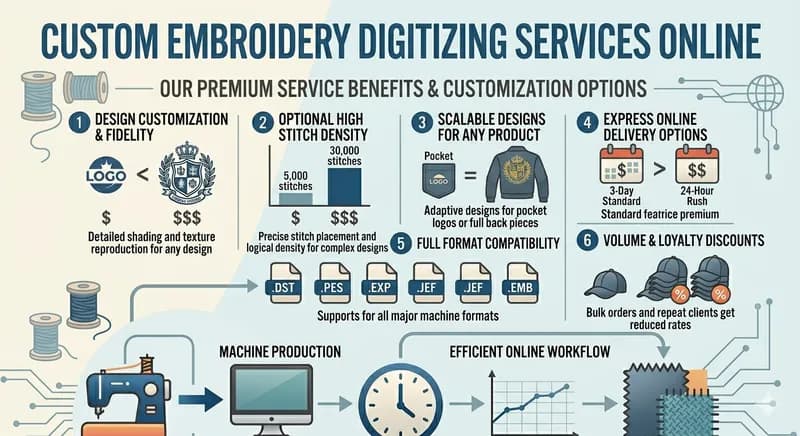
Specify your machine format. DST for Tajima and most commercial machines, PES for Brother and Babylock, JEF for Janome, VP3 for Viking and Pfaff, XXX for Singer, EXP for Melco. If you're not sure which format your machine needs, check the machine documentation or manufacturer's website. If you need to understand sizing for different placements before specifying dimensions, the size guidelines page walks through standard dimensions for left chest, hat, jacket back, and other common placements.
Flag anything that's particularly important. If your design includes a logo with brand-critical elements, small text that absolutely has to be readable, or specific color matching requirements, say so in your order notes. Your digitizer can give those elements extra care when they know it matters.
The Most Common Types of Custom Digitizing Orders
Custom embroidery digitizing online covers a much wider range of work than just converting a business logo. Here's a look at the types of custom digitizing orders that come through most frequently and what makes each one worth handling carefully.
Business Logo Digitizing
This is the most common type of custom digitizing order, and it's the one where quality matters most visibly. Your logo is your brand identity on every garment. Getting it right means clean outlines, correct proportions, readable text even at small sizes, and accurate color representation in thread. Getting it wrong means your brand looks sloppy on the very products you're using to represent it. Digitizing Studio's embroidery digitizing service handles logo work with the attention to brand accuracy it requires.
Team and Sports Designs
Sports teams and athletic apparel often involve custom artwork — mascots, wordmarks, player names and numbers, and designs that combine multiple elements. These need careful handling because they frequently include fine detail, complex shapes, and small text that has to stay legible when stitched on caps and jerseys. Athletic fabrics also have specific embroidery challenges because many performance materials stretch under the presser foot during stitching.
Corporate Uniform Programs
Businesses running uniform programs need consistent, production-reliable digitizing that runs cleanly across hundreds or thousands of pieces. This type of work benefits enormously from getting the file right once rather than dealing with periodic quality inconsistencies. The investment in professional custom digitizing pays back through lower rejection rates, faster machine operation, and consistent brand presentation.
Custom Apparel and Merchandise Brands
Independent apparel brands and merchandise creators need digitizing that respects the creative intent of their artwork. This is an area where human judgment matters a lot — understanding not just the technical requirements of a design but the artistic choices behind it, and translating those choices faithfully into the constraints of the embroidery medium.
Promotional Products
Promotional product distributors source digitizing for client artwork across an enormous range of product types — bags, caps, polos, outerwear, towels, and much more. The ability to handle all of these from a single reliable online provider simplifies operations significantly. Consistent quality across different product types, paired with fast turnaround to meet campaign deadlines, makes professional online digitizing especially valuable for this market segment.
Design Complexity and How It Affects Your Custom Digitizing
Not all custom embroidery digitizing is equally complex, and understanding where your designs fall on the complexity spectrum helps you set realistic expectations about the work involved and what you should pay for it.
Simple designs — clean wordmarks, basic shapes, text with limited elements — are the easiest to digitize well and represent the lower end of the complexity range. A skilled digitizer can build these efficiently and accurately.
Medium complexity designs include standard business logos with moderate detail, team names with straightforward mascots, designs with several color stops and clean linework. These require more time and attention but are well within the capabilities of any experienced professional digitizer.
High complexity designs are where the real expertise shows. These include designs with extremely fine detail, intricate linework, very small text under 4mm in height, many color stops with tight registration requirements, or large fill areas with directional shading intended to create visual depth. Designs like this expose the gap between auto-digitizing and genuine human craft most clearly.
Specialty design types carry their own complexity regardless of the visual complexity of the artwork. 3D puff digitizing for raised cap embroidery requires foam-specific settings, wider satin columns, and precise stitch angles that flat digitizing doesn't need. Applique digitizing involves multi-step stitching sequences for fabric placement that require careful planning. Chenille digitizing uses a completely different machine system and demands specialized knowledge.
For a detailed breakdown of what each complexity tier costs, the embroidery digitizing cost guide covers pricing ranges by stitch count and design type in full detail.
Why the Online Model Works Better Than Local-Only Digitizing
A lot of people's first instinct is to look for embroidery digitizing near them. That impulse makes sense — there's a natural comfort in working with someone local and the feeling that proximity equals accountability.
In practice, online custom embroidery digitizing services consistently outperform local-only options on the factors that actually matter.
Access to genuine expertise is the biggest one. The best embroidery digitizers in the USA aren't necessarily in your city or even in your region. Online services give you access to skilled professionals regardless of where either of you is located. A digitizing service that serves clients nationally operates at a scale that attracts and develops better talent than a local-only shop with a limited client base.
Turnaround through a well-run online service is almost always faster than local alternatives. The entire workflow — submission, digitizing, delivery, revisions — happens digitally with no physical handoffs or scheduling constraints. Standard orders at Digitizing Studio deliver within 24 hours, which is faster than most local shops can commit to.
Pricing through online services is typically more competitive because the national and international market creates genuine price competition. Local providers often charge higher rates simply because their customers don't have easy local alternatives.
The range of services available online is broader. A local embroidery shop that offers in-house digitizing may handle flat embroidery well but not have the specialized expertise for puff, chenille, or applique work. An online provider serving thousands of clients has both the demand and the incentive to develop capability across all digitizing types.
None of this means local relationships have no value — but for the digitizing work itself, online delivery through a quality provider is genuinely the better choice for most embroidery operations.
Understanding Machine File Formats for Online Digitizing
One of the practical advantages of ordering custom embroidery digitizing online is that good providers make format flexibility easy. But understanding the formats yourself means you never end up with a file you can't use.
Every major embroidery machine brand reads its own native format. The format determines whether your machine can understand the file at all, so getting this right is non-negotiable.
DST is the Tajima format and has become the most broadly compatible option across commercial embroidery machines. If you're running commercial equipment and don't have a specific requirement, DST is usually a safe default.
PES is the Brother and Babylock format. It's the most common format in the home and semi-commercial embroidery market because Brother machines are the most widely used in that segment.
JEF is Janome's native format. Many Janome machines also accept DST, but JEF gives you native compatibility.
VP3 is the primary format for Husqvarna Viking and Pfaff machines. Older Viking models may use HUS instead. If you're on a newer Viking or Pfaff, VP3 is almost certainly correct.
XXX is the Singer format, used on Singer Futura and related machines.
EXP is used with Melco commercial embroidery systems, which are common in larger commercial embroidery operations.
EMB is Wilcom's native software format. You're most likely to encounter this in a commercial production environment.
When you order from Digitizing Studio, specify your format in the order and that's exactly what arrives. If you ever switch machines or need to provide a file to a vendor with different equipment, format conversion is available. Checking the services overview gives you a clear picture of what's included with every order type.
How to Evaluate Quality Before You Commit to a Custom Digitizing Provider
Choosing who to trust with your custom digitizing isn't just about price or claimed expertise. There are practical ways to evaluate a provider before you place your first order.
Look for real stitch-out photos, not just design renders. Software simulation previews always look good. What you need to see are photos of actual embroidered garments showing finished results. A gallery that shows real stitched pieces on real fabric tells you something meaningful about output quality. Visit the Digitizing Studio gallery to see actual digitized work.
Ask directly whether digitizing is done by humans or software. Any reputable provider will answer this clearly. If the answer is vague or evasive, auto-digitizing is almost certainly involved. A company that's confident in their quality wants you to know human professionals are working on your files.
Understand the revision policy completely. Free revisions until you're satisfied is the standard that quality providers offer because they're confident in their first-attempt work. Providers who charge per revision or limit the number of revisions are building the cost of their own quality inconsistency into your order.
Check how transparent the pricing is. Published, clear pricing that you can review before placing an order signals a provider who's confident in their value. Hidden pricing or rates that only appear after you've submitted your artwork creates leverage the provider doesn't deserve.
See what other customers have experienced. Reviews, testimonials, and repeat customer behavior tell you more about consistent quality than any marketing copy.
Check the turnaround commitment. Standard 24-hour delivery is realistic for professional online digitizing. Claims of 1 or 2 hour turnaround for complex custom work should raise questions about what's actually being skipped in the process.
Getting Size and Placement Right with Your Custom Digitizing Order
One of the most common issues with custom embroidery digitizing is a mismatch between the size the customer assumed and the size the digitizer worked to. Getting this right upfront saves a revision round.
Standard placement sizes that most embroidery operations use are well-established. Left chest placement on shirts and polos typically runs 3.5 inches wide by 4 inches tall at most. Cap and hat designs generally work best between 2 and 4 inches wide with a height limit of around 2.25 inches on standard structured caps. Front chest placements on t-shirts can go up to about 6 by 6 inches. Full jacket back designs typically run up to 11 by 11 inches.
These aren't arbitrary limits — they reflect the actual embroidery hoop sizes and the practical constraints of how designs look proportionally on different garment types. The size guidelines page at Digitizing Studio covers all standard placement dimensions with specific measurements for each application.
If you're not sure what size to specify, looking at examples of similar designs on the garment type you're working with is a quick way to calibrate your expectations. For unusual placements or non-standard applications, mentioning your specific use case in the order notes lets the digitizer give you relevant guidance.
The Role of Artwork Quality in Custom Digitizing Results
This point deserves more emphasis than it usually gets because it's something customers control entirely and it has a significant effect on what comes back.
A digitizer working from clean, high-resolution, clearly defined artwork can build an accurate, detailed file that closely represents your original design. A digitizer working from a blurry, pixelated, or low-resolution image has to interpret and guess at design details — and those guesses introduce errors.
Vector artwork — files in AI, EPS, or SVG format — is the gold standard for embroidery digitizing source material because it scales infinitely without quality loss and gives the digitizer perfectly clean, defined edges to work from. If your artwork exists as a vector file, always use that version when submitting a digitizing order.
If you only have raster artwork — JPEG, PNG, BMP — the resolution matters. A PNG exported from design software at 300 dpi or higher gives a digitizer clean material. A JPEG downloaded from a website at screen resolution gives them a much harder job.
If your artwork is genuinely low quality and needs to be cleaned up before it can be digitized properly, Digitizing Studio's vector tracing service addresses this. The service converts raster artwork to clean vector files, which then go into the digitizing process with the clarity they need to produce sharp results.
Submitting the best possible artwork version isn't just about making the digitizer's job easier. It's about giving your design the best possible chance of coming off the machine looking exactly like you intended it to.
What Makes Digitizing Studio the Right Online Partner
There are a lot of options for custom embroidery digitizing services online. Here's what specifically makes Digitizing Studio worth choosing.
Every file is hand-digitized by an experienced professional. Auto-conversion software isn't part of the process. A real digitizer builds your file stitch by stitch, making deliberate decisions about every technical element based on your specific artwork and requirements. That's not a claim every provider can honestly make, but it's the standard at Digitizing Studio on every order.
Turnaround is within 24 hours on standard orders, with rush service available for time-sensitive work. The ordering process is fully online and available around the clock, so you can submit artwork and place orders on your schedule rather than working around business hours.
All major machine file formats are supported. DST, PES, JEF, VP3, XXX, EMB, EXP — whatever your machine needs is what gets delivered. You don't need to worry about receiving a file in a format you can't use.
The full service range covers everything under one roof. Standard flat embroidery digitizing handles the majority of work. Specialty services — 3D puff digitizing, applique embroidery digitizing, chenille digitizing, and vector art conversion — are available through the same provider relationship without sourcing specialty work elsewhere.
Revisions are free on every order. If a test stitch reveals something that needs adjustment, the revision gets handled without any additional charge. That policy reflects genuine confidence in the quality of the work.
Pricing is transparent and published on the pricing page so you know what you're paying before you submit your order. There are no hidden setup fees, no surprise charges, and no per-revision billing that makes your total cost unpredictable.
Over 40,000 customers have trusted Digitizing Studio with their embroidery digitizing work. That kind of customer base doesn't happen with inconsistent quality.
If you want to get a sense of the range of work the team handles, browsing the free design library gives you exposure to the variety of design styles and types that Digitizing Studio produces regularly.
To start your first order or continue with ongoing work, head to the order portal and submit your artwork. Questions about a specific project or requirements can go through the contact page — the team responds quickly and can advise on the best approach for your particular design before you commit.
Custom Digitizing for Different Fabric Types
Fabric type is one of the most significant variables in how a custom embroidery file needs to be built, and it's one that genuinely custom digitizing accounts for as a matter of course.
Woven fabrics — cotton twill, canvas, poly-cotton blends — are the most straightforward to embroider and the most forgiving of imperfect digitizing. They're stable, don't stretch much during stitching, and hold their position under the presser foot reliably. Left chest logo work on polos and uniform shirts falls into this category.
Knit fabrics — jersey, interlock, performance knits — stretch significantly during stitching, which means pull compensation settings need to be more generous to account for the additional movement. Without this adjustment, the finished design ends up narrower in the stitch direction than the artwork specifies. Athletic apparel and t-shirts typically use knit fabrics.
Fleece and terry cloth are the most technically demanding common fabric types. Both have surface pile — loops of fiber that rise above the base fabric — that interferes with stitching if the file isn't built to push through it. Heavy underlay stitching is essential on these materials to compress the pile and create a stable surface for top stitches. Towel embroidery specifically benefits from this treatment, and Digitizing Studio's approach to towel work is built around these technical requirements.
Structured caps present a unique combination of challenges. The curved frame means designs need tight registration and specific starting point planning. The buckram backing of structured caps affects how stitches sit. Cap-specific digitizing considers all of these factors rather than treating a cap order as just a small version of a flat garment design.
Common Questions About Custom Embroidery Digitizing Online Answered Honestly
People have a lot of questions when they're new to ordering custom digitizing online, and a lot of the answers they find online are either vague or self-serving. Here are honest answers to the questions that actually matter.
Will I need to revise my order? With professional custom digitizing from an experienced provider, most orders come back right the first time. But embroidery is a physical medium with a lot of variables, and even excellent digitizing sometimes needs a small tweak for a specific machine or thread brand. Always run a test stitch on a fabric sample before production. If anything needs adjustment, free revisions make that process painless.
What if my artwork is complicated? Complex artwork is handled routinely by professional digitizers. The complexity affects the cost and sometimes the turnaround time, but it doesn't mean the work can't be done well. Extremely fine detail and very small text have inherent limitations in the embroidery medium that no digitizer can fully overcome — but a good one will find the best achievable result and advise you honestly about any tradeoffs.
Can I use the same digitized file on different machines? A file digitized in one format can typically be converted to another format for different machines. The core stitching data translates. Format conversion is available through Digitizing Studio for this reason.
How do I know the price before I submit? Pricing at Digitizing Studio is published on the pricing page before you order. The cost is based on design complexity and stitch count, so you can estimate based on a description of your design. For unusual projects, reaching out through the contact page before ordering gets you a clear quote.
Summary
Custom embroidery digitizing services online have made professional-quality digitizing accessible to embroidery operations of any size, anywhere in the country. The key is knowing how to identify providers that deliver genuine custom work — human-built files tailored to your specific design and requirements — rather than auto-converted output that looks like custom on the surface.
Digitizing Studio delivers fully custom digitizing with 24-hour turnaround, experienced professional digitizers on every file, all major machine formats, free revisions, and transparent pricing. Whether you need a single logo digitized or ongoing digitizing support for a busy commercial operation, the service is built to deliver consistent, production-reliable quality every time.
Place your order through the order portal, check the pricing page to understand costs before you commit, and reach out through the contact page if you have questions about your specific project. The team at Digitizing Studio is ready to get your artwork stitch-ready.
Frequently Asked Questions
What is custom embroidery digitizing and how is it different from standard digitizing?
Custom embroidery digitizing means your design is built from scratch by an experienced human digitizer, with every technical setting — stitch types, underlay structure, pull compensation, density, color sequencing — chosen specifically for your artwork and your application. Standard or template digitizing applies the same generic settings to every design regardless of what the design needs. The difference shows most clearly on complex artwork, small text, specialty fabrics, and designs where accuracy to the original artwork matters. Custom digitizing produces files that run cleanly and represent your artwork faithfully. Generic digitizing produces files that work reasonably well on simple designs but fail on anything that requires real expertise.
How do I submit artwork for custom embroidery digitizing online?
You submit artwork through the online order portal after creating your account. Any common file format works — JPEG, PNG, PDF, AI, EPS, or a photo of a physical design. Along with the file, you specify your garment type, finished design size, required machine file format, and any notes about elements that need particular attention. Vector files give the best results because they provide the cleanest source material. If you only have raster artwork, send the highest resolution version available. If your artwork needs cleaning up before it can be digitized properly, the vector tracing service converts raster files to clean vectors first.
How long does custom embroidery digitizing take when ordered online?
Standard orders at Digitizing Studio deliver within 24 hours. Simple designs are often completed same day. Complex or specialty work — detailed artwork, 3D puff, chenille, multi-placement orders — may take up to 48 hours depending on the scope. Rush same-day service is available for urgent projects at an additional charge. The entire process is digital and the ordering portal is available around the clock, so you can submit at any time and receive your file without scheduling delays.
What machine formats are available for custom digitized files?
Digitizing Studio delivers files in any major embroidery machine format. DST for Tajima and most commercial machines. PES for Brother and Babylock. JEF for Janome. VP3 for Husqvarna Viking and Pfaff. XXX for Singer. EXP for Melco. EMB for Wilcom-based commercial systems. Specify your required format in the order and that's exactly what you receive. If you need the same design in multiple formats for different machines or client requirements, that can be arranged through the order notes.
Is online custom embroidery digitizing reliable for high-volume commercial operations?
Absolutely. Online digitizing services are used by commercial embroidery shops, uniform suppliers, promotional product distributors, and apparel brands running high-volume production. The digital workflow actually makes online services more reliable for high-volume work than local options because there are no physical handoffs, no scheduling constraints, and no geographic limitations. Consistent quality across many orders is what commercial operations need most, and a professional online provider serving a large national client base has strong incentive to maintain that consistency. Digitizing Studio serves customers across the USA and internationally with the same quality and turnaround standards on every order regardless of volume.
What happens if the custom digitized file doesn't produce the right result on my machine?
Request a revision. Revisions are free at Digitizing Studio on all orders. Before requesting one, run a physical test stitch on scrap fabric similar to your actual garment material and note specifically what's not right — density issues, text clarity, registration problems, thread breaks at a specific point. Specific feedback produces faster, more accurate revisions. Most issues resolve in a single revision round when clear feedback accompanies the request. If you're unsure whether a problem is in the file or in your machine settings, the team at Digitizing Studio can advise through the contact page.
Can custom embroidery digitizing handle logos with fine detail and small text?
Yes, with the understanding that embroidery has real physical limitations on extremely fine elements. A skilled digitizer will get the best possible result from your artwork and will simplify fine detail and small text just enough to make it stitch cleanly without losing the essential character of the design. Text under about 4mm in height becomes very difficult to keep legible regardless of the digitizer's skill — the needle and thread simply can't reproduce letterforms that small with precision. For designs where small text is critical, discussing your priorities with the digitizing team before ordering helps ensure the approach taken matches what matters most to you.
How does the pricing work for custom embroidery digitizing orders?
Pricing is based on design complexity and stitch count, which are the factors that actually reflect the amount of skilled digitizer time your project requires. All pricing is published on the pricing page before you place your order so there are no surprises. Simple designs under 8,000 stitches run at the lower end of the price range. Complex designs with high stitch counts, fine detail, or specialty techniques like puff or chenille cost more. Revisions are included in the price rather than billed separately. The best embroidery digitizing services guide covers pricing ranges in detail if you want a thorough breakdown before ordering.