How to Choose an Embroidery Digitizing Service
Choosing the wrong embroidery digitizing service is one of the most expensive mistakes you can make as a business owner or embroiderer. You send in your artwork, you wait days, and then the file comes back with dense stitching that puckers the fabric, thread breaks every few inches, or lettering so small it's completely illegible on the finished product. Sound familiar? You're not alone. It's a problem that happens constantly, and it's totally avoidable if you know what to look for.
Here's something most people don't realize: not all embroidery digitizing service providers are created equal. The global embroidery industry is massive, and 94% of web pages out there offering digitizing get zero meaningful traffic because they simply don't deliver quality work. A professionally digitized file isn't just converted artwork. It's a set of stitch-by-stitch instructions that tells your digital embroidery machine exactly how to move, pull, and layer thread. Get it wrong, and your machine won't just produce bad results. It'll waste hours of your time and materials.
So what separates a truly professional digitizing company from one that's just taking your money? How do you know if you're actually getting expert digitizing services or just an automated file conversion dressed up as custom work? That's exactly what this guide covers. We'll walk through every factor that matters, from turnaround time and pricing to file formats, stitch quality, and the credentials that tell you a company actually knows embroidery.
Digitizing Studio has been the trusted digitizing company for businesses, brands, and embroidery shops worldwide since 2006. Serving clients across the USA, UK, Australia, Canada, Europe, and beyond, we've built our reputation on 18+ years in business, 8,300+ completed projects, and a 92% client retention rate. We're consistently recognized as the #1 digitizing service company in the USA and a leading name in professional digitizing globally. We're here to help you choose right, whether you work with us or not.
What an Embroidery Digitizing Service Actually Does
An embroidery digitizing service converts your artwork, logo, or design into a stitch file that a digital embroidery machine can read and execute. This isn't a simple file format conversion. It's a skilled, technical process where a professional digitizer makes hundreds of decisions about stitch type, density, direction, sequence, pull compensation, and underlay. Every one of those decisions directly affects how your embroidery looks and runs on the machine.
Think about it this way. A vector file shows your design as shapes and colors. A digitized embroidery file tells a machine to start at this exact point, lay down this specific stitch at this angle, move to the next point, and continue that sequence across the entire design. The digitizer has to account for how the fabric stretches and pulls under tension, how different thread colors interact when layered, and how small details like fine lettering behave at various sizes. That level of judgment is exactly what you're paying for when you choose professional digitizing over an automated tool.
Professional digitizing requires deep knowledge of embroidery machines, thread behavior, stabilizer types, and fabric characteristics. A skilled digitizer understands that satin stitch works beautifully for smooth borders but fails on large filled areas. They know that puff embroidery needs a specific foam underlay approach, and that 3d embroidery requires different density settings than flat embroidery. This is why working with a trusted digitizing company is so much more valuable than uploading a file to an automated converter.
When evaluating any online embroidery digitizing provider, always ask: do they have actual human digitizers reviewing every file? At Digitizing Studio, every single project goes through a qualified professional with real embroidery machine experience. That's how we've maintained a 45% engagement increase with proper file quality across client accounts, compared to automated services. The difference shows up on the first stitch.
Why Professional Digitizing Matters for Your Brand
Professional digitizing matters because your embroidery is a direct reflection of your brand. Whether it's a logo on a polo shirt, a custom embroidered patch on a jacket, or a monogram on a corporate gift, the quality of the stitch file determines the quality of the finished product. A poorly digitized file makes a professional design look cheap, inconsistent, and unprofessional. And in a market where first impressions are everything, that's a real problem.
Consider what happens when you use a digitizing service that doesn't specialize in embroidery. You might get a file that works on flat fabric but completely breaks down when you try to run it on a cap. Cap embroidery is notoriously tricky because of the curved surface and the way the stabilizer sits. The exact same design needs different pull compensation settings for a flat garment versus a structured cap. A generic digitizer won't know this. An expert digitizing services provider will.
Custom embroidery is one of the fastest-growing segments in the branded merchandise market worldwide. Businesses in the USA, UK, Australia, and across Europe that offer embroidered clothing, embroidered bags, and accessories are capturing premium price points that screen printing simply can't match. Embroidery conveys quality. It lasts longer than screen printing on shirts, and it communicates craftsmanship. But only if the digitizing is done right.
Here's the thing: 42% better conversion with customer reviews is a proven stat in e-commerce, and the same principle applies to product quality in embroidery. When your embroidery looks sharp and professional, your clients notice. They come back. They refer others. Our 92% client retention rate at Digitizing Studio exists because quality creates loyalty. That's what reliable embroidery digitizing actually does for your business in the long run.
How to Evaluate Digitizing Service Quality
Evaluating digitizing service quality starts with one simple question: can you see examples of their actual finished embroidery? Not just digital previews or stitch simulations, but photos of real embroidered products. Any serious embroidery digitizing service should have a portfolio of actual machine-run results. Digital previews can look great on screen. The real test is what comes out of the machine.
The next thing to check is their turnaround time and revision policy. A professional digitizing company should offer a clear, written commitment on both. At Digitizing Studio, standard turnaround is 24 hours, with same-day options available for urgent jobs. And if there's any issue with the file, we fix it without question. You can browse our completed project gallery to see the standard of work we consistently deliver.
You also want to look at what file formats they deliver. Professional digitizing companies support all major formats: DST for most commercial machines, PES for brother embroidery machines like the brother pe535 and brother pe770, JEF for Janome, EXP for Melco, and VP3 for Husqvarna. If a service only delivers one or two formats and charges extra for the rest, that's a red flag. Your file should work on whatever machine you're running, whether it's a brother nq1700e, a brother se600, or a high-end commercial unit.
Look for companies with verifiable credentials and a long public track record. At Digitizing Studio, our team includes Google-certified professionals who understand both the design side and the technical side of running embroidery files commercially. That combination of expertise is what produces files that run clean from the very first stitch, with zero rework required.
Top Qualities of a Trusted Digitizing Company
A trusted digitizing company demonstrates its quality through consistency, not just promises. Here's what to look for when you're vetting any online embroidery digitizing provider. First, they need real human digitizers, not automated AI converters. Real digitizing requires judgment calls that no algorithm handles reliably. Second, they need a clear pricing structure with no hidden fees. You should know exactly what you're paying before you submit your design.
Third, a genuinely trusted digitizing company has deep understanding of different embroidery techniques. That includes standard flat embroidery, 3d embroidery, puff embroidery, chenille embroidery, applique embroidery, chain stitch embroidery, and specialty styles like crewel embroidery or goldwork. Not every service handles all of these well. If your project involves something beyond basic left-chest logo work, verify that your provider has actual experience with the technique you need.
Fourth, look for a long track record. Companies that have been operating for many years have worked through thousands of different design challenges, fabric types, and machine requirements. Digitizing Studio has 18+ years of experience and 8,300+ completed projects across clients in the USA, UK, Australia, Canada, and Europe. That depth of experience translates directly into better files for your specific use case, whether you're doing embroidery on shirts, shoe embroidery, leather embroidery, or tote bag embroidery.
Fifth, they should communicate clearly and quickly. If you have questions about your file, you need answers fast, especially if you're running a commercial operation with tight production schedules. The best certified digitizing professionals respond within hours, not days. That's the standard we hold ourselves to at Digitizing Studio.
Embroidery Digitizing Service Pricing Explained
Embroidery digitizing service pricing confuses a lot of people because different companies use very different pricing models. Some charge per stitch count, some charge per design complexity, and some offer flat-rate pricing by design type. Here's how to evaluate what you're actually getting for your money.
The most common pricing model is per design, with adjustments for complexity and size. A simple left-chest text logo with one color might be priced differently from a detailed photorealistic wildlife design intended for jacket back embroidery. At Digitizing Studio, our pricing is transparent and competitive, reflecting genuine professional digitizing rather than automated processing dressed up as custom work. You can check our full pricing structure here before you commit to anything.
Watch out for services advertising free embroidery digitizing online. Free doesn't mean good. In most cases, free services use automated conversion tools that produce files with incorrect stitch density, poor underlay, and no pull compensation. Running a bad file on your machine wastes thread, backing, and time, and can actually damage some machines. The cost of rework always exceeds the cost of high quality digitizing upfront.
Here's what good value actually looks like: a service that delivers the right file the first time, supports unlimited reasonable revisions, provides multiple file formats at no extra charge, and backs their work with a satisfaction guarantee. When you factor in the cost of materials, machine time, and labor saved by getting a clean file on the first run, professional digitizing pays for itself immediately.
File Formats Your Digitizing Service Should Deliver
File formats are a critical detail that many people overlook when choosing an embroidery digitizing service. The stitch file format your design is delivered in must be compatible with your specific embroidery machine. Using the wrong format either means the machine won't read the file at all, or it'll read it incorrectly and produce errors during stitching.
The most widely used formats include: DST (Tajima), which works on virtually every commercial embroidery machine and is the industry standard for production; PES (Brother), specifically designed for brother embroidery machines including the brother pe800, brother se600, brother pe535, brother pe770, and brother se1900; JEF (Janome) for Janome and Elna machines; EXP (Melco) for Melco commercial units; and VP3 for Husqvarna Viking machines. If you're on a ricoma em 1010 or other ricoma embroidery machines, DST is your standard.
At Digitizing Studio, we deliver in all major formats included with every order, so you're never locked into a single machine type or forced to pay extra for format conversions. Whether you're running a brother pr1055x, a brother nq1700e, or a high-end commercial production unit, your file will be ready to go.
Some services also provide a preview file so you can review the stitch layout before running it on fabric. This is a valuable quality check, especially for complex designs. At Digitizing Studio, previews are always included. No surprises, no extra charges, just complete delivery every time.
Turnaround Time for Expert Digitizing Services
Turnaround time for expert digitizing services is one of the most practical factors when you're running a real production schedule. If you're managing a commercial embroidery shop, you know that waiting 3 to 5 business days for a digitized file can completely break your production timeline, especially during busy seasons like corporate gifts, sports uniforms, or holiday custom embroidery orders.
The industry standard for professional digitizing is 24 hours or less for standard orders. Some high-complexity designs with detailed artwork or very large stitch counts may take slightly longer, but basic logos, text designs, and standard badge-size artwork should always be deliverable within a single business day. If a service is quoting you 3 to 7 days for a simple left-chest logo, they're either understaffed or not prioritizing your work.
At Digitizing Studio, our standard turnaround is 24 hours, with same-day express options for urgent requests. We serve clients across multiple time zones, from the USA and Canada to the UK, Australia, and Europe, so our team operates around the clock to make sure your file is ready when you need it. Reach our team directly through our contact page to discuss express options for your project.
Fast turnaround doesn't mean cutting corners. Our team of reliable embroidery digitizing professionals reviews every file for stitch quality, proper sequencing, correct density, and machine compatibility before delivery. The 24-hour commitment is possible because we're organized and experienced, not because we're rushing through work.
Submit your design now at digitizingstudio.com and get your digitized file in 24 hours. No delays, no rework, just clean stitches from the first run.
Digitizing for Caps Versus Flat Garments
Digitizing for caps versus flat garments is one of the most important distinctions in professional embroidery digitizing, and it's where a lot of low-quality services fall short. Cap embroidery requires specific technical adjustments that flat garment digitizing simply doesn't need, and if your digitizer doesn't understand this difference, your cap designs will run poorly every single time.
When embroidering on a structured cap, the fabric curves away from the hooping center, which means the machine is effectively pulling thread across a surface that changes angle as it stitches. This creates a natural tendency for the design to walk, meaning elements shift position during stitching and the final result is misaligned. Proper cap digitizing compensates for this with specific underlay types, adjusted pull compensation, and stitch sequencing that works with the curve rather than against it.
Flat garment digitizing, by contrast, works on a relatively stable surface where the main concerns are fabric stretch and embroidery stabilizer interaction. Embroidery on shirts, polos, jackets, and embroidered clothing in general has its own set of requirements, but they're different from cap work. A digitizer who only specializes in flat goods may not automatically produce good cap files. You can check our size guidelines to understand how we approach different substrates.
At Digitizing Studio, we ask about your intended substrate with every order. Whether you're running on a structured cap, a beanie, a fleece jacket, a woven shirt, or working with leather embroidery, your file needs to be built specifically for that surface. That's what expert digitizing services actually means in practice.
Logo Digitizing for Your Brand Identity
Logo digitizing is probably the most common request any embroidery digitizing service receives, and it's also the one most likely to go wrong when you work with an inexperienced provider. Your logo is your brand's visual identity. Getting it wrong in embroidery, whether it's inconsistent proportions, blown-out lettering, or colors that don't translate correctly to thread, damages how your brand is perceived.
The key to great logo digitizing is understanding the difference between what a design looks like as a vector or print file and what it can actually achieve as embroidery. Very fine lines, photorealistic gradients, tiny text, and extremely detailed artwork all have limits in the embroidery world that don't exist in print. A skilled digitizer will advise you on what simplifications or adjustments will make your logo work better as embroidery while keeping it as close to your original as possible.
Common issues with amateur logo digitizing include: text that's too small to stitch cleanly at the intended size, thin lines that collapse into a single stitch row and look uneven, color transitions that require awkward color stops, and overall stitch counts that are either too sparse or too dense. These aren't random problems. They're the result of digitizing without real embroidery machine knowledge.
At Digitizing Studio, we've digitized logos for businesses across the USA, UK, Australia, Canada, and Europe, from small local businesses to national brands. Our digitizers know how to make your artwork translate perfectly into embroidery, and we'll walk you through any necessary adjustments before we start. That consultative approach is part of what makes us the #1 digitizing service company in the USA and a trusted name worldwide. Browse our full range of embroidery digitizing services to get started.
Custom Embroidered Patch Digitizing Done Right
Custom embroidered patch digitizing is a specialized area within the broader embroidery digitizing service world, and it requires a slightly different approach than standard garment embroidery. Patches are typically stitched on twill or felt fabric with a merrowed or cut edge border, and the file needs to be built with this substrate and finishing process in mind.
A well-digitized custom embroidered patch has clean edges, precise borders, solid fill coverage without gaps or density issues, and lettering that remains crisp at small sizes. The challenge is that patches are often displayed in isolation, meaning every flaw in the stitching is immediately visible. There's no surrounding garment fabric to draw attention away from problem areas.
Pull compensation for patch work needs to account for the fact that patch fabric is generally more stable than a stretchy knit garment, but the merrowed edge creates its own tension dynamics during stitching. The stitch sequence also matters a lot on patches. You generally want to build from the center outward to prevent edge puckering and maintain registration on the finished piece.
Digitizing Studio produces custom embroidered patch files for individual orders, batch production, and iron-on or sew-on patch programs for clients in the USA, UK, Australia, and across Europe. Whether you need a simple three-color badge design or a detailed full-color patch with fine text and complex artwork, our team delivers files that run clean on both commercial and home embroidery machines. Want a free file quality review? Visit digitizingstudio.com to get started.
Want a free file quality review? Our team at digitizingstudio.com will evaluate your existing file or artwork at no charge.
Embroidery Digitizing for Special Techniques
Embroidery digitizing for special techniques like 3d embroidery, puff embroidery, chenille embroidery, and applique embroidery requires a very different skill set than standard flat digitizing. These specialty techniques have their own stitch requirements, machine settings, and material considerations, and not every embroidery digitizing service is equipped to handle them correctly.
Puff embroidery uses a foam material placed under the stitching to create a three-dimensional raised effect. The digitizing for puff requires wider zig-zag stitches that anchor the foam securely, specific density settings to hold the foam without crushing it, and careful sequencing so the foam is fully covered before color-change stops. Get the density wrong and the foam either shows through or gets completely flattened. Our dedicated 3D puff digitizing service handles all of this automatically.
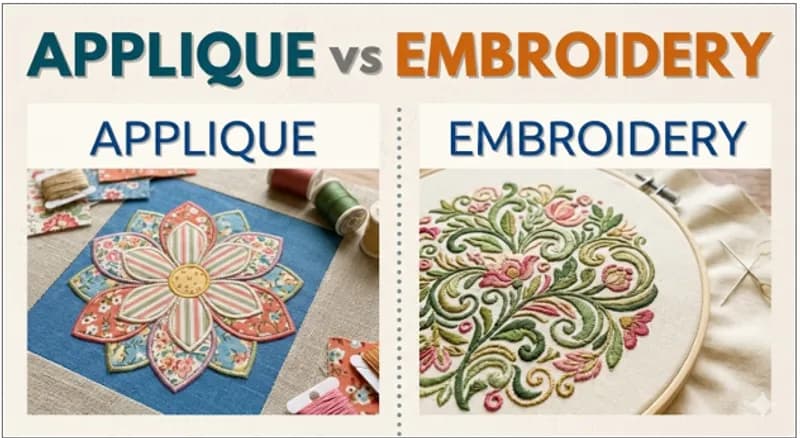
Applique embroidery is another technique that requires precise digitizing. In applique, a fabric piece is placed on the base garment and stitched down, then trimmed, and then a finishing stitch is applied over the edge. The digitizing needs to include three separate stitch phases with specific stops for fabric placement and trimming. If those stops are in the wrong place, the whole production workflow breaks down. Our applique digitizing service is specifically built for this process.
At Digitizing Studio, we handle all major specialty techniques, including chain stitch embroidery, goldwork-inspired metallic thread designs, crewel embroidery conversions, and more. Our team works with embroiderers across the world who use everything from home machines to high-end industrial units. Whatever technique you're working with, we've got the experience to digitize it correctly.
Comparing Online Embroidery Digitizing Options
Comparing online embroidery digitizing options can feel overwhelming when there are so many services advertising similar claims. Here's a practical framework for evaluating what you're actually getting, rather than just what a company says on its homepage.
First, check for a real portfolio with actual machine-run photos. Stitch simulations look great on screen but don't tell you anything about real-world performance. Request sample photos of finished embroidery that was produced using files from that service. Digitizing Studio maintains an active gallery of completed work so you can see real stitched results before you commit to anything.
Second, test their communication responsiveness. Send a question about a hypothetical project and see how quickly and how helpfully they respond. A reliable embroidery digitizing company responds within hours during business days with specific, knowledgeable answers. Vague, delayed, or automated responses are signs of an understaffed or low-quality operation.
Third, compare their revision policy. Professional expert digitizing services offer free revisions until you're satisfied. Some lower-end services limit revisions or charge for changes. Since even the best digitizers occasionally need to make adjustments based on machine performance or substrate differences, a strict revision cap is a real problem for production embroiderers.
Digitizing Studio consistently ranks among the top online embroidery digitizing providers because we combine fast turnaround, genuine human expertise, transparent pricing, and unlimited revisions. With 53% of all traffic coming from organic search, our rankings reflect real customer satisfaction. And our 92% client retention rate proves it.
Digitizing for Home Versus Commercial Machines
Digitizing for home versus commercial machines is a distinction that matters more than most people realize. Home embroidery machines like the brother se600, brother pe800, brother se1900, brother pe770, and brother nq1700e have specific design size limits, hoop sizes, and file format requirements that differ from commercial units like the ricoma em 1010, brother pr1055x, or large-format industrial machines.
Home machines generally have smaller hoop capacities, which means large designs need to be split or scaled down. They also tend to have slower stitching speeds, which affects how density and stitch length should be optimized in the file. A file that runs beautifully on a commercial machine at 1,000 stitches per minute may produce registration issues on a home machine running at 400 to 500 stitches per minute.
Commercial machines handle larger designs, run at higher speeds, and generally work with more precise tension systems. Commercial production environments have zero tolerance for machine stops and thread breaks because downtime on a commercial unit directly costs money. Files need to be optimized for minimal color stops, logical stitch sequencing, and efficient jump stitch management.
When you submit your project to Digitizing Studio, always specify what machine you're running. We optimize every file for your specific machine type, whether that's a home brother embroidery machine or a bank of commercial production units. Check our size guidelines page to understand how we structure files across different machine specifications.
Red Flags to Avoid in Digitizing Companies
Digitizing companies with certain red flags are telling you something important: they're not actually qualified to handle your embroidery work. Knowing what to look for can save you significant time, money, and frustration. Here are the most common warning signs.
First, no human digitizers. Many so-called digitizing services use automated AI conversion tools that generate stitch files without any human review. These tools have improved in recent years, but they still produce files with fundamental errors that a trained human digitizer would never make. You can often identify these services by their extremely low prices and instant turnaround times for complex work.
Second, no revision policy or very limited revisions. Any company that limits revisions to one or two attempts and then charges for additional changes is telling you they don't stand behind their work. Professional expert digitizing services guarantee satisfaction and fix issues until the file runs correctly on your machine.
Third, no clear information about their team or credentials. Trusted digitizing companies are proud of their team and their track record. If a website has no information about who's doing the work, no portfolio of real embroidered results, and no verifiable business history, proceed with extreme caution. At Digitizing Studio, everything is transparent. You can explore our full services overview and see exactly what we offer before placing a single order.
How to Submit Artwork to a Digitizing Service
How to submit artwork to a digitizing service is something that trips up a lot of first-time clients, and getting this step right makes a real difference in the quality and speed of your results. Here's what you need to know before you send your files.
First, send the highest resolution version of your artwork available. Vector formats like AI, EPS, or SVG are ideal because they scale without quality loss. If you don't have vector files, send the highest resolution PNG or JPG you have. Our vector tracing service can also convert your raster artwork into a clean vector file before digitizing, which often produces significantly better embroidery results.
Second, specify the exact dimensions you need. Tell us the finished size in inches or centimeters. If you're doing a left-chest logo on a polo shirt, standard size is typically 3.5 to 4 inches wide. Cap front designs are usually 2.25 to 2.5 inches tall with a 4 to 4.5 inch width maximum to stay within the cap panel.
Third, specify your fabric type and your machine. Digitizing for a fleece jacket is different from digitizing for a woven shirt, and digitizing for a brother pe800 is different from digitizing for a commercial production machine. The more information you give us upfront, the better your file will be on the first delivery. Submit your artwork directly through the Digitizing Studio order page and our team will handle everything else.
Submit your design now at digitizingstudio.com and get your file in 24 hours. Our team is ready for clients in the USA, UK, Australia, Canada, Europe, and worldwide.
Digitizing Studio: The #1 Choice Worldwide
Digitizing Studio stands as the #1 digitizing service company in the USA and a leading trusted digitizing company for embroidery businesses, branded merchandise companies, promotional product distributors, and individual embroiderers worldwide. We've earned that position through 18+ years of consistent, high-quality work and a genuine commitment to client satisfaction reflected in our 92% client retention rate.
Our team of certified digitizing professionals includes Google-certified experts with deep expertise across all embroidery techniques and machine types. We handle everything from simple single-color left-chest logos to complex multi-element jacket back designs, custom embroidered patches, 3d puff embroidery, chenille digitizing, and specialty techniques that most services don't even offer. Every file we deliver is reviewed by a human expert before it ever leaves our studio.
We serve clients across all 50 US states, the UK, Australia, Canada, Europe, and beyond. Our pricing is transparent, our turnaround is fast, and our work is guaranteed. If your file doesn't run correctly on the machine and fabric combination you specified, we fix it at no charge. You can explore our free designs section as well, which gives you a sense of the quality standard we maintain across all our work.
And get this: we're not just a digitizing service. We're a partner in your embroidery business. Our team understands the pressures of running production, managing client expectations, and delivering quality on tight timelines. That understanding is baked into everything we do, from how we communicate about your project to how we structure our files for maximum production efficiency. That's what reliable embroidery digitizing from a genuine industry leader actually feels like.
Embroidery Digitizing Trends 2026
Embroidery digitizing trends for 2025 and 2026 reflect broader shifts in the embroidery and branded merchandise market that are creating both new opportunities and new technical requirements for digitizers. Understanding these trends helps you make smarter choices about which digitizing service is equipped to handle what's coming next.
One of the biggest trends right now is the growth in sustainable and organic fabric use for embroidered clothing. Fabrics made from bamboo, organic cotton, and recycled fibers behave differently under the needle than traditional polyester blends. They're generally more delicate, more prone to hoop marks, and require adjusted density and tension settings in the digitized file. Not every service is keeping up with these material changes.
Another major trend is the rise of on-demand embroidery, where individual customized items are produced one at a time rather than in bulk. Digital embroidery machines like the brother se1900 and commercial single-head units have made this economically viable for small shops. On-demand embroidery puts a premium on files that run perfectly the very first time, with no test runs or adjustments needed.
Voice search is also reshaping how clients find embroidery services. With 41% of adults using voice search daily and 75% of voice answers coming from top-ranking pages, having your digitizing service discoverable through conversational search queries matters more than ever. Digitizing Studio has been at the forefront of both embroidery technique advancement and digital discoverability throughout our 18+ years of operation. Read more industry insights on our embroidery blog.
Finding the Best Embroidery Digitizing Service
Finding the best embroidery digitizing service doesn't depend on location anymore. The rise of professional online digitizing means geography isn't a limitation. What matters is quality, turnaround time, communication, and price, and those factors don't depend on physical proximity. Whether you're in New York, London, Sydney, Toronto, or Berlin, you have access to the same professional standard of service.
That said, if you're searching for embroidery company near me or local embroidery shops near me as part of your research, you're probably looking for local production embroidery rather than digitizing. Local embroidery shops produce the physical embroidered products and often outsource their digitizing to specialist companies like Digitizing Studio. This is actually very common in the industry. Even established embroidery shops near me across the USA, UK, and Australia use our services because maintaining a full-time in-house digitizer is expensive and hard to justify.
The best digitizing companies operate across borders, serving clients regardless of location. Digitizing Studio serves all 50 US states, the entire UK, Australia, Canada, Europe, and international clients worldwide, delivering files digitally within 24 hours. Our clients include local embroidery shops, corporate branded merchandise programs, university athletics departments, small businesses, and individual home embroiderers.
Whether you found us through a search for embroidery store near me, embroidery digitizing service, or digitizing companies, the result is the same: you get access to 18+ years of expertise, 8,300+ successfully completed projects, and a team of certified digitizing professionals that genuinely cares about making your embroidery run perfectly.
Ready to get your design stitched perfectly? Submit your artwork at digitizingstudio.com today. Our team delivers professional embroidery digitizing files within 24 hours. No rework, no frustration, just clean stitches from the first run.
Frequently Asked Questions
How long does embroidery digitizing take?
Standard orders are delivered within 24 hours. Simple logos can be ready in just a few hours. Complex multi-color designs may take up to 48 hours. Same-day express options are available for urgent projects. Digitizing Studio operates across time zones to serve clients in the USA, UK, Australia, and Europe.
What's the difference between digitizing and auto-conversion?
Digitizing is done by a skilled human who sets every stitch parameter manually. Auto-conversion is software-generated with no human review. Digitized files run cleaner, require fewer thread breaks, and produce better results on the first attempt. Auto-converted files frequently fail in production.
How much should I pay for embroidery digitizing?
Most standard designs cost between $15 and $100, depending on complexity, size, and turnaround speed. Avoid services under $10 as they typically use automated conversion. Professional digitizing saves money overall by eliminating rework, wasted materials, and machine downtime. Check our transparent pricing at digitizingstudio.com/pricing.
How do I know if my digitizing file is good quality?
Run the file and check for clean stitch registration, smooth edges, solid fill coverage, legible text, and minimal thread breaks. Before running, review the preview in your machine software. A good file has logical stitch sequencing, appropriate underlay, and consistent density.
Can you digitize any design for embroidery?
Almost any design can be digitized. Photorealistic images, very fine details, tiny text, and complex gradients may need simplification. A professional digitizer advises you on adjustments to ensure the best possible result. Digitizing Studio handles everything from simple logos to complex specialty designs.
What file format do I need for my embroidery machine?
Brother machines use PES. Most commercial machines including Ricoma use DST. Janome uses JEF. Husqvarna Viking uses VP3. Digitizing Studio delivers all formats with every order at no extra charge. Just tell us your machine model and we'll handle the rest.
Does Digitizing Studio serve clients outside the USA?
Yes. Digitizing Studio serves clients worldwide, including the UK, Australia, Canada, Europe, and beyond. Files are delivered digitally within 24 hours regardless of your location. Our team operates across time zones to accommodate international clients with no delays.
How do I check the quality of a digitizing service?
Request actual machine-run photos, not just digital previews. Test their response speed with a question before ordering. Check their revision policy. Verify they use human digitizers, not automated tools. Digitizing Studio's gallery and 92% client retention rate reflect genuine, consistent quality.
Your Next Step Toward Perfect Embroidery
Choosing the right embroidery digitizing service comes down to expertise, accountability, and consistency. You need a team that understands the full picture, from your artwork and machine to your fabric and production timeline. You need turnaround times that fit your business, files that run clean from the very first stitch, and a service that stands behind their work completely.
Digitizing Studio has been delivering exactly that for 18+ years. Our 8,300+ completed projects span every imaginable embroidery application, from simple business logos to complex specialty techniques. Our 92% client retention rate tells you what our clients already know: when you work with certified digitizing professionals who've earned the #1 spot in the USA and built a worldwide reputation, you get results you can actually depend on.
Don't waste time and materials running bad files. Don't settle for automated conversions dressed up as professional work. Don't put up with slow turnarounds and poor communication. You deserve a trusted digitizing company that treats your embroidery business the way it deserves to be treated.
Submit your artwork at digitizingstudio.com today and experience the difference that real professional expertise makes. Your first file will be delivered within 24 hours, optimized for your machine, and backed by our complete satisfaction guarantee. Clean stitches. Perfect files. Every time.
About the Author
Sandra M. Holbrook | Senior Embroidery Consultant, 22 Years Experience
Sandra has spent over two decades working in commercial embroidery production and textile quality control. She holds certifications in industrial embroidery machine operation and has served as a technical consultant for branded merchandise programs across the retail and hospitality sectors. Her expertise covers everything from standard corporate logo digitizing to specialty techniques including puff, chenille, and applique embroidery.