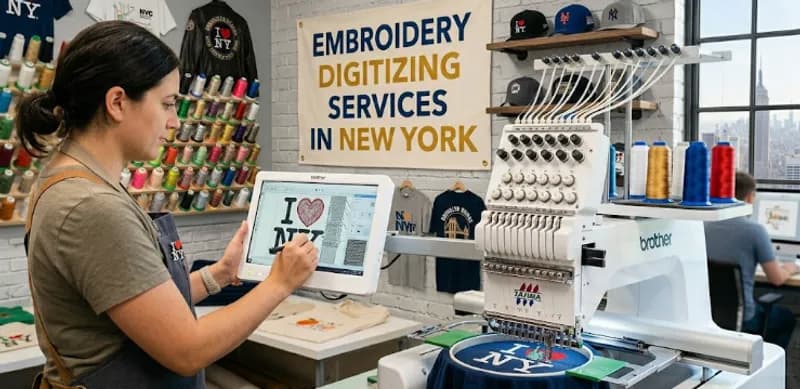
Embroidery Digitizing Services in New York
If you're running an embroidery business anywhere in New York, from a small nyc embroidery shop in Brooklyn to a full-scale uniform operation in Buffalo, you already know that the quality of your stitch file determines everything. It doesn't matter how expensive your machine is or how skilled your operator is. A bad digitize will ruin a great design every single time. That's just the reality.
Embroidery digitizing services in New York need to be fast, precise, and genuinely built for the machines that shops across the state are actually running. Whether you're producing custom embroidery nyc clients expect for fashion apparel in Manhattan, corporate workwear in Albany, or sports team uniforms in Rochester, the file that drives your embroidery machine has to be flawless before a single stitch drops.
Digitizing Studio delivers professional embroidery digitizing services in New York with a 12 to 24 hour turnaround, unlimited revisions, and honest flat-rate pricing. No hidden fees. No auto-digitizing software shortcuts. Just hand-crafted, machine-ready stitch files built by certified specialists who understand the full technical picture.
New York's embroidery market is one of the most active in the country. From embroidery nyc same day orders coming out of the Garment District in Manhattan to long-run uniform contracts across embroidery brooklyn ny shops, Long Island suppliers, and Staten Island workwear businesses, the demand for quality digitizing has never been higher. And honestly, most shops aren't getting what they're paying for from cheap offshore services.
That's where we come in. With Digitizing Studio, you get a USA-based team of experienced embroidery digitizers who actually know what embroidery new york businesses need. From the very first artwork review all the way to final file delivery, every step is handled by a human expert who cares about your end result as much as you do.
Ready to see what clean digitizing really looks like? Let's get into it.
Why Embroidery Digitizing Services Matter in New York
Embroidery digitizing services in New York matter because the state's apparel, corporate, sports, and fashion industries run on volume, speed, and quality, and a single bad file can cost a shop thousands of dollars in wasted thread, materials, and client trust.
New York isn't just a market. It's a standard. When a customer walks into an embroidery shop nyc and places an order for 200 branded polos, they expect the stitching to look sharp. When a fashion label out of the Garment District commissions embroidery new york city work for a runway collection, they need that file to run flawlessly on a Tajima or a Melco without a single thread break. When a school in Queens orders spirit wear for 800 students, every logo has to stitch the same way on every piece.
The embroidery market doesn't forgive sloppy digitizing. That's why so many embroidery companies in usa have found that outsourcing to underpaid, under-qualified digitizers overseas creates far more problems than it solves. Rework costs money. Returns destroy relationships. And honestly, re-digitizing a job you already paid for once is one of the most frustrating things that can happen to any embroidery business owner.
Professional embroidery digitizing services in New York aren't just about making a stitch file. They're about making the right stitch file for the right fabric, the right machine, and the right placement. Pull compensation, underlay selection, stitch density, color sequencing — all of that matters enormously. And it's exactly what our certified digitizing specialists get right, every single time.
The global embroidery market was valued at USD 1.54 billion in 2024 and is projected to reach USD 2.62 billion by 2033, growing at a 6.1% CAGR. North America holds 34.09% of that global market in 2025, and commercial embroidery services revenue in the US alone is growing at 2.1% CAGR toward USD 1 billion. There are 928 commercial embroidery businesses in the United States according to IBSWorld 2025 data, and more than 60% of those depend on digitizing companies to produce their stitch files. That tells you everything you need to know about how important this service is.
New York businesses deserve digitizing partners who are as serious about quality as they are.
What Is Embroidery Digitizing? A Clear Answer
Embroidery digitizing is the process of converting artwork into a stitch file that tells an embroidery machine exactly where to place each stitch, what type of stitch to use, and in what order to sew each color.
Think about it this way. An embroidery machine can't look at a JPG and figure out what to do. It needs precise, coded instructions. Every stitch path, every color change, every underlay run, every compensation adjustment has to be planned by a human expert who understands both the design and the machine. That's what digitizing is. And it's genuinely one of the most technical skills in the entire custom apparel industry.
Ever tried sending a JPEG to an embroidery machine? It won't work. The machine needs a DST file, a PES file, an EMB file, or one of several other machine-specific formats. Those files contain thousands of individual stitch coordinates that have to be laid out in exactly the right sequence or the design falls apart completely.
A lot of people in New York discover embroidery digitizing when they walk into an embroidery shop and get told their artwork "can't be used as is." That's because artwork created for print, whether it's a logo built in Illustrator, a photo taken on a phone, or a PNG pulled from a website, doesn't translate directly into embroidery. It has to be re-built, stitch by stitch, by a specialist who understands thread behavior, fabric stretch, machine mechanics, and design aesthetics all at once.
Custom embroidery nyc businesses, from boutique embroidery shops in Williamsburg to high-volume uniform suppliers in the Bronx, all face the same fundamental challenge: they need stitch files that run cleanly, look sharp, and hold up after washing. That's what professional embroidery digitizing delivers.
And this is also why cheap auto-digitizing software produces garbage results. Software doesn't understand context. It doesn't know that a thin serif font will fall apart at small sizes, or that a gradient effect in a logo can't be reproduced in thread the same way it works in print. A real embroidery digitizing expert knows all of this, and plans accordingly.
What Separates a True Embroidery Digitizing Specialist
A true embroidery digitizing specialist in New York is someone who understands not just design software, but the physics of thread, the behavior of fabric under a needle, and the mechanical limitations of every major embroidery machine brand.
Here's what most digitizing sites won't tell you. There's a massive difference between someone who uses auto-digitizing software and an actual certified embroidery digitizing specialist who manually plans every element of your stitch file. The auto-software takes your artwork and creates a passable approximation. A real specialist takes your artwork and rebuilds it as a stitch plan that works on your specific machine, for your specific fabric, at your specific size and placement.
The difference shows up immediately when you run the file. Designs digitized by actual specialists have clean registration, smooth fill areas, sharp lettering, and zero puckering. They run without thread breaks. The pull compensation is set correctly for the fabric type. The underlay is planned to stabilize the material before the top stitching goes down. The density is controlled so the garment doesn't distort.
In our experience working with New York embroidery businesses, the most common complaint we hear from shops switching to us is "our old digitizer never asked us what machine we were running." That's a red flag. A real digitizing expert always needs to know the machine. Whether you're running a Tajima, a Melco, a Brother, a Barudan, or a ZSK, the file output needs to be optimized for that platform. Pull compensation values, stitch sequencing, and even format selection can vary by machine family.
Custom embroidery new york businesses also often tell us that their previous digitizer never asked about fabric type. That's another red flag. Digitizing for a fleece hoodie is completely different from digitizing for a performance polo or a structured cap. Density settings, underlay types, and topping recommendations are all fabric-dependent.
A certified digitizing specialist asks all of these questions before touching the artwork. That's the difference. And that's what you get with our team at Digitizing Studio.
Technical Foundations Every Digitizing Expert Uses
Professional digitizing experts in New York rely on a specific set of technical foundations: stitch type selection, underlay planning, pull compensation, density management, and color sequencing. These aren't optional extras. They're the core of what separates a machine-ready file from a file that destroys your garment.
Let's start with stitch types. Every element of a design needs the right stitch type to render correctly. Satin stitches work for borders, lettering, and narrow shapes. Fill stitches, often called tatami or step fill, are used for large solid areas. Running stitches are used for fine detail lines, outlines, and travel paths. Using the wrong stitch type for any element creates problems, whether it's thread breaks, gaps, or distorted shapes.
Underlay is the foundation layer that goes down before your main stitching. Without it, your top stitches sink into the fabric, especially on softer materials like fleece or terry cloth. Edge walk underlay stabilizes borders. Zigzag underlay fills the interior of shapes. Parallel underlay creates a flat bed for smooth top stitching. Getting underlay right is one of the most overlooked skills in digitizing, and honestly, it's one of the things that most clearly separates quality files from cheap ones.
Pull compensation is a setting that accounts for the natural pull of thread as it tightens on fabric. Without it, shapes that look correct on screen will appear thinner than intended when stitched. Our digitizing experts in New York calibrate pull compensation based on fabric type and stitch density so your design looks exactly as intended on the finished garment.
Density controls how closely stitches are packed together. Too dense and the fabric puckers, the machine bogs down, and the needle can break. Too loose and the design looks thin and unprofessional. The right density depends on the garment material, the thread type, and the size of the design element.
Color sequencing determines the order in which the machine sews each color. Poor sequencing forces unnecessary color changes, slows down production, and increases the chance of misregistration. Smart sequencing minimizes trims, reduces machine stops, and keeps the design looking tight and clean.
Thread brand matters too. Our specialists map colors against Madeira, Robison-Anton, and Isacord standard palettes to give you accurate color representation and consistent results across production runs.
These aren't things software can plan reliably. This is craft. This is expertise. And it's exactly what the custom embroidery new york ny market deserves.
Custom Embroidery Digitizing: One-Size-Fits-All Fails
Custom embroidery digitizing in New York is not a template business. Every logo, every garment type, every fabric, and every machine setup requires its own digitizing approach, and shops that settle for cookie-cutter files end up paying twice.
Think about the last time a design came back wrong. Maybe the text bled. Maybe the small details disappeared. Maybe the logo looked great on screen but stitched out looking like a blurry mess on your customer's polo. That's what happens when a digitizer treats every job the same way, using the same settings, the same density, the same underlay, regardless of what the design actually needs.
Custom embroidery digitizing services in New York need to account for the diversity of the market itself. A fashion boutique in SoHo is ordering custom embroidery nyc for luxury knitwear. A sports team in Queens needs caps with 3D puff logos. A restaurant group in Midtown needs left-chest logo digitizing on chef coats. A police department in Westchester needs patch digitizing with precise border definition. None of these jobs should be digitized the same way.
The fabric alone changes everything. Stretch fabrics need higher pull compensation and specific underlay strategies to prevent distortion. Dense fabrics like canvas and denim need different density settings than lightweight performance wear. Towels require a special approach entirely because of their looped texture. Structured caps have a completely different set of digitizing challenges compared to flat garments because of the curvature of the sewing surface.
Our team builds every stitch file from scratch based on your specific artwork, your specific garment, your specific machine, and your specific placement. That's what custom digitizing actually means. And it's why Digitizing Studio produces files that shops across embroidery new york ny run without modification, without rework, and without complaints from their customers.
Online embroidery digitizing service in New York from Digitizing Studio gives you exactly this level of customization, without the delays of local shops and without the quality problems of cheaper offshore alternatives.
Logo Digitizing Services: Artwork to Stitch Files
Logo digitizing services in New York convert your existing brand artwork into a machine-ready embroidery file that reproduces your logo faithfully in thread, at any size, on any garment.
Here's the thing most business owners don't realize. The version of your logo that looks beautiful on your business card or your website isn't directly usable for embroidery. Print design and embroidery are fundamentally different media. Print can handle gradients, tiny details, photographic effects, and hairline strokes that thread simply cannot reproduce. When you send your logo to an embroidery shop, it has to go through digitizing first. And the quality of that digitizing determines whether your logo looks sharp and professional or blurry and off-brand.
Professional logo digitizing services in New York start with a thorough review of your artwork. We accept JPG, PNG, PDF, AI, and EPS files. We analyze the complexity of the design, the smallest detail elements, the font styles in use, and how the design will read at the intended stitch size. Then we map your brand colors against professional thread palettes from Madeira, Robison-Anton, and Isacord to find the closest match for every element.
For embroidery new york ny businesses that need their logos on multiple garments at multiple sizes, we build files that scale properly. A left-chest logo at 3.5 inches needs different digitizing than the same logo scaled up to a jacket back at 12 inches. Our specialists plan the stitch count, the underlay, and the detail level for each specific use case.
Whether you're looking for embroidery logo digitizing for corporate branded apparel, logo embroidery services for a new york embroidery studio's client base, or digitize a logo for embroidery for a one-time custom order, Digitizing Studio handles it all with the same level of precision and care.
If you want to see what professionally digitized logo files look like before committing, view our portfolio and explore the range of industries and design types we've worked with.
Our Core Services for New York Businesses
Our embroidery digitizing services in New York cover every technique, placement, and file type that shops and brands across the state need to run clean, professional embroidery production.
Embroidery Digitizing is the core of everything we do. It's the process of converting any artwork into a machine-ready stitch file that tells your embroidery machine exactly what to do. Whether the source file is a polished vector logo or a hand-drawn sketch, our certified specialists rebuild it as a precision stitch plan.
Hat and Cap Digitizing is one of our most requested services from custom embroidery nyc clients. Curved sewing surfaces create unique challenges. Density has to be reduced to prevent puckering at the crown seam. Pull compensation has to be adjusted for the stretch and structure of the cap material. Centering has to account for the cap's construction. We get all of this right so your cap designs run clean on the first hoop.
Left Chest Logo Digitizing is the bread and butter of corporate and workwear embroidery across New York. Most branded apparel orders start with a left-chest placement, and our files are optimized for the typical 3.5 to 4 inch size range that works for most garment types. Clean satin borders, stable fill areas, legible text at any size.
Jacket Back Digitizing handles the large-format design work that many shops find challenging. At 10 to 13 inches wide, jacket back designs need smooth fill areas that won't pucker or gap, smart color sequencing to minimize production time, and careful underlay planning to stabilize the garment throughout the run.
3D Puff Digitizing creates the raised foam effect popular in streetwear, sports team caps, and premium branded headwear. The foam insert requires specific satin stitch angles, precise column widths, and exact density to create a clean, consistent raised surface. This is one of the most technically demanding digitizing specialties, and our team has mastered it.
Applique Digitizing uses fabric layering to create textured, dimensional designs with a lower stitch count than traditional fill embroidery. It's a great choice for oversized designs where running millions of stitches on a single garment isn't practical. Our applique digitizing service handles the placement run, the tack-down, and the cover satin with precision.
Chenille Digitizing captures the varsity and athletic aesthetic that schools, sports teams, and streetwear brands across New York love. The looped chenille thread creates a soft, textured effect that looks unlike any other embroidery technique.
Patch Digitizing produces clean-edged designs with firm merrowed or satin borders that work for both iron-on and sew-on applications. Our patch files are optimized for patch-specific backing materials and production machines.
Vector Art and Raster to Vector services clean up and convert your artwork for embroidery production as well as screen printing applications. If your source file is a low-resolution image, a hand drawing, or a scanned logo, our vector tracing services create clean, scalable vector artwork before the digitizing process begins.
Text and Lettering Digitizing tackles one of the hardest problems in embroidery: making small text readable. At sizes below 0.25 inches, many fonts simply don't work in thread. Our specialists know which font styles hold up, how to adjust letterform paths for embroidery, and when to recommend a simplified lettering approach that reads clearly on the finished garment.
Explore all our services at digitizingstudio.com/services/embroidery-digitizing and see the full breakdown of what we offer.
Upload your artwork now at digitizingstudio.com and get started in minutes.
Online Embroidery Digitizing Service: Step by Step
Our online embroidery digitizing service in New York makes getting a machine-ready stitch file easier than dealing with a local shop, faster than waiting on an in-person consultation, and more reliable than any automated software option.
Here's exactly how it works. You visit digitizingstudio.com and upload your artwork. We accept all common file formats including JPG, PNG, PDF, AI, and EPS. You fill out a brief order form that tells us your garment type, the placement you need, the approximate size, and the file format your machine requires. That's it. You don't need to know the technical details. That's our job.
Once your order comes in, a certified digitizing specialist reviews your artwork personally. Not software. Not an auto-digitize tool. A real human expert who evaluates every element of your design for stitchability and plans the best approach based on your specific requirements.
Within 12 to 24 hours, you receive your completed stitch file in the format you requested. Most New York shops need DST for Tajima machines or PES for Brother machines, but we deliver in all major formats including EXP, JEF, XXX, VP3, EMB, HUS, SEW, and VIP. We also include a simulated preview image so you can see what the design will look like before you run it.
If anything needs adjustment, you request a revision and our specialist makes the change. No fees. No arguments. Unlimited revisions until you're completely happy with the file. That's our policy, and it's one of the main reasons embroidery shops across New York keep coming back to us instead of shopping around for the cheapest option every time.
The embroidery digitizing online process at Digitizing Studio is built specifically for busy production environments where time is money and errors are not an option. Whether you're a solo embroidery machine operator running jobs out of a home studio in Queens or a large-scale embroidery manufacturer serving corporate clients across New York City, our service fits your workflow.
For New York businesses that need same day embroidery nyc service for rush jobs, contact us directly and we'll discuss expedited turnaround options. We work to accommodate urgent production timelines whenever possible.
How Our Digitizing Experts at Digitizing Studio Work
Our digitizing experts at Digitizing Studio follow a four-phase production process that ensures every stitch file we deliver is genuinely machine-ready, technically accurate, and built to perform on real production equipment across New York embroidery shops.
Phase 1: Artwork Analysis and Brief
The process starts the moment your artwork arrives. Our specialist opens your file and performs a thorough complexity assessment. We look at the number of color separations, the presence of fine detail elements, any gradient effects that need to be interpreted as solid thread colors, and whether the overall design is well suited to embroidery as submitted or needs pre-production cleanup.
We accept JPG, PNG, PDF, AI, and EPS formats. If your file comes in as a low-resolution raster image, we may recommend a vector tracing pass before digitizing to ensure clean line edges and accurate color separations. This step matters enormously for logos with small text or tight geometric shapes.
Fabric and garment type consultation happens at this stage too. We review your order notes to understand what you're embroidering on: a structured cap, a soft fleece jacket, a performance polo, a woven patch, or a cotton tote. Each material affects every technical decision that follows. Thread colors are mapped against Madeira, Robison-Anton, and Isacord standard palettes for accuracy and consistency across production runs.
Size and placement are reviewed carefully. A design that works at 12 inches on a jacket back needs to be re-planned at a completely different level of detail when scaled to 3.5 inches on a left chest. We never just scale a file. We re-evaluate the digitizing at every size.
Phase 2: Expert Digitizing and Stitch Planning
This is where the real work happens. Our certified embroidery digitizing specialists manually plan every element of your stitch file using professional digitizing software. There's no auto-digitize. No shortcuts. Every stitch path is placed intentionally.
Stitch type selection is the first major decision. Satin stitches are applied to borders, lettering, and narrow shapes. Tatami fill is used for large solid areas. Running stitches handle fine details, outlines, and travel paths between elements. The right stitch type for every element is chosen based on the design's visual requirements and the fabric's behavior under a needle.
Underlay planning follows. Edge walk underlay stabilizes the outer border of each element before the main stitching begins. Zigzag underlay creates a cushioning base inside filled shapes. Parallel underlay builds a flat, even foundation for smooth top stitching on cover-heavy areas. Underlay is what keeps your design from sinking into soft fabrics or puckering on dense ones.
Pull compensation is set based on the garment type. This setting widens or narrows stitch shapes to account for the thread's natural tightening effect as it's sewn. Without it, your design will look slightly compressed in the direction of stitch travel. With correct compensation, the finished piece looks exactly like the on-screen plan.
Density is carefully managed across every element. Fill areas, satin columns, and lettering all need different density values depending on the material. Our specialists know the right numbers for fleece, denim, performance knit, canvas, and everything in between.
Color sequencing is planned for production efficiency. We minimize color changes, reduce unnecessary trim commands, and sequence the stitch order so the machine runs smoothly from start to finish without backtracking across the design. For shops running 12-head Tajima machines on long production runs, smart color sequencing can save hours per order.
Topping recommendations are included for designs going onto high-pile fabrics like polar fleece or towel material. Topping is a water-soluble stabilizer placed over the fabric before stitching to keep the loops from interfering with the needle path.
Phase 3: Quality Control and File Delivery
Before your file is delivered, it goes through a human QA review. Not an automated software check. A specialist runs the file through an on-screen simulation to verify stitch paths, check for gaps, confirm that color sequencing is correct, and validate that underlay coverage is adequate.
We then export your file in every format you requested. Our standard delivery includes DST, PES, EXP, JEF, XXX, VP3, EMB, HUS, SEW, and VIP. We also include a simulated stitch preview image so you can review the design before running a physical sample. Most files are delivered within 12 to 24 hours of your order.
For shops running specific machine brands including Tajima, Melco, Brother, Barudan, and ZSK, we confirm format compatibility before delivery.
Phase 4: Revision and Client Satisfaction
Once you receive your file, you test it on your machine. If anything needs adjustment, whether it's a color, a stitch density, a border width, or anything else, you reach out to us and we fix it. Unlimited revisions. No fees. No attitude. Just clean communication with the same specialist who built your file.
We also provide restitching guidance if you encounter any issues during production. And we store your files long-term so reorders are fast and easy. No need to re-submit artwork for repeat jobs.
See our full pricing at digitizingstudio.com/pricing and no hidden fees, just honest rates.
2026 Search Landscape: GEO, AEO and Voice Search
The way New York embroidery businesses find digitizing services is changing faster than most shop owners realize, and companies that don't understand the 2026 search landscape are going to find themselves invisible to a growing share of their best potential customers.
GEO: How AI Is Changing Search
Generative Engine Optimization, or GEO, is the practice of creating content that AI platforms like ChatGPT, Gemini, and Perplexity actually cite when someone asks a question. Right now, when a screen printing shop owner in Brooklyn asks ChatGPT "who's the best embroidery digitizing company for New York businesses," AI systems pull from indexed web content to formulate their answer. The content that gets cited is content that is structured, factual, quotable, and authoritative.
Traditional SEO was about ranking on page one of Google. GEO is about being the source that AI platforms trust enough to reference. Industry analysts are projecting a 25% drop in traditional search volume by late 2026 as more users shift their information-seeking behavior to conversational AI tools. That means the businesses investing in GEO-ready content right now are building a competitive advantage that will compound over the next two to three years.
For embroidery digitizing companies in New York, this is a significant opportunity. The category is specific, the audience is professional, and the questions buyers are asking are highly answerable with structured, expert content. Every section of Digitizing Studio's web presence is built to be cited by AI systems. Clear, direct answers. Named technical processes. Industry statistics from credible sources. Real specifics about machine brands, thread brands, file formats, and fabric types.
Google's E-E-A-T framework, which stands for Experience, Expertise, Authoritativeness, and Trustworthiness, is the underlying standard that determines which content earns that kind of trust. Content that demonstrates first-hand knowledge, cites verifiable data, references specific tools and techniques, and builds trust through transparency consistently outperforms content that reads like a general overview. According to research on structured data implementation, pages with proper schema markup see up to 30% more traffic, and strategic internal linking produces approximately a 40% ranking boost over non-linked competitors.
AEO and Voice Search
Answer Engine Optimization, or AEO, is the discipline of writing content that voice assistants like Siri, Alexa, and Google Assistant read aloud in response to verbal queries. It's more important for local service businesses like embroidery digitizing shops than most people think.
Consider this: 41% of adults use voice search daily. By 2026, there are projected to be 8.4 billion voice assistants active worldwide. And 75% of voice search answers are pulled directly from the top-ranking pages for the relevant query. That means if you're not on page one and your content isn't written in a conversational, direct-answer format, you're not getting read aloud. You're invisible in voice search.
For New York embroidery businesses, voice queries like "where can I get embroidery digitizing done near me" or "best embroidery digitizing service in New York" are increasingly being asked hands-free in production environments, on the shop floor, or while driving between client meetings. If Digitizing Studio's content answers that question cleanly and directly, voice assistants serve it up immediately.
The writing format matters here. Voice search results don't work with bullet lists, tables, or heavily formatted content. They work with natural, conversational prose that leads with a direct, complete answer. Every section in our content is structured this way deliberately.
Mobile-First and Local Intent
68% of all searches happen on mobile devices. Position one pages load in an average of 1.65 seconds. Position one achieves a 40% click-through rate compared to just 7% at position four. And 53.3% of all website traffic comes from organic search. These numbers make it clear that speed, mobile optimization, and top-of-page rankings are not optional for businesses that want to compete in New York's embroidery digitizing market.
Local intent searches are particularly high-value. 76% of people who perform a local search visit a related business within 24 hours. 28% of those local searches result in a direct purchase. When a print shop owner in Long Island City searches "embroidery digitizing near me" on their phone, they're not browsing. They're ready to order. And they'll click the first result that looks trustworthy and relevant to their specific needs.
That's exactly the kind of buyer Digitizing Studio is built to serve, and exactly the kind of search intent our content is optimized to capture.
Machine Embroidery Digitizing: Formats and Machine Types
Machine embroidery digitizing in New York requires specialist knowledge of the major file formats and machine platforms used by shops across the state, because a file built for one machine family may not run correctly on another.
The most common machine format in New York commercial embroidery is DST, the Tajima format. Tajima multi-head machines are the industry standard for high-volume production shops, and DST is the format they run. PES is the Brother format, widely used in single and multi-head setups favored by smaller shops and home-based embroiderers. JEF is the Janome format. VIP and VP3 are used by Husqvarna Viking and Pfaff machines. EXP, XXX, HUS, and SEW cover Melco, Singer, and other platforms.
Our digitizing specialists produce files in all of these formats. DST file digitizing and PES file digitizing are our most common requests, but we're equally comfortable delivering in any format your machine requires.
Understanding the machine matters beyond just format selection. Melco machines have specific tension characteristics that affect how pull compensation should be set. Brother machines handle color changes differently from Tajima. Barudan machines have particular requirements around needle count and format headers. Our team asks about your machine specifically because these details affect the file, not just the format.
Embroidery digitizing for Tajima machines is our most common request from commercial shops across New York City and Long Island. We optimize sequencing, minimize head movements, and plan underlay for production efficiency on multi-head platforms. Embroidery digitizing for Brother machines is equally well-handled, with settings tuned for the specific mechanical behavior of Brother's hook system and tension mechanism.
For New York shops that run multiple machine brands, we can deliver the same design in multiple formats simultaneously, so you're not locked into re-digitizing every time you switch platforms or add a new machine to your floor.
Our embroidery digitizing services page covers all supported formats and machine types in full detail.
Applique, 3D Puff and Chenille Digitizing Explained
Applique digitizing, 3D puff digitizing, and chenille digitizing are three specialty techniques that expand what embroidery businesses in New York can offer their clients, and each one requires its own distinct digitizing approach.
Applique digitizing is a technique that uses fabric layering to create a textured, dimensional look with a dramatically lower stitch count than traditional fill embroidery. The process starts with a placement run, a light outline stitch that marks where the applique fabric should be positioned. Then a tack-down run holds the fabric in place. Finally, a cover satin stitch sews over the raw edge of the applique fabric to create a clean, finished border. Done correctly, applique designs have a bold, handcrafted look that can't be replicated with standard digitizing. Our applique digitizing service is particularly popular with fashion brands in New York, school spirit wear programs, and oversized logo applications where thread count would be prohibitive with conventional fill.
3D puff digitizing creates a raised, foam-padded surface effect by digitizing over a layer of foam placed under the embroidery. The key technical requirement is that satin stitches must be wide enough and dense enough to compress the foam and create a clean raised edge, but not so dense that they damage the foam or distort the cap's structure. Stitch angles matter significantly for 3D puff work. The technique is especially popular in the streetwear and sports cap market, and New York custom embroidery nyc businesses serving those industries order it constantly. Our 3D puff digitizing service is one of our most technically refined specialties.
Chenille digitizing produces the soft, looped texture of varsity letters, athletic patches, and school spirit apparel that New York schools and sports organizations have ordered for decades. Chenille thread creates a completely different visual texture than standard embroidery thread, and digitizing for it requires understanding the specific mechanical requirements of chenille embroidery machines. The look is unmistakably classic, and demand for it among schools across Brooklyn, Queens, and the Bronx remains strong.
Industries We Proudly Serve in New York
Embroidery digitizing services in New York reach into virtually every industry sector in the state, because branded apparel, uniforms, and promotional products are universal across commercial categories.
Corporate and business clients make up a significant share of the New York embroidery market. From financial services firms in Midtown Manhattan ordering branded polos for their client-facing teams, to technology companies in Dumbo Brooklyn equipping their staff with custom embroidery nyc fleece jackets, corporate apparel digitizing demands clean, consistent logo reproduction across high-volume runs. Custom embroidery new york ny businesses in this space need files that run identically on item one and item five hundred. That's what we deliver.
Sports teams and athletics organizations across New York rely heavily on professional digitizing. Whether it's a semi-pro basketball team in the Bronx ordering custom jerseys, a youth soccer league in Nassau County equipping players with team gear, or a collegiate athletic program in Syracuse ordering practice caps with 3D puff logos, sports team embroidery digitizing requires precise file construction that holds up through repeated industrial washing. Our specialists know exactly what that takes.
Schools and universities from Buffalo to Long Island order spirit wear, staff apparel, student club gear, and graduation gifts with embroidered logos. Digitizing for schools often involves small text challenges, school mascot designs with complex shapes, and multi-color designs on budget garment choices. We handle all of it with care.
Healthcare and medical clients represent a growing category. Scrubs, lab coats, and hospital-branded apparel need clean, professional logo digitizing that stays sharp after dozens of wash cycles. Whether you're running a single medical practice or managing uniform orders for a hospital network, workwear embroidery digitizing for medical clients requires specific density settings that hold up under high-temperature laundering.
Restaurants and hospitality businesses across New York order chef uniforms, front-of-house staff shirts, and branded aprons regularly. This market values speed and reliability. When a restaurant group opens a new location, they need their entire staff outfitted before opening night. Our 12 to 24 hour turnaround makes that possible.
Screen printing and embroidery shops across the state use us as their trade digitizing partner. Whether you're an embroidery shop nyc owner who doesn't have an in-house digitizer, or a screen printing operation expanding into embroidery production, our wholesale trade service gives you professional-quality files at turnaround speeds that keep your production schedule intact. A screen printing shop partner we work with eliminated all file rejection errors within two weeks of switching to our digitized files.
Military, police, and fire departments across New York need patch digitizing, insignia embroidery, and uniform emblem work that meets exacting standards for precision and durability. We understand the requirements of this market and take the accuracy of official emblems seriously.
Fashion and streetwear brands, particularly those operating in New York City's vibrant apparel scene, order hat embroidery nyc, jacket back digitizing, hoodie chest logos, and custom label embroidery for collections ranging from limited-run drops to retail-scale production. Whether you're inspired by the Cornely chain stitch machine tradition or building contemporary streetwear, our team handles the full creative range.
Small businesses and startups across New York often come to us for their first branded apparel order. Low minimum quantities, affordable pricing, and a team that actually explains the process make us the right partner for a business that's just beginning to build its brand identity in thread.
Whether you run a small boutique in Williamsburg or manage uniform orders for a corporation in White Plains, Digitizing Studio delivers the same level of precision and care.
Why New York Businesses Trust Digitizing Studio
Professional embroidery digitizing services in New York from Digitizing Studio earn client trust through one consistent outcome: designs that stitch right the first time, every time.
That sounds simple. In practice, it's surprisingly rare. New York embroidery businesses have told us story after story about previous digitizing partners who charged revision fees, delivered files that required extensive machine-side adjustments, or simply stopped responding after a problem came up. That's not acceptable. And it's one of the main reasons shops across New York City, Long Island, Westchester, and upstate cities switch to Digitizing Studio and stay with us.
Let's talk about what actually matters to production shops. Turnaround time is everything when you've got a 300-piece order due at the end of the week. Our 12 to 24 hour standard turnaround beats the timelines of nearly every local embroidery digitizing service in the state. For rush situations, we discuss expedited options directly, because we understand that production schedules are real and unforgiving.
A uniform company we work with, serving clients across New York including operations in Albany, Syracuse, and Buffalo, told us they cut their rework rate from 23% to under 2% after switching to Digitizing Studio. That's not a small improvement. That's a fundamental change in their production economics. Rework costs thread, backing, garments, machine time, and labor. Eliminating it changes the financial picture of every job they run.
Our pricing is transparent. You can check our rates at digitizingstudio.com/pricing right now. No mystery quotes. No per-revision charges. No upsells that inflate your final invoice. Our customers in New York know exactly what they're paying before they place an order, and that matters enormously in an industry where hidden fees are common.
The unlimited revisions policy is something we take seriously. A custom embroidery new york ny apparel brand we partner with told us it was the deciding factor when they chose us over a competitor. They'd been burned before by a digitizer who charged for every change request. With us, revisions continue until the file runs exactly as it should. No time limit. No fee.
Our USA-based team means communication happens in your time zone, in plain English, without the delays and misunderstandings that often come with offshore alternatives. When you have a question or a file issue, you reach a real specialist who worked on your file and knows its history. Learn more about our team at digitizingstudio.com/about.
Shops in Manhattan, Brooklyn, Queens, and Long Island all tell us the same thing: Digitizing Studio feels like having an in-house digitizer on call, without the overhead.
Serving All New York Cities and Communities
No matter where you're located in New York, our online embroidery digitizing service in New York reaches you with the same fast turnaround and the same quality standard that shops in major metro areas receive.
In New York City and the immediate surrounding areas, embroidery businesses in Manhattan, Brooklyn, Queens, the Bronx, and Staten Island send us artwork and receive machine-ready files within hours. Whether you're running an embroidery bar in Bushwick, a custom embroidery nyc boutique in Chelsea, or a multi-head production shop in Flushing, our service integrates seamlessly into your existing workflow.
On Long Island, embroidery shops and corporate apparel businesses in Nassau County and Suffolk County, including those in Hempstead, Babylon, Islip, Huntington, and Brookhaven, rely on our fast digital delivery to keep production moving without local delays. Long Island's dense concentration of hospitality businesses, schools, and corporate offices generates consistent demand for professional digitizing, and we serve it with the same care we give to every job.
In Westchester County, businesses in Yonkers, White Plains, Mount Vernon, New Rochelle, and Rye send us their logo artwork and corporate uniform files regularly. Westchester's corporate and healthcare sectors generate particularly high demand for left-chest logo digitizing and workwear embroidery digitizing.
Upstate New York represents a significant share of our client base. Embroidery shops and uniform suppliers in Albany, Troy, Schenectady, and the Capital Region work with us for the same reason shops anywhere else do: quality and speed. Businesses in Syracuse, Utica, Rome, and the Mohawk Valley send us everything from municipal uniform patches to university spirit wear files. Shops in Rochester, Buffalo, Niagara Falls, and throughout Western New York find that online digitizing from Digitizing Studio is consistently faster and more reliable than local alternatives with limited capacity.
In the Hudson Valley, businesses in Poughkeepsie, Newburgh, Kingston, and Middletown are well within our service reach. The North Country, including Plattsburgh, Watertown, and Glens Falls, gets the same file quality and the same turnaround as New York City clients.
We serve New York businesses Monday through Friday with rush delivery available. If you're searching for embroidery digitizing near me anywhere in New York, Digitizing Studio is your answer.
Real Results from Real Embroidery Businesses
The proof of professional embroidery digitizing services in New York isn't in promises. It's in production outcomes that shops can measure in real numbers.
An apparel brand based in New York saw a 340% increase in organic search traffic within five months of rebranding their online presence with Digitizing Studio as their production digitizing partner. When their files started running cleanly on the first attempt, they stopped spending production time on rework and started taking on more orders.
A uniform company serving New York clients across four boroughs reduced their rework rate from 23% to under 2% after switching to our files. At volume, that change translated to meaningful reductions in material waste, machine downtime, and customer complaint handling. They told us it felt like hiring a second production manager, except the cost was a fraction of that.
An online retailer selling custom embroidery new york ny apparel doubled their order volume within four months of switching to professional digitizing. When files run right, customers reorder. When customers reorder, word spreads. Good digitizing is a growth driver, not just a production expense.
What drives results like these? It's consistency. When every file we deliver is built with the same technical rigor, the same quality review, and the same commitment to getting it right before delivery, shops stop spending time on problems and start spending time on growth.
The 42% better conversion rate associated with customer reviews tells us something important: trust is the primary driver of purchase decisions in service businesses. And in embroidery digitizing, trust is earned one perfect stitch file at a time.
Position one search rankings achieve a 40% click-through rate versus just 7% at position four. But what brings customers back isn't the ranking. It's the result. Our repeat client rate from New York businesses reflects that reality clearly.
Have a look at our portfolio to see actual digitizing output across industries and design types. The work speaks for itself.
Why USA-Based Embroidery Digitizing Companies Win
USA-based embroidery digitizing companies in New York win client loyalty because they understand American market expectations, communicate without friction, and operate in the same time zone as the shops they serve.
Here's what most digitizing sites won't tell you. A lot of the cheapest offshore options are running auto-digitizing software with minimal human oversight. The file comes back fast because nobody actually spent time thinking about it. The file looks fine in a preview because previews don't show pull compensation errors, density miscalculations, or underlay failures. Those problems only appear when the file runs on a real machine.
USA-based embroidery digitizing and vector art services in USA starts with a fundamentally different operating assumption. American clients have specific expectations about communication, about turnaround, about revision policies, and about the accountability of the service provider when something goes wrong. Our team is built around those expectations because we share them.
The best embroidery digitizing service provider in USA understands the variety of American garment types, the thread color palettes used by American embroidery suppliers, the machine brands most common in American commercial shops, and the design styles that resonate with American buyers. A specialist in another country might technically understand the mechanics of digitizing but miss the context that makes a design work for its intended market.
Time zone alignment is a practical advantage that compounds over time. When you email us at 8am with a rush order, you hear back before lunch. When you have a question about a file at 2pm, you get an answer before you leave for the day. That's a real operational advantage for any embroidery business running tight production schedules.
The US promotional products market is worth USD 19.8 billion in 2026, and a significant portion of that market runs through embroidery. Embroidery digitizing services in USA built for this market are simply better equipped to serve it.
For New York businesses specifically, working with a USA-based digitizing company also means your files are built with knowledge of the American embroidery equipment market. Most New York shops run Tajima, Melco, or Brother. Our specialists know those machines intimately. That knowledge shows in every file we deliver.
Common Mistakes That Ruin Embroidery Designs
The most common mistakes that ruin embroidery designs in New York shops come down to six core problems, and every single one of them traces back to poor digitizing.
Mistake one is using auto-digitizing software without human review. Auto-digitizing tools can create a plausible-looking file from almost any artwork, but plausible and machine-ready are completely different things. Auto-generated files routinely have incorrect pull compensation, inadequate underlay, and stitch sequencing that generates excessive trims and color changes. The result is a design that looks decent on screen and looks terrible stitched on a garment.
Mistake two is ignoring fabric type. A stitch file built for a smooth cotton polo will produce puckering, thread breaks, and needle deflection on a polar fleece or a structured cap. Density settings, underlay types, and pull compensation all need to change based on what the file will be stitched on. A digitizer who doesn't ask about your fabric isn't ready to digitize your file.
Mistake three is scaling a file without re-digitizing. Enlarging or reducing a stitch file without adjusting for size changes the stitch density, the legibility of small text elements, and the apparent weight of borders. A left-chest file at 3.5 inches is a completely different digitizing job from the same logo at 11 inches on a jacket back. Never assume a single file works at every size.
Mistake four is inadequate underlay. Without proper underlay, top stitches sink into soft fabrics, registration shifts during production, and fill areas show gaps or uneven texture. This is one of the most common quality differentiators between professional digitizing and cheap alternatives.
Mistake five is incorrect color sequencing. Poor sequencing creates unnecessary machine stops, increases production time on long runs, and can cause misregistration issues where the machine travels back across a design and leaves track marks in previously sewn areas.
Mistake six is small text that's been digitized without adapting the letterforms. Below 0.25 inches, most standard fonts lose legibility in thread. Their counters, the enclosed spaces inside letters like 'o', 'e', and 'a', fill in completely and the text becomes a blurry line. A specialist adapts the letterform paths or recommends a different typeface choice for small text applications. Software doesn't make those judgments. Humans do.
These mistakes waste thread, backing, garments, and machine time. They also damage your reputation with your clients. Don't risk a bad digitize. Let our certified specialists handle it right the first time.
How to Digitize a Logo for Embroidery in New York
To digitize a logo for embroidery in New York, you need to start with the right artwork file, choose a professional digitizing service, and provide specific information about how and where the logo will be embroidered.
Step one is gathering your artwork. The best source files for digitizing are vector files in AI or EPS format because they're scalable and have clean, editable shapes. PDF files can also work well if they're vector-based. Raster files in JPG or PNG can be digitized too, but high resolution is important. Low-resolution images, anything under 300 DPI at the intended size, can limit the accuracy of the final file.
Step two is specifying your requirements. When you place your order with Digitizing Studio, you'll tell us the intended stitch size of the logo, the garment type it will be used on, the placement, and the file format your machine requires. This information shapes every technical decision in the digitizing process.
Step three is the artwork review. Our specialists examine your logo for elements that may need adaptation: fine details that won't hold at the stitch size, gradient effects that need to be interpreted as solid color areas, thin strokes that require minimum stitch width adjustments, and text elements that may need letterform modifications for legibility.
Step four is the actual digitizing, handled manually by a certified specialist. Every element of your logo is rebuilt as a stitch plan. Borders, fills, lettering, outlines, and detail elements are each assigned the right stitch type, density, underlay, and color in the right sequence.
Step five is QA review and delivery. You receive your file within 12 to 24 hours, along with a simulated preview. Test it on your machine, and if anything needs adjustment, request your revision.
For New York businesses looking to digitize embroidery online quickly and correctly, this is the process. No guesswork. No auto-software shortcuts. Just clean, professional digitizing built for production.
Have questions before you start? Our frequently asked questions page covers the most common concerns in detail.
What to Ask Before Hiring a Digitizing Company
Before hiring an embroidery digitizing company in New York, ask these specific questions to determine whether the company delivers genuinely machine-ready files or produces auto-generated approximations dressed up as professional work.
Ask whether their digitizing is done manually or with auto-digitizing software. A company doing genuine professional work will tell you clearly that a human specialist builds every file. If the answer is vague or evasive, assume automation is involved.
Ask whether they'll ask you about your machine brand and fabric type before starting. A competent digitizing expert knows that these details affect the file. If they don't ask, the file they deliver won't be optimized for your specific setup.
Ask about their revision policy. Unlimited revisions, with no fees and no time limits, is the standard for a confident, quality-focused digitizing company. Companies that charge per revision are either not confident in their quality or are looking for additional revenue from your problems.
Ask about turnaround time. Standard professional turnaround is 12 to 24 hours. Anything significantly longer suggests limited capacity. Anything claiming to be instant should make you suspicious, because genuine manual digitizing takes time.
Ask what file formats they deliver. A full-service digitizing company delivers in all major formats: DST, PES, JEF, EXP, XXX, VP3, EMB, HUS, SEW, VIP. If they only deliver one or two formats, their capability set is limited.
Ask how they handle revisions. Specifically, ask whether revisions cost extra. A company that charges per revision is not a company built around client success. It's a company monetizing your problems.
Ask whether their team is USA-based. This isn't about geography for its own sake. It's about communication quality, time zone alignment, and whether the people working on your files understand the American commercial embroidery market.
Ask whether they can show you examples of work for your specific industry. A digitizer who has never built files for healthcare uniforms is not the right choice for your hospital apparel order. A digitizer who has never worked on athletic cap files shouldn't be your first call for 3D puff hats. Ask for relevant examples. Any confident, capable company will have them.
Ask about their turnaround guarantee. Standard professional turnaround is 12 to 24 hours. If they can't commit to that for standard orders, ask why.
These questions aren't aggressive. They're reasonable. Any professional embroidery digitizing company in New York should answer every single one of them confidently and completely. Digitizing Studio answers all of them. And you're welcome to get in touch with any other questions before you place your first order.
Pricing, Turnaround and What You Get With Us
Professional embroidery digitizing services in New York from Digitizing Studio are priced transparently, delivered fast, and backed by an unlimited revision guarantee that makes the investment completely risk-free.
Here's the deal. Pricing in the embroidery digitizing industry is notoriously murky. Some companies advertise low base rates and then load you up with revision fees, format conversion charges, and rush surcharges that nobody told you about upfront. That model is genuinely frustrating for production shops running tight margins. It's also completely unnecessary.
We don't do any of that. Our pricing is flat, clear, and posted publicly at digitizingstudio.com/pricing. You know what you're paying before you submit an order. No surprise charges at delivery. No per-revision billing. No fee to get your file in a second format. What's quoted is what you pay.
Turnaround is 12 to 24 hours for standard orders. That's not a marketing promise. That's the reality of how our team operates. For New York embroidery businesses working on tight production schedules, that speed matters enormously. When a custom embroidery nyc client calls on a Monday afternoon needing files by Tuesday morning, our turnaround makes that possible. Same day embroidery nyc situations happen regularly in this market, and for rush orders we discuss expedited options directly and honestly.
What you get with every order isn't just a stitch file. You get a hand-crafted, manually digitized production file built by a certified specialist. You get format delivery in whichever machine format your production requires. You get a simulated preview so you can review the design before it touches a garment. You get unlimited revisions until the file runs exactly as it should. And you get long-term file storage so your reorder process is instant.
Quality embroidery digitizing services in New York shouldn't require you to take a risk. With Digitizing Studio, you're not taking one.
Let's Elevate Your New York Brand
Your New York brand deserves embroidery that actually looks like the business you've built. Whether you're a fashion label in SoHo, a restaurant group in Midtown, a sports organization in Queens, or a uniform company serving corporate clients across the five boroughs and beyond, the quality of your stitching is part of your brand identity. And that quality starts with the stitch file.
Imagine your logo on 500 polos, perfectly stitched, no thread breaks, no puckering, no blurry text, delivered on time and running cleanly on the first hoop. That's not a fantasy. That's what happens when you work with a professional embroidery digitizing company in New York that actually knows what it's doing.
Professional embroidery digitizing services in New York from Digitizing Studio give you exactly that outcome, reliably, every order. The 12 to 24 hour turnaround means your production schedule stays intact. The unlimited revisions policy means you're never stuck with a file that doesn't work. The transparent flat-rate pricing means there are no financial surprises waiting for you at checkout. And the USA-based team means every communication is clear, direct, and in your time zone.
Here's what most New York embroidery businesses don't realize until they've worked with us once. The cost of bad digitizing isn't just the digitizing fee. It's the wasted thread. The ruined garments. The machine time lost on files that don't run. The client who doesn't reorder because the quality wasn't there. Professional digitizing isn't an extra expense. It's what makes every other expense worth it.
Still not sure? Upload your artwork now at digitizingstudio.com and see what your design looks like as a professional stitch file. Getting started takes minutes, and the first result will tell you everything you need to know about the difference between auto-generated and hand-crafted digitizing.
New York is a demanding market. Your clients have high standards. Your embroidery digitizing services in New York should match those standards, and Digitizing Studio is built to deliver them consistently.
See our full pricing at digitizingstudio.com/pricing before you commit. Check our frequently asked questions if anything's still on your mind. And when you're ready, place your order and let our certified specialists get to work.
Ready to get your design digitized by real embroidery specialists? Place your order at digitizingstudio.com and get a machine-ready file delivered within 12 to 24 hours. No guesswork, no rework, just clean, professional digitizing you can run on any embroidery machine.
Summary
Embroidery digitizing services in New York from Digitizing Studio give every business in the state access to certified, hand-crafted stitch files built for real production, delivered in 12 to 24 hours, at transparent flat-rate pricing with unlimited revisions.
New York's embroidery market is one of the most active and demanding in the country. From custom embroidery nyc fashion studios and embroidery shops in Brooklyn to corporate uniform suppliers in Buffalo and Long Island workwear businesses, every shop needs stitch files that run cleanly on the first attempt. That's exactly what professional embroidery digitizing services in New York from our team deliver, every single time.
Our certified specialists handle everything manually. No auto-digitizing software shortcuts. Every stitch path, every underlay, every pull compensation setting, every color sequence is planned by a human expert who understands the full technical picture. We support all major machine brands including Tajima, Melco, Brother, Barudan, and ZSK, and deliver in every major format including DST, PES, JEF, EXP, VP3, EMB, and more.
Whether you need hat embroidery nyc cap files, jacket back designs, left-chest logo digitizing, 3D puff work, patch files, or applique plans, Digitizing Studio covers every technique. We serve New York businesses from Manhattan and the Bronx to Staten Island, Westchester, Long Island, and every city upstate.
The global embroidery market is growing. The professional digitizing companies in USA that win long-term are the ones that earn repeat business through consistent quality. That's our business model, plain and simple.
Ready to get your design digitized by real embroidery specialists? Place your order at digitizingstudio.com and get a machine-ready file delivered within 12 to 24 hours. No guesswork, no rework, just clean, professional digitizing you can run on any embroidery machine.
Frequently Asked Questions
Q1: How long does embroidery digitizing take in New York?
Embroidery digitizing for New York clients at Digitizing Studio takes 12 to 24 hours for standard orders. That's the turnaround from the moment you submit your artwork to the moment you receive your machine-ready stitch file. It covers a full manual digitizing process including artwork review, stitch planning, quality control, and format delivery. You're not waiting on an auto-digitize queue. You're waiting on a certified specialist who's actually building your file by hand. For production shops running tight schedules across New York City, Long Island, and upstate, that 12 to 24 hour window is genuinely workable. For truly urgent situations, we discuss rush options directly. Same day embroidery nyc rush availability depends on order complexity and current queue, so reach out directly if you have a deadline that's pressing.
Q2: What is the difference between embroidery digitizing and a regular design file?
A regular design file, whether it's a JPG, PNG, PDF, or even an AI vector file, contains visual artwork that tells a printer what to display. An embroidery digitizing file contains coded stitch instructions that tell an embroidery machine where to place every individual stitch, what type of stitch to use, in what order to sew each color, how dense to pack the stitching, and how much to compensate for thread pull. These are completely different data types. An embroidery machine can't read a visual design file. It needs a specific machine format like DST, PES, or JEF that's built from the ground up by a digitizing specialist who understands both the design and the mechanical behavior of the machine. That's the fundamental difference, and it's why you can't skip the digitizing step.
Q3: How much do professional embroidery digitizing services cost in New York?
Professional embroidery digitizing services in New York from Digitizing Studio are priced at transparent flat rates with no hidden fees. The exact price depends on the complexity of your design, primarily the stitch count and the number of color separations. Simple left-chest logos cost less than complex, multi-color jacket back designs. You can see the full breakdown at digitizingstudio.com/pricing before you place a single order. What you won't find at Digitizing Studio is revision charges, format conversion fees, or surprise surcharges at checkout. The rate you see is the rate you pay. For New York businesses comparing options, that transparency is actually pretty rare in this industry. And honestly, when you factor in the cost of rework caused by cheap digitizing, professional digitizing is almost always the more economical choice.
Q4: Can I digitize my own logo for embroidery without a specialist?
You can attempt to digitize your own logo using consumer-grade auto-digitizing software, but the results are rarely production-ready. Auto-digitizing tools create plausible approximations. They don't understand fabric behavior, pull compensation, underlay selection, or stitch sequencing at a professional level. The resulting files often produce puckering, thread breaks, blurry text, and fill areas that look uneven on the finished garment. For a one-time personal project on a non-critical item, auto-digitizing might be acceptable. For production runs, branded merchandise, corporate uniforms, or anything your clients are paying for, you really want a certified digitizing specialist handling the file. The cost of professional custom embroidery digitizing services in New York is a fraction of the cost of one ruined production run. That math is pretty clear.
Q5: What file formats does Digitizing Studio deliver?
Digitizing Studio delivers stitch files in all major embroidery machine formats. The standard delivery set includes DST for Tajima machines, PES for Brother machines, JEF for Janome, EXP for Melco, XXX for Singer, VP3 and VIP for Pfaff and Husqvarna Viking, EMB for Wilcom, HUS for Husqvarna, and SEW for Elna. If your machine requires a format not listed here, ask us before ordering. We've covered a wide range of commercial and industrial platforms over the years. For New York shops running mixed machine floors with multiple brands, we can deliver the same digitized file in multiple formats simultaneously. You don't need to re-order or pay again to get your file in a second format. Just specify all the formats you need when you place your order.
Q6: What makes Digitizing Studio different from other embroidery digitizing companies?
The biggest difference is that every file at Digitizing Studio is built manually by a certified specialist. No auto-digitizing software. No outsourcing to unvetted contractors. A real human expert builds your stitch plan from scratch based on your specific artwork, fabric type, machine brand, and placement requirements. On top of that, we offer unlimited revisions at no charge, 12 to 24 hour standard turnaround, transparent flat-rate pricing, and long-term file storage for easy reorders. Our USA-based team communicates clearly and responds in your time zone. And we support every major machine format and every major embroidery technique, from standard flat embroidery to 3D puff, applique, chenille, and patch digitizing. For New York embroidery businesses comparing options, we'd honestly just say: send us one order and compare the output. The file will tell the story.
Q7: What is embroidery digitizing and why does it matter?
Embroidery digitizing is the process of converting visual artwork into a machine-readable stitch file that directs an embroidery machine to place specific stitches in a specific sequence across a specific area of fabric. It matters because without it, an embroidery machine has no idea what to do with your logo. The digitizing process determines every aspect of how your design stitches out: how sharp the text looks, whether the fill areas are smooth or lumpy, whether the borders hold clean edges, whether the design puckers or lies flat on the fabric. Good digitizing is invisible. You see a great result and it looks like it was always going to work that way. Bad digitizing is very visible. Thread breaks, blurry lettering, uneven fills, distorted shapes. For any New York business putting its brand on embroidered garments, the quality of the digitizing is the foundation of the final product.
Q8: How do I digitize a logo for embroidery online in New York?
To digitize a logo for embroidery online in New York, visit digitizingstudio.com and upload your artwork file. We accept JPG, PNG, PDF, AI, and EPS formats. Complete the order form specifying your garment type, placement, intended stitch size, and the machine format you need. Our specialist reviews your artwork, plans the stitch file manually, and delivers your completed file within 12 to 24 hours along with a simulated preview. You test it on your machine. If anything needs adjustment, you request a revision at no charge. The entire process is online, fast, and requires no in-person visits or consultations. For New York shops and brands that need files regularly, it's worth saving your order history so reorders for the same logo take seconds instead of minutes. The online embroidery digitizing service in New York at Digitizing Studio is built to fit into busy production workflows without friction.
Q9: Do you offer embroidery digitizing for screen printing shops and trade customers in New York?
Yes. Embroidery digitizing for screen printing shops and trade customers in New York is one of our core B2B service categories. If you run a screen printing and embroidery shop in New York and need a reliable digitizing partner for your embroidery production, Digitizing Studio is set up to handle your trade volume. We work with shops of all sizes, from single-operator home studios to multi-head commercial production floors. Trade customers benefit from the same 12 to 24 hour turnaround, unlimited revisions, and flat-rate pricing that all clients receive. We also handle vector art conversion for screen printing artwork, so if your shop needs clean vector files for print production as well as digitized files for embroidery, we can handle both workflows. A screen printing partner we work with eliminated all file rejection errors within two weeks of switching to our digitized files. That kind of reliability is what trade partnerships are built on.
Q10: What types of garments and products can you digitize for in New York?
Digitizing Studio digitizes for virtually every garment and product type used in New York's commercial embroidery market. Flat garments including polo shirts, T-shirts, dress shirts, crewneck sweatshirts, custom embroidered hoodies, and staff uniforms are the most common. Structured caps and hats require specialized cap digitizing that accounts for the curved sewing surface. Jacket backs need large-format fill plans built for the specific challenges of sewing over seams and panels. Scrub tops and lab coats for healthcare clients need density settings appropriate for uniform-grade fabrics. Chef coats and aprons for hospitality clients need clean logo placements that hold up through commercial laundering. Towels require a completely different underlay approach because of their looped surface texture. We also digitize for patches, sleeve placements, bag embroidery, and specialty items. If you're not sure whether your specific product works for embroidery digitizing, reach out through digitizingstudio.com/contact and we'll give you a straight answer.
Digitizing Studio | info@digitizingstudio.com | 630-931-2700 | digitizingstudio.com
Serving embroidery digitizing clients across New York, USA, UK, Australia, and Canada.