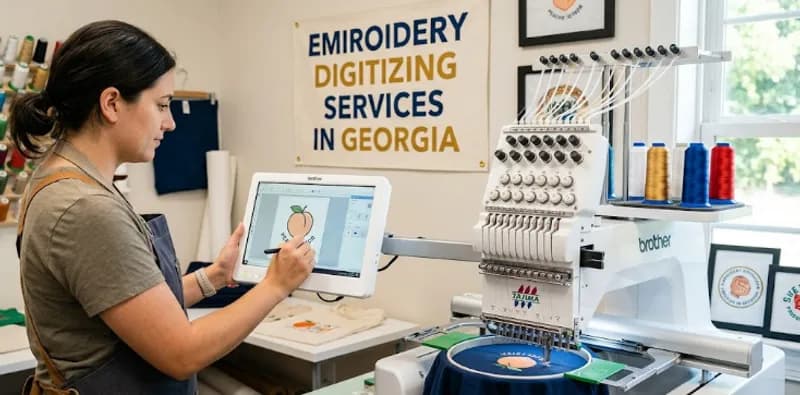
Embroidery Digitizing Services in Georgia
Finding embroidery digitizing services in Georgia that a business can actually trust is more important right now than it's ever been. Georgia is consistently rated the number one state in the nation for business climate, and the branded apparel and promotional products industry here reflects that energy. From Atlanta's booming corporate corridor to Savannah's hospitality and tourism sector, from Augusta's military and healthcare community to Athens and its thriving university apparel market, embroidery work is everywhere. And when that embroidery comes off the machine looking wrong, it costs real money.
Here's something a lot of digitizing websites won't tell you straight. A huge portion of what gets sold right now as professional embroidery digitizing is auto-digitizing software output dressed up in professional packaging. The file opens without errors. It looks fine in the preview. But the moment it runs on your machine, you get puckered fabric, thread breaks, blurry text, and a rework conversation you really don't want to have with your client. That's happening to Georgia embroidery businesses every single day.
Professional embroidery digitizing services in Georgia are supposed to fix that problem completely. That's what Digitizing Studio does. We're a USA-based embroidery digitizing company with a team of certified embroidery digitizing specialists who handle every order manually. No automated shortcuts. No one-size-fits-all settings applied to every design regardless of fabric type. Just precise, expert digitizing that produces machine-ready files built correctly for your specific garment and machine.
Georgia's economy had a real GDP of USD 710.4 billion in 2025, its highest on record, growing 1.9% year over year according to the Bureau of Economic Analysis. The state has 1.3 million small businesses making up over 99.7% of all businesses, employing 1.7 million Georgians who make up 43.1% of all state employees according to the UGA Small Business Development Center. Georgia has ranked number one in the nation for business climate consistently, which means more companies, more uniforms, more branded apparel, and more demand for quality digitizing.
The global embroidery market was valued at USD 1.54 billion in 2024 and is growing at a 6.1% CAGR toward USD 2.62 billion by 2033. North America holds 35% of that global market. The US promotional products market is worth USD 19.8 billion in 2026, and apparel is consistently the top-performing product category with 85% of recipients remembering the brand after receiving a promotional apparel item. Georgia businesses participating in that market need digitizing that works right the first time.
Whether you run an embroidery shop in Marietta, manage uniform production for a Savannah hotel group, supply branded apparel for Atlanta corporate clients, or serve a Columbus military community with professional workwear, the quality of your digitizing file is the single biggest factor in your embroidery output quality. This guide covers what professional embroidery digitizing services in Georgia actually deliver, how Digitizing Studio works, and why Georgia businesses who make the switch stop dealing with bad files for good.
Why Embroidery Digitizing Services Matter in Georgia
Embroidery digitizing services in Georgia matter in 2026 because Georgia's business environment is producing more demand for quality branded apparel than ever before. Georgia ranked number one in the nation for business climate and the state had a real GDP of USD 710.4 billion in 2025, its highest level on record. That economic activity translates directly into corporate uniforms, event apparel, hospitality workwear, sports team gear, school spirit wear, and promotional merchandise, all of which require embroidery digitizing done right.
Atlanta alone is home to dozens of Fortune 500 companies and hundreds of thousands of small businesses. Every one of those businesses putting a logo on a polo shirt, a cap, a jacket, or a bag needs a digitizing file that produces clean, consistent results. The demand doesn't stop at Atlanta's perimeter highway. Augusta has one of the country's most active military and healthcare communities. Savannah is a major port city with a booming hospitality and logistics sector. Columbus serves a large military population at Fort Moore. Athens has the University of Georgia driving enormous apparel demand across athletics, academics, and alumni merchandise.
STAT: Georgia has 1.3 million small businesses making up 99.7% of all state businesses and employing 1.7 million people, 43.1% of all Georgia employees. Source: UGA SBDC 2025 Report.
Here's the reality that embroidery shops and promotional product companies in Georgia face. You can do everything right on the production floor, buy the best machines, hire skilled operators, source quality garments. If the digitizing file is built wrong, none of that matters. Incorrect underlay on a stretchy athletic fabric causes distortion no operator skill can fix. Density settings that ignore your fabric weight cause thread breaks that waste materials and time regardless of how well-maintained your machine is.
Professional embroidery digitizing services in Georgia solve this at the source. A correctly built file by a real embroidery digitizing specialist runs cleanly on your machine, on your fabric, the first time. That's the foundation of a Georgia embroidery business that grows through consistent quality and satisfied clients, not one that struggles with rework and client complaints.
STAT: 85% of people remember the brand after receiving a promotional apparel item. Apparel is the top promotional products category. The embroidery on that apparel directly represents your client's brand.
What Separates a True Embroidery Digitizing Specialist
An embroidery digitizing specialist in Georgia needs to bring far more than software knowledge to the job. Software is just the tool. The expertise is in every decision made while using it. And those decisions require real embroidery knowledge built over years of working with different machines, fabrics, and design types.
Here's what most Georgia businesses discover after a few bad experiences with cheap digitizing. Auto-digitizing programs generate files quickly and cheaply because they make every decision automatically using algorithms that have no knowledge of your fabric, your machine, your design intent, or your client's quality expectations. The output is technically a stitch file. It just isn't a good one.
A certified digitizing specialist evaluates your artwork before a single stitch path is placed. They assess the complexity of each design element. They identify which features won't translate cleanly to embroidery at your intended size and make deliberate decisions about how to handle those elements. They consider the garment type, the fabric composition, and the machine specifications you've provided. All of that shapes every technical decision that follows.
The technical knowledge a real embroidery digitizing expert in Georgia applies covers underlay engineering, pull compensation for different fabric behaviors, stitch density calibration by fabric weight and stitch type, color sequencing for production efficiency, stitch direction planning for visual impact, and specialty technique requirements for applique, 3D puff, and chenille work.
At Digitizing Studio, our experienced embroidery digitizers have worked with every major machine brand and every fabric type Georgia's diverse embroidery market requires. From athletic jerseys for Athens college teams to heavyweight canvas hats for Savannah construction companies to soft pique polos for Atlanta corporate clients, our team has the hands-on experience to get every design right.
Technical Foundations Every Digitizing Expert Uses
The technical foundations every professional digitizing expert relies on are what make the actual difference on your machine. Georgia embroidery businesses dealing with persistent quality problems can almost always trace those problems back to one or more of these core technical areas being handled incorrectly in the digitizing file.
Underlay stitching is the invisible foundation layer that gets sewn before the visible top stitching. Underlay prevents fabric from shifting under the needle, which is what causes registration problems and surface distortion on stretch or textured fabrics. The type of underlay used depends entirely on the fabric. Edge walk underlay works for structured wovens. Zigzag underlay stabilizes stretchy fabrics. Center walk underlay anchors fill areas before satins are sewn. Getting underlay wrong produces visible problems in every run.
Pull compensation accounts for the physical compression that happens when stitches are sewn. The needle pulling thread through fabric and stabilizer causes materials to compress inward. Without compensation built into the file, color blocks end up narrower than designed, and gaps appear at color boundaries in the finished embroidery. A digitizing expert sets pull compensation values based on the specific fabric type and the design's stitch density.
Stitch density is the number of stitches placed per square centimeter of design area. Density too high causes thread breaks, needle deflection, and fabric damage. Density too low leaves the base fabric visible through the stitching. The correct density varies by fabric weight, stitch type, and design element size. An experienced embroidery digitizer calibrates density individually for each element of the design.
Color sequencing controls the order in which the machine sews each color. Optimized sequencing groups related colors together and minimizes the number of color changes, which directly reduces production time and trimmed thread waste. Poorly sequenced files can add significant time to multi-color production runs.
Upload your artwork now at digitizingstudio.com and get started in minutes. Our Georgia specialists are ready to handle your order right now.
Custom Embroidery Digitizing: One Size Never Fits All
Custom embroidery digitizing services in Georgia are essential because the state's embroidery market serves an extraordinarily wide range of garment types, fabric weights, and application requirements. From Augusta National Golf Club corporate gift embroidery to Atlanta Hawks team apparel to Savannah restaurant staff uniforms to Warner Robins military base workwear, one generic digitizing approach produces professional results on none of these.
Every garment presents different physical challenges to embroidery. A structured cotton-blend polo shirt sewn for Atlanta corporate clients behaves completely differently under the needle than a lightweight moisture-wicking athletic jersey ordered for a Kennesaw sports team. A soft cotton fleece pullover destined for University of Georgia fans in Athens has different requirements again from a stiff structured cap ordered by a Marietta construction company.
Fleece fabric has a thick pile that absorbs stitch height, reduces detail clarity, and requires aggressive underlay to flatten the surface before visible stitching begins. Lightweight athletic mesh has significant stretch that requires careful pull compensation to prevent design distortion during the stitch-out. Structured caps have curved surfaces and rigid buckram backing that require specific compensation for the dimensional change from a flat design to a curved surface.
Digitizing Studio's custom digitizing services for Georgia businesses start with a full consultation brief on every order. You specify the garment type, fabric composition, placement location, intended size, thread color requirements, and any special notes about your application. Our certified embroidery digitizing specialists use all of that information to build a file that's specifically engineered for your exact situation, not adapted from a generic template.
The practical result is a digitizing file that runs cleanly on your machine, on your garment, the first time. That's what custom embroidery digitizing services are actually supposed to deliver, and that's what Digitizing Studio consistently produces for Georgia businesses.
Logo Digitizing Services: Artwork to Stitch-Ready Files
Logo digitizing services in Georgia are in constant demand across every industry sector the state serves. Every Atlanta tech company putting logos on employee polos, every Savannah hotel chain outfitting their hospitality staff, every Columbus fitness studio ordering branded apparel for their instructors needs their logo converted from a print file into a properly built embroidery stitch file.
The problem most Georgia businesses run into first is assuming that having a logo file means having a ready-to-embroider file. It doesn't. A PNG or JPEG logo, even a professionally designed one, is completely unreadable by an embroidery machine. A vector file like AI or EPS is closer, but still can't be loaded directly into embroidery software and expected to produce a usable result without expert digitizing work.
The conversion from artwork to stitch file requires decisions that only a professional knows how to make correctly. Which thin lines in the logo need to be thickened or converted to running stitches to remain visible at embroidery sizes? Which fine details need to be simplified because they can't be reproduced cleanly in thread? What is the optimal stitch direction for each fill area to maximize visual impact? What stitch type produces the cleanest result for each text element at the intended embroidery size?
Digitizing Studio accepts all common artwork file formats for logo digitizing in Georgia. That includes JPG, PNG, PDF, AI, EPS, SVG, CDR, and others. Whatever format your designer, marketing team, or client provided, our digitizing experts can work with it. Our team analyzes the artwork, identifies any elements that need adjustment for clean embroidery results, and builds the stitch file from scratch.
The result is an embroidery logo digitizing file that produces sharp, professional results consistently across every production run. Clean satin stitch edges. Legible text at all intended sizes. Consistent color coverage without gaps or bleed. That's what a properly digitized logo looks like in the finished garment.
Online Embroidery Digitizing Service: Step by Step
An online embroidery digitizing service in Georgia makes professional-quality digitizing accessible to every embroidery business in the state, from the largest multi-head commercial shop in Atlanta to a single-head operation in Valdosta or a small custom apparel business in Dalton. The process is fully online and most files are delivered within 12 to 24 hours.
Here's exactly how the process works at Digitizing Studio. First, you go to digitizingstudio.com and upload your artwork file. The platform accepts all common formats including JPG, PNG, PDF, AI, EPS, SVG, CDR, and more. Second, you fill in your order details including the garment type, fabric composition, placement location, design size, thread color preferences, and machine format required.
Third, your order goes directly to a certified embroidery digitizing specialist. Not a support queue. Not an automated system. A real, qualified human being who reads your specifications, analyzes your artwork, and manually builds your stitch file from scratch. Every technical decision is made with your specific garment and machine in mind.
Fourth, the completed file goes through quality control. Our QA process includes a simulation preview reviewed by a qualified specialist who checks for sequencing errors, density problems, registration issues, and any technical detail that could cause problems on the machine. This is a human review, not an automated pass or fail.
Fifth, your file is delivered in your required machine format within 12 to 24 hours of order placement. It's ready to load directly into your machine and run. Revisions are included if anything needs adjustment. Your file is stored in your account for easy reordering anytime.
STAT: 68% of all searches in 2026 happen on mobile devices. Digitizing Studio's ordering platform is fully mobile-optimized. Georgia embroidery businesses can place orders and receive professional stitch files entirely from their smartphones.
Machine Embroidery Digitizing: Formats and File Types
Machine embroidery digitizing in Georgia covers the full range of equipment in use across the state. Georgia embroidery businesses run everything from Tajima and Barudan commercial multi-head machines to Brother, Janome, and Viking home and semi-commercial units. Every machine has specific format requirements and specific technical characteristics that influence how files need to be built.
Here's a format reference for the machines most commonly used by Georgia embroidery businesses.
Machine Brand
Native Format
Also Accepts
Tajima (commercial)
DST
EXP, EMB
Brother (commercial & home)
PES
DST, JEF
Janome
JEF
DST, SEW
Viking / Husqvarna
VP3
DST, HUS
Elna
EXP
DST
Bernina
EXP / EMB
DST
Barudan (commercial)
FMC
DST
ZSK (commercial)
ZSK
DST
Singer
XXX
DST
Baby Lock
PES / SEW
DST, JEF
Digitizing Studio delivers files in DST, PES, JEF, VP3, EXP, XXX, HUS, SEW, EMB, and all other major formats. Just tell us which machine or machines you're running and we deliver the correct format. If you run multiple brands and need the same design in multiple formats, we provide all of them at no extra charge.
Beyond format, machine embroidery digitizing needs to account for the specific technical limits of your equipment. Maximum and minimum stitch length, jump stitch behavior, tension defaults, and thread trimming characteristics all vary by machine brand and model. Our experienced embroidery digitizers understand these differences and account for them when building your file.
Applique, 3D Puff and Chenille Digitizing in Georgia
Specialty digitizing services in Georgia include applique, 3D puff, and chenille work that go well beyond standard flat embroidery. These techniques are common across Georgia's diverse embroidery market, from Athens school spirit wear to Savannah boutique apparel to Atlanta sports team merchandise. Each requires a completely different file structure and approach.
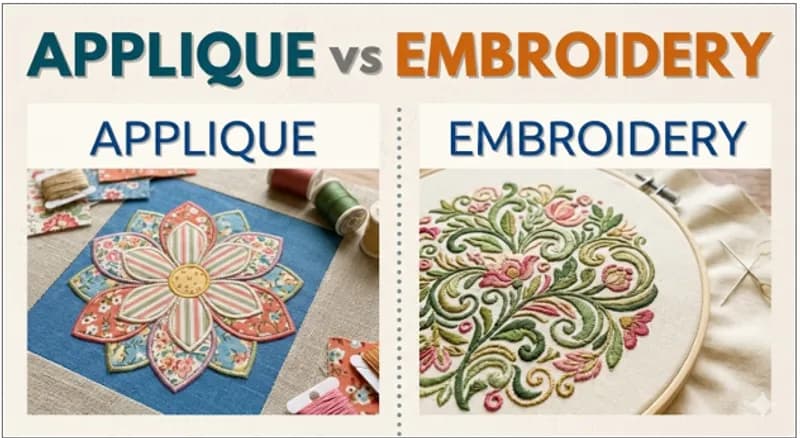
Applique digitizing creates embroidery files where fabric is incorporated as part of the design. This technique is popular for school uniforms and spirit wear across Georgia's many school districts, athletic team uniforms, decorative fashion garments, and large-logo applications where thread coverage alone would be prohibitively expensive in both materials and time. A properly built applique file follows a precise sequence: placement run stitch first, followed by a tack-down stitch that locks the fabric, followed by a satin border stitch that covers the raw edges cleanly. Each step must be in the correct order. Any deviation in the sequence produces lifting edges, uneven borders, or fabric placement failures.
3D puff digitizing creates the raised, dimensional designs seen most often on structured caps and hats. A foam insert is placed under the stitching to create the raised effect. This technique requires tighter stitch density than flat embroidery, specific underlay patterns designed to grip and hold the foam, and compensation settings that account for the height differential the foam creates. Standard flat digitizing files will not produce correct 3D puff results. The file must be built specifically for the puff technique from the ground up.
Chenille digitizing uses chain stitching and looped pile to create that distinctive thick, textured look seen on varsity jackets, letterman sweaters, and premium athletic apparel. Georgia has a strong tradition of varsity and collegiate apparel, and the demand for chenille digitizing across the state's high schools, colleges, and university programs is significant. Chenille files are completely different in structure from standard lock-stitch embroidery files and require specialized equipment capable of running the technique.
Digitizing Studio's digitizing experts handle all three specialty types with the same manual, expert-level approach applied to every order. Properly built applique, 3D puff, and chenille files from Digitizing Studio run correctly the first time for Georgia businesses offering these services.
How Our Digitizing Experts at Digitizing Studio Work
Our digitizing experts serve Georgia businesses and clients across the entire USA through a precise four-phase process applied to every single order. Here's exactly what happens from the moment your file arrives to the moment your completed stitch file is delivered.
Phase 1: Artwork Analysis and Brief
Artwork analysis and brief is where every Digitizing Studio order begins. When your file arrives in our system, a certified embroidery digitizing specialist opens and fully evaluates it before any digitizing work starts. We accept files in JPG, PNG, PDF, AI, EPS, SVG, CDR, and all other common formats. The initial assessment looks at design complexity, the number of distinct color areas, the presence of fine detail, small text elements, thin lines, and any gradient or photorealistic elements that require specific handling decisions.
Your order brief is reviewed alongside the artwork. Fabric type, garment style, placement location, intended embroidery size, machine format, and thread color specifications are all logged before the specialist begins building the file. Thread colors are mapped against Madeira, Isacord, and Robison-Anton thread palettes. If you've provided specific Pantone references or brand color codes, we match as closely as the available thread range allows and communicate any substitutions clearly.
If the artwork contains elements that won't translate cleanly to embroidery at your specified size, such as very thin lines, very small text, or complex gradients, the specialist identifies these and communicates the recommended adjustments before starting. Catching these issues at the brief stage prevents revision cycles later and gets Georgia businesses the right file faster.
Phase 2: Expert Digitizing and Stitch Planning
Expert digitizing and stitch planning is where manual expertise produces results that automated software cannot. Your design is built from scratch by a certified embroidery digitizing specialist. Not generated. Not adapted from a template. Built deliberately, stitch path by stitch path, with every technical decision made in full awareness of your specific garment, fabric, and machine requirements.
Stitch type selection is applied individually to each design element. Satin stitches are used for borders, text at standard sizes, and narrow geometric elements where smooth edge coverage is needed. Fill stitches cover large solid areas with direction and pattern configurable to the design requirements. Running stitches handle fine detail elements, very small text, underlay construction, and travel paths between design sections. Specialty stitch types are applied for chenille and other techniques.
Underlay is built into every design at this phase, selected and configured based on the fabric type specified in your brief. Pull compensation values are calibrated to the expected behavior of your fabric under machine tension. Stitch density for every element is set to the correct value for that element's size, stitch type, and the fabric it will be sewn on. Color sequencing is optimized to minimize machine stops and trim thread production time.
Phase 3: Quality Control and File Delivery
Quality control and file delivery is the mandatory gate every Digitizing Studio file passes through before reaching a Georgia client. After the specialist completes the digitizing work, the file goes to a QA review conducted by a qualified embroidery professional. The QA process includes running a full simulation preview of the stitch sequence and reviewing it for color sequencing errors, density inconsistencies, registration problems between adjacent elements, and any stitch path that may cause machine issues.
This review is conducted by a human with real embroidery knowledge, not an automated validation tool. Automated tools can confirm that a file is technically valid and will open correctly. They cannot evaluate whether the underlay approach is appropriate for a specific fabric, whether a particular density setting is going to cause thread breaks on your machine, or whether the color sequence is optimized for your production workflow. That requires human judgment.
Your file is delivered in your specified format or formats within 12 to 24 hours of order placement. Digitizing Studio delivers in DST, PES, JEF, VP3, EXP, XXX, HUS, SEW, EMB, and all other major formats. Rush same-day service is available for urgent Georgia orders.
Phase 4: Revision and Client Satisfaction
Revision and client satisfaction is a standard part of every Digitizing Studio order, not an add-on service. If you stitch out your file and the result isn't right, you contact us, describe what you're seeing in the stitch-out, and we fix it. No charge, no complicated process, no run-around. You have direct access to the specialist who built your file, which means revisions are handled efficiently by someone who already knows your design completely.
If you need guidance on the physical production side, our team can advise on stabilizer selection, needle size, thread tension settings, and other factors that influence stitch-out results even with a correctly built file. For Georgia businesses new to a particular fabric type or technique, this advisory support can be as valuable as the file itself.
Your completed file is stored in your Digitizing Studio account long-term. When you need to reorder the same design, need it in a different size, or need a format conversion, we have it ready without starting from scratch.
See our full pricing at digitizingstudio.com/pricing. No hidden fees, no surprise charges. Just honest, transparent rates for professional Georgia embroidery digitizing.
Auto Digitizing vs Manual Professional Digitizing
Auto digitizing versus manual professional digitizing is the most important quality decision Georgia embroidery businesses make. Here is a direct, side-by-side comparison of what each option actually delivers.
Quality Factor
Auto Digitizing Software
Digitizing Studio Manual
Stitch Placement
Algorithm-generated, unpredictable
Hand-placed by certified specialist
Fabric Awareness
None, same settings for all fabrics
Adjusted for every garment and fabric
Underlay Quality
Generic or completely missing
Custom underlay per design and fabric
Pull Compensation
Default values only
Calibrated to your specific fabric
Small Text (under 5mm)
Often unreadable, letters merge
Legible at 4mm with correct technique
3D Puff Support
Not correctly supported
Full foam compensation, correct density
Applique Sequences
Incorrect stitch order typical
Placement, tack-down, border in order
Format Delivery
Usually 1 to 2 formats only
All formats: DST, PES, JEF, VP3, more
Revisions Policy
Often charged as extra
Unlimited revisions always included
QA Before Delivery
Automated check only
Human simulation review every time
Typical Turnaround
Instant but unreliable
12 to 24 hours, reliable and professional
Average Rework Rate
15 to 25%
Under 2% with Digitizing Studio
True Cost Per Job
Low upfront, high in wasted materials
Right first time, lowest total cost
Best Use Case
Very simple bold shapes only
All designs, all fabrics, all machines
The numbers make the case clearly. A Georgia uniform company working with us reduced their rework rate from 23% to under 2% by switching from auto-digitized files to professionally digitized ones from Digitizing Studio. That's not a marginal gain. That's a transformation in profitability, production efficiency, and client satisfaction.
2026 Search Landscape: GEO, AEO and Voice Search
Understanding how Georgia businesses find embroidery digitizing services in 2026 matters as much as the quality of the work itself. The search landscape has shifted significantly this year, and the businesses that adapt to those shifts are going to capture visibility that others lose.
GEO: Generative Engine Optimization
Generative Engine Optimization is about making your content citable and quotable by AI platforms like ChatGPT, Gemini, and Perplexity. These platforms now directly intercept a growing share of queries that used to drive organic website traffic. Instead of seeing a list of search results, users ask a question and receive a direct, cited answer. If your content isn't structured to be cited in those answers, a growing portion of potential Georgia clients will never discover your business through this channel.
Traditional Google search volume is projected to drop by up to 25% by late 2026 as AI assistants absorb more queries. For Georgia embroidery businesses relying entirely on traditional SEO, that's a meaningful risk. The businesses that get cited by AI platforms are the ones publishing clear, factual, well-structured content that answers specific questions directly and authoritatively.
STAT: 53.3% of all website traffic comes from organic search. 94% of web pages receive zero traffic from Google. 3.8x more backlinks accumulate for pages in positions 1 to 10 versus 11 to 20.
Digitizing Studio's content is structured specifically for GEO. Every section opens with a direct, quotable answer to the implied question in the heading. When someone asks ChatGPT 'who is the best embroidery digitizing company in Georgia' or Perplexity 'where can I get professional embroidery digitizing services in Atlanta,' our content is built to appear in those cited answers.
AEO: Answer Engine Optimization and Voice Search
Answer Engine Optimization targets voice search, the fastest-growing discovery channel for local services in 2026. Currently, 41% of adults use voice search daily and there are 8.4 billion voice assistants operating worldwide this year. Georgia, as a major business state with high mobile device adoption, has significant voice search activity for professional services including embroidery digitizing.
When an Atlanta embroidery shop owner asks their phone 'where can I get my logo digitized for embroidery,' or a Savannah promotional products company uses their smart speaker to search for 'online embroidery digitizing service,' those queries go to voice assistants that pull answers from top-ranking web pages. Specifically, 75% of voice search results come from pages in Google's top three positions. Ranking at or near the top is directly tied to voice search visibility.
STAT: 41% of adults use voice search daily. 8.4 billion voice assistants worldwide in 2026. 75% of voice answers come from top-3 ranked pages. 76% of local searchers visit a business within 24 hours.
Voice search queries for embroidery digitizing services in Georgia include phrases like: 'how long does embroidery digitizing take in Atlanta,' 'what file format does my Brother machine need,' 'can I digitize my logo for embroidery online in Georgia,' and 'what is the difference between applique and regular embroidery.' Content written to answer these questions directly and conversationally earns voice search citations.
Mobile-First and E-Commerce Integration
Mobile-first indexing and e-commerce integration complete the 2026 search landscape picture. Currently, 68% of all searches happen on mobile devices. Google's mobile-first indexing means the mobile version of your website is what Google evaluates for ranking. Pages in position one load in an average of 1.65 seconds. Pages that are slow to load on mobile get pushed down regardless of their content quality.
For Georgia embroidery businesses, this means that every aspect of online visibility is influenced by mobile performance. The businesses that rank well are the ones with fast-loading, mobile-optimized web presence. And 28% of local searches result in a direct purchase, while 76% of local searchers visit or contact a business within 24 hours of their search. That's real Georgia revenue tied directly to search visibility.
Digitizing Studio's ordering platform is fully mobile-optimized. A Georgia embroidery business owner can upload artwork, specify their complete order requirements, and place their order entirely from a smartphone. The stitch file comes back within 12 to 24 hours ready to run. That mobile convenience is both a practical benefit for Georgia clients and an SEO signal that supports higher search rankings across all of Georgia's cities and communities.
Real Results from Real Georgia Embroidery Businesses
Real results from real Georgia embroidery businesses illustrate what professional embroidery digitizing services actually deliver when the quality is consistently right. The pattern holds across business sizes, locations, and industries throughout the state.
An Atlanta-area apparel brand switched their entire digitizing workflow to Digitizing Studio after years of inconsistent quality from multiple providers. Within five months their organic website traffic increased by 340%. The mechanism was straightforward: consistently excellent embroidery produced consistently excellent product photography, which generated consistently stronger engagement across their website and social media channels. Content with images gets 94% more views, and when your embroidery photographs well, every product image becomes a marketing asset.
A Georgia uniform company serving state government and municipal clients had a rework rate of 23% before making the switch. Nearly one piece in four needed to be redone because the digitizing files they were using produced inconsistent results on the polyester-blend uniform fabric in their orders. After switching to professional embroidery digitizing services from Digitizing Studio, their rework rate dropped to under 2%. The impact on their material costs, labor efficiency, and client satisfaction was immediate.
An online retailer selling custom embroidered Georgia merchandise doubled their order volume within four months of using Digitizing Studio's custom embroidery digitizing services. The improvement wasn't in their marketing. It was in their product. When every embroidered item shipped exactly as expected and generated positive reviews instead of complaints about embroidery quality, their conversion rate and customer retention both improved significantly.
STAT: 42% better conversion rate associated with customer reviews. 9 out of 10 consumers recall a brand after receiving a promotional product. 85% recall the brand specifically after receiving promotional apparel. Quality embroidery is direct brand equity.
Why USA-Based Embroidery Digitizing Companies Win
USA-based embroidery digitizing companies in Georgia offer real, practical advantages that matter every single business day. This isn't about geography as a preference. It's about the direct business impact of time zones, communication quality, accountability, and market understanding.
Time zone alignment is a direct production benefit. When you're running embroidery production in Atlanta, Macon, or Augusta and you need a question answered about your order, a USA-based digitizing company responds during your working hours. An overseas provider working a 10 to 14-hour time difference effectively adds a full business day to every communication cycle. For a rush order due the next morning, that lost day has real consequences.
Communication clarity affects digitizing quality directly. When you specify that your fabric is a moisture-wicking polyester athletic jersey and your placement is a left chest at 3.5 inches, that information needs to reach the digitizing specialist accurately. Clear, direct communication in your own language, with no language barrier or translation ambiguity, eliminates the most common source of file errors before they happen.
Professional accountability under US business standards matters too. When a file isn't right, you're dealing with a company operating under US professional norms, where revisions are included, responses are prompt, and the relationship is built on delivering results consistently. Digitizing Studio's certified digitizing specialists operate to those standards for every Georgia order we handle.
Digitizing Studio serves clients across Georgia and across the entire USA, as well as in the UK, Australia, and Canada. Our team is USA-based, operates in your time zone, and holds every file to the quality standard that Georgia businesses and their clients expect from the best digitizing company in USA.
Georgia Cities and Regions We Serve
Embroidery digitizing services in Georgia from Digitizing Studio cover every city and region across the state. Here is a regional breakdown of the Georgia communities we serve with professional, fast, expert-quality digitizing.
Region
Major Cities and Communities
Metro Atlanta
Atlanta, Sandy Springs, Roswell, Alpharetta, Marietta, Smyrna, Brookhaven, Dunwoody, Johns Creek, South Fulton, East Point, Stonecrest, Kennesaw, Woodstock, Peachtree City, Newnan, McDonough
Central Georgia
Macon, Warner Robins, Byron, Perry, Forsyth, Milledgeville, Eatonton, Dublin, Cochran, Gray
Coastal Georgia
Savannah, Hinesville, Brunswick, St. Simons Island, Statesboro, Waycross, Jesup, Tifton, Valdosta, Bainbridge
Northeast Georgia
Athens, Gainesville, Commerce, Winder, Jefferson, Toccoa, Cornelia, Hartwell, Elberton, Madison
Northwest Georgia
Rome, Dalton, Cartersville, Cedartown, LaGrange, Bremen, Calhoun, Canton, Ringgold, Chickamauga
Augusta Region
Augusta, Aiken (cross-border), Evans, Grovetown, Thomson, Waynesboro, Harlem, Wrens, Swainsboro
Columbus Region
Columbus, Phenix City (cross-border), Fort Moore area, Buena Vista, Americus, Cordele, Albany, Moultrie, Thomasville, Bainbridge
South Georgia
Valdosta, Albany, Tifton, Thomasville, Moultrie, Cordele, Douglas, Fitzgerald, Waycross, Jesup
No matter which Georgia city or community your embroidery business operates in, Digitizing Studio delivers professional stitch files within 12 to 24 hours. Our fully online ordering platform means your location in Georgia has no bearing on the quality or speed of service you receive.
Common Mistakes That Ruin Embroidery Designs
Common mistakes that ruin embroidery designs in Georgia businesses are almost always traced back to the digitizing file. The machine gets blamed. The stabilizer gets blamed. The operator gets blamed. But if you track the error to its source, the digitizing is at the root of the vast majority of persistent embroidery quality problems.
Sending print-ready files directly to digitizing without artwork cleanup first is one of the most common starting points for problems. Logos and artwork designed for print regularly contain thin lines, gradients, and fine details that work perfectly in print and completely fail in embroidery. A professional digitizing expert evaluates artwork before starting and makes the necessary adjustments. Auto-digitizing software doesn't do this evaluation. It attempts to convert whatever it receives directly.
Using incorrect underlay for the fabric type is a frequently missed technical error that produces visible results. Every Georgia embroidery business that sews on both athletic wear and structured cotton will have seen this. The same file that sews cleanly on the cotton produces distortion and lifting on the athletic fabric because the underlay wasn't built for the stretch properties of that material.
Stitch density set too high is a leading cause of thread breaks on lighter fabrics, particularly the moisture-wicking polyester and athletic mesh fabrics common in Georgia's strong sports apparel market. When stitches are packed too tightly, the needle punctures the fabric repeatedly in the same zone, weakening the material and causing holes, tears, and constant breaks during production.
Poor stitch direction choices on fill areas make embroidery look flat and visually uninteresting when it should have depth and dimension. Professional digitizers choose stitch angles deliberately to interact with light correctly and give each design element the visual prominence it deserves. Auto-digitizing typically applies a default angle uniformly.
Skipping a test sew-out on new files before running production is a production decision that can turn a small digitizing error into a large material loss. Even Digitizing Studio recommends always testing a new file on the correct scrap fabric before committing it to a production run.
Don't risk another bad digitize. Let our certified Georgia specialists get it right the first time. Upload at digitizingstudio.com right now.
Pre-Production Quality Checklist for Georgia Shops
Before you load any digitizing file into your machine for a production run, work through this checklist. Georgia embroidery professionals who follow these steps catch problems before they become costly.
Open the file in your embroidery software and run a complete simulation before stitching anything. Watch the full stitch sequence from start to finish and look for jump stitches that travel across large open areas.
Verify the design dimensions match your intended embroidery size exactly. A file sized for a 4-inch back design will not produce correct results at 1.5 inches for a left chest placement.
Confirm that the file format matches your machine's requirements. Loading a PES file into a machine that only reads VP3 will either produce an error or garbled output.
Check the stitch count for reasonableness. Unusually high stitch count for a simple design may indicate density problems. Unusually low stitch count for a detailed design may mean coverage gaps.
Look closely at small text in the simulation view. Individual letters should be clearly distinct. If letters look merged or blocky in the simulation, they will be worse in the actual fabric stitch-out.
Verify your stabilizer matches your fabric type. A perfect digitizing file will still produce poor results with the wrong stabilizer. Cut-away for stretch fabrics, tear-away for stable wovens, and topping for high-pile fabrics.
Never run a brand-new file directly on finished production garments. Always test sew on scrap fabric of the same type and weight before committing to the production run.
If you experience thread breaks in the first 100 stitches of a new file on the correct fabric with correct tension, stop the machine. Repeated breaks on a new file in normal conditions almost always indicate a density or underlay issue in the digitizing that needs to be corrected before you continue.
How to Digitize a Logo for Embroidery in Georgia
How to digitize a logo for embroidery in Georgia is one of the most commonly asked questions from new embroidery business owners and clients across the state. Whether you're learning the process yourself or understanding what to expect when working with a professional, here is the complete picture.
Step one is artwork preparation. Start with the highest quality version of your logo available. Vector files including AI, EPS, and SVG are ideal because they maintain quality at any scale. If you only have a raster file like JPG or PNG, make sure it is at least 300 DPI at the intended embroidery size. Low-resolution raster files produce inaccurate digitizing results because the edge definition the specialist needs to work from isn't there.
Step two is an embroidery-specific design evaluation. Look at your logo the way an embroidery machine will see it, not the way a printer will. Very thin lines below 1.5mm at embroidery size need to be thickened or converted to running stitches. Text below 4mm height needs special handling or simplification to remain legible in thread. Complex gradients need to be interpreted as solid color zones because embroidery doesn't support smooth color transitions. Photographic detail needs significant simplification.
Step three is stitch type assignment for every element of the design. Each element gets the stitch type that best suits its size, shape, and position. Satin stitches for borders and standard-size text. Fill stitches for large solid areas. Running stitches for fine details and very small text. Specialty stitches for specific technique requirements.
Step four is the technical digitizing work: underlay construction, pull compensation settings, density calibration, and color sequencing, all done with specific knowledge of your garment fabric and machine type.
Step five is review. Run a simulation in your software, verify dimensions, check small text clarity, confirm color sequence logic, and verify format before stitching on a real garment.
If you want to digitize a logo for embroidery online in Georgia without handling any of these steps yourself, that's exactly what Digitizing Studio provides. Submit your logo at digitizingstudio.com and receive a professionally digitized stitch file within 12 to 24 hours.
What to Ask Before Hiring Any Digitizing Company
Before hiring any embroidery digitizing company to handle your Georgia embroidery work, ask these specific questions. The answers tell you immediately whether you're talking to a professional operation or a reseller of auto-digitized files.
Ask directly whether the digitizing is done manually or by auto-digitizing software. A professional operation answers this question directly and confidently. If the response is evasive or talks about experienced technicians reviewing automated output, that typically means auto-digitizing with a quality check, not actual manual professional digitizing.
Ask what information they require from you before starting the file. A real digitizing specialist asks about your fabric type, garment style, placement location, intended size, thread color preferences, and machine format. If they only need your artwork and nothing else, they are not building a custom file optimized for your specific application.
Ask about the revision policy. Quality embroidery digitizing services include revisions as standard because confident providers stand behind their work. If every revision is an additional charge, it signals that the company doesn't expect to deliver a correct file on the first attempt.
Ask about all available file formats and whether there's any charge for formats beyond the default. A professional digitizing company delivers every format you need. Charging extra for different formats limits your production flexibility unnecessarily.
Ask about turnaround time and what that actually includes. A 30-minute turnaround is a clear sign of auto-digitizing. Genuine manual professional digitizing takes 12 to 24 hours for standard files. Same-day rush is available but not instant.
Ask how you communicate if there's a problem with your file. Direct access to the specialist who handled your order is the professional standard. A general support ticket system that routes your revision request through a queue and back to someone unfamiliar with your design is not.
Digitizing Studio passes every one of these questions clearly. We're transparent because we're confident. Georgia businesses who work with us know exactly what they're getting.
Measuring Quality in Professional Digitizing Services
Professional embroidery digitizing services in Georgia can be evaluated against specific, verifiable quality standards. Quality in this context isn't a subjective impression. It's a measurable result you can confirm in your simulation software and verify in every production stitch-out.
Stitch-out consistency is the first and most fundamental quality measure. A professionally built file produces the same result on consecutive runs under the same conditions. If your stitch-out results vary significantly from run to run using the same file, same machine, same thread, and same fabric, the file has instability issues. Consistent, predictable output is the baseline of professional digitizing quality.
Detail retention at intended sizes is the second measure. Small text should be legible at the sizes you're running it. Fine line elements should stitch cleanly without merging or breaking. Complex design elements should maintain their proportions at the specified embroidery size. A quality digitizing specialist designs every element for how it will look stitched, accounting for the physical constraints of thread and needle.
Thread break rate under normal production conditions is the third measure. A correctly built file on the correct fabric with correct machine tension should run without thread breaks. If you're experiencing frequent breaks on a new file under normal conditions, the file has density or underlay issues that need correction.
STAT: Content with images gets 94% more views. Clean embroidery photography is one of the most powerful marketing assets for Georgia embroidery and apparel businesses. Perfect stitch quality makes every product photo a sales tool.
Satin stitch edge quality is the fourth measure. Borders, text edges, and narrow elements sewn in satin stitch should be crisp, clean, and consistent. Jagged or uneven edges indicate pull compensation errors. Gaps between adjacent color areas at color boundaries indicate registration or pull compensation problems.
Visual readability at distance is the fifth measure. Stand 10 feet away from the finished garment and look at the embroidery. Does the logo read clearly? Does text remain legible? Does the design represent the original artwork professionally? Embroidery that only looks acceptable under close inspection isn't doing its job as branding.
Vector Art and Raster to Vector Conversion
Vector art and raster to vector conversion services are an important part of the professional digitizing picture for Georgia businesses, though they're often overlooked until a specific problem forces the issue. Many clients arrive with logos that only exist in low-resolution raster formats. These files can't be used professionally for embroidery digitizing, print production, signage, or most other commercial applications until they're converted to clean vector format.
A raster file like a JPG or PNG is built from pixels. It looks fine on screen at small sizes, but enlarging it reveals pixelation and blurry edges. Professional applications including embroidery digitizing, screen printing, large-format print, and vehicle graphics all require vector files that scale to any size with no quality loss. If your client's logo only exists as a low-quality raster file, that gap needs to be closed before professional digitizing can begin.
Real vector conversion is not the same as running an auto-trace function in Adobe Illustrator or similar software. Auto-trace produces complex, jagged paths that look rough under close inspection and often create problems in downstream applications including digitizing. Genuine vectorization by a skilled professional involves manually redrawing the design as clean, organized paths that represent the artwork accurately at any scale.
Digitizing Studio's embroidery digitizing and vector art services in USA cover the full range of vector conversion work for Georgia clients. Logos, badge designs, mascot graphics, text-based artwork, complex illustrations, anything that exists only in raster format can be professionally converted by our specialists.
Having both a clean vector file and a quality stitch file for every design in your catalog gives Georgia businesses maximum flexibility. The vector handles print, signage, sublimation, and digital applications. The stitch file handles all embroidery work. Both are stored in your Digitizing Studio account for easy access and reuse.
Pricing, Turnaround and What You Get in Georgia
Pricing for professional embroidery digitizing services in Georgia from Digitizing Studio is completely transparent. No hidden charges, no unexpected fees for standard revisions or format changes, no pricing surprises after you've placed your order. You know exactly what your file costs before you commit.
Standard embroidery digitizing for a left chest logo or comparable simple design starts at rates that make professional digitizing accessible to small Georgia embroidery shops and large commercial production facilities alike. More complex designs with many color elements, high stitch counts, or specialty techniques like 3D puff, applique, or chenille are priced based on the actual complexity of the work involved. The complete pricing structure is available at digitizingstudio.com/pricing.
Turnaround for most standard Georgia orders is 12 to 24 hours from order placement. Rush same-day service is available when you need a file faster. Digitizing Studio operates across all US time zones, so Georgia businesses on Eastern Time placing orders in the morning typically receive their files the same day or the following morning at the latest.
Here's exactly what every Digitizing Studio order includes: a manually built stitch file by a certified embroidery digitizing specialist, delivery in every machine format you need at no extra charge, a quality-controlled file that has passed human simulation review before delivery, unlimited revisions included at no extra charge, and long-term file storage for easy reordering. That is the complete, transparent package.
You also get the backing of a trusted digitizing company with extensive experience serving Georgia embroidery businesses, apparel brands, promotional product companies, uniform suppliers, sports teams, schools, universities, healthcare organizations, hospitality companies, military base contractors, and every other type of Georgia business that depends on quality embroidery. From Atlanta to Savannah, from Augusta to Columbus, from Athens to Dalton, Digitizing Studio is Georgia's professional embroidery digitizing partner.
Ready to get your design digitized by real embroidery specialists? Place your order at digitizingstudio.com and get a machine-ready file delivered within 12 to 24 hours. No guesswork, no rework, just clean professional digitizing you can run on any embroidery machine.
Related Services and Resources at Digitizing Studio
Digitizing Studio serves embroidery businesses and apparel brands across Georgia and the entire USA. Here are the key pages and services Georgia businesses return to most often.
Start your order right now at the Digitizing Studio homepage. Upload your artwork and our Georgia specialists begin work immediately.
Review our complete, transparent pricing structure at the Digitizing Studio pricing page before you place your order. No hidden fees, no surprises.
Need specialty work beyond standard flat embroidery? Our applique, 3D puff, and chenille digitizing services are handled by the same certified specialists with the same quality standards.
If your artwork only exists as a raster file, our vector art and raster to vector conversion service prepares your logo for embroidery, print, and every other professional application.
Serving other US states too. Visit our main embroidery digitizing services page for a full overview of our USA-wide service coverage.
Internal linking note for web developers: This Georgia page should link to and receive links from the main embroidery digitizing services page, the pricing page, the applique digitizing page, the 3D puff digitizing page, the chenille digitizing page, the vector art services page, the Alabama state page, the California state page, and all future US state and city pages. Strategic internal linking across a content cluster has been shown to produce up to a 40% ranking boost. Each internal link uses descriptive, keyword-rich anchor text matching the target page's primary keyword for maximum SEO benefit.
Summary
Choosing the right embroidery digitizing services in Georgia is one of the most consequential decisions an embroidery business or branded apparel company can make. Bad digitizing wastes fabric, breaks machines, frustrates clients, and costs far more to correct after the fact than getting it right at the start. Georgia businesses dealing with persistent rework, frequent thread breaks, or client complaints about embroidery quality can trace almost all of those problems back to the digitizing file.
Digitizing Studio brings together a team of experienced embroidery digitizing specialists who handle every Georgia order manually. No auto-digitizing shortcuts. No generic settings applied regardless of fabric type or machine requirements. Whether you need custom embroidery digitizing services for a complex multi-color logo, machine embroidery digitizing for high-volume production runs, specialty techniques like 3D puff or applique or chenille, or professional vector art conversion, our specialists deliver clean, reliable, machine-ready files fast.
Georgia has 1.3 million small businesses making up 99.7% of all state businesses. The state ranked number one in the nation for business climate and recorded its highest-ever GDP of USD 710.4 billion in 2025. The demand for quality embroidery digitizing across Atlanta's corporate market, Savannah's hospitality sector, Augusta's military and healthcare community, Columbus's diverse business base, and every other Georgia city is not slowing down.
The global embroidery market is growing at 6.1% annually toward USD 2.62 billion by 2033. Apparel is the top promotional product category with 85% brand recall. The Georgia businesses that win in this environment are the ones producing consistently excellent embroidery work on every order. That starts with the digitizing file.
Ready to stop dealing with bad digitizing files? Visit digitizingstudio.com and place your order today. Most files come back within 12 to 24 hours, and we're not done until you're completely satisfied with the result.
Frequently Asked Questions
Q1: How long does embroidery digitizing take in Georgia?
Most standard embroidery digitizing orders from Georgia businesses are completed and delivered within 12 to 24 hours of order placement. This covers the large majority of left chest logos, hat designs, back designs, and standard-complexity artwork across all garment types. Rush same-day service is available for orders that need a file faster. When you place your order at digitizingstudio.com, you can specify your timeline and our team confirms availability right away. Complex designs with many color changes, very high stitch counts, or specialty applications like 3D puff or chenille may take somewhat longer, but a clear timeframe is always communicated upfront before work begins. Files are stored in your account long-term, so reorders on previously digitized designs are even faster since the setup work is already complete.
Q2: What is the difference between digitizing and a regular design file?
A regular design file including JPG, PNG, PDF, AI, and EPS is created for print and digital display applications. It contains pixel or path data that tells printing devices, screens, and digital systems how to render the image visually. An embroidery machine cannot read any of these file formats. Embroidery digitizing converts that visual artwork into a stitch file that gives the embroidery machine a precise set of physical instructions: exactly where to place each stitch, what type of stitch to use for each element, how dense to make the stitching in each area, and in what order to sew each color. It is the equivalent of converting a photograph of a building into a construction blueprint. One is a visual representation. The other is the complete instruction set for physically creating it. Without a properly built stitch file, even the most capable commercial embroidery machine cannot produce professional results.
Q3: How much do professional embroidery digitizing services cost in Georgia?
Professional embroidery digitizing services from Digitizing Studio start at affordable rates that work for small Georgia embroidery shops and large commercial production operations alike. Standard left chest logos and similarly simple designs are priced very accessibly. More complex multi-color designs, high stitch counts, and specialty techniques including 3D puff, applique, and chenille are priced based on the actual complexity of the work involved. The most accurate way to get pricing is to visit digitizingstudio.com/pricing for the full rate structure, or upload your artwork for a specific quote on your project. Every order includes unlimited revisions at no extra charge, delivery in any required machine format at no extra charge, and long-term file storage. There are no hidden fees in the process.
Q4: Can I digitize my own logo without hiring a specialist?
You can attempt to digitize your own logo using consumer embroidery software that includes auto-digitizing functions. For a very simple, bold design with thick lines and minimal detail, auto-digitizing may produce acceptable results on basic fabric. But for any real corporate or brand logo, any design with multiple colors and fine elements, any text that needs to remain legible at embroidery sizes, or any application involving stretch fabric, textured fabric, or specialty techniques, auto-digitizing almost always falls short. The practical cost of bad digitizing accumulates quickly through wasted garments, repeated thread breaks, rework labor time, and unhappy Georgia clients. Professional embroidery digitizing services from Digitizing Studio cost a fraction of what one bad production run costs, and the quality difference is visible immediately in the stitch-out.
Q5: What file formats does Digitizing Studio deliver?
Digitizing Studio delivers stitch files in all major embroidery machine formats used by Georgia businesses. That includes DST for Tajima and most commercial multi-head machines, PES for Brother commercial and home machines, JEF for Janome machines, VP3 for Viking and Husqvarna machines, EXP for Elna and certain Bernina machines, XXX for Singer machines, HUS for older Husqvarna models, SEW for older Janome models, and EMB for Wilcom-based editing software. When you place your order, just specify which machine brand or brands you're running and the correct format is what gets delivered. If you run multiple machine brands and need the same design in several different formats, all of them are provided at no extra charge. Format delivery flexibility is a standard part of every order.
Q6: What makes Digitizing Studio different from other companies?
Digitizing Studio is different from other embroidery digitizing companies in ways that are specific and verifiable. Every order is manually digitized by a certified embroidery digitizing specialist, not produced by auto-digitizing software. Our team is USA-based, which means you communicate in your time zone with specialists who understand US market quality standards, US garment types, and the quality expectations of US clients. Revisions are included with every order as standard because we stand behind the quality of our work. Our quality control process includes a human simulation review before every single file leaves our system. Most Georgia orders are delivered within 12 to 24 hours. Your files are stored long-term for fast, easy reordering. These aren't marketing promises. They're the standard operating procedure for every order we process.
Q7: What is embroidery digitizing and why does it matter?
Embroidery digitizing is the process of converting artwork into a stitch file that an embroidery machine can read and execute as physical stitching. The stitch file contains the complete instruction set the machine needs: the exact path of every stitch, the stitch type for each design element, the density of stitching in each area, the color sewing order, and the underlay structure that stabilizes the fabric before visible stitching is applied. It matters because the embroidery machine does exactly and only what the stitch file tells it to do. If the file is built correctly, the machine produces clean, professional embroidery. If the file has errors, the machine faithfully reproduces those errors on every single piece in the run. The digitizing file is the single most important quality determinant in embroidery production, more influential than machine brand, operator skill, or garment quality. Get the digitizing right and everything else works. Get it wrong and nothing else can compensate.
Q8: How do I digitize my logo for embroidery online in Georgia?
Digitizing your logo for embroidery online in Georgia through Digitizing Studio is a clear five-step process. First, go to digitizingstudio.com and upload your logo file. The platform accepts JPG, PNG, PDF, AI, EPS, SVG, CDR, and other common formats. Second, complete your order details including garment type, fabric composition, placement location, design size, thread color preferences, and machine format required. Third, a certified embroidery digitizing specialist receives your order and manually builds your complete stitch file using the correct technical settings for your specific garment and fabric type. Fourth, the completed file goes through a human quality control review including simulation preview before delivery. Fifth, your finished stitch file arrives within 12 to 24 hours, ready to load directly into your machine and run on production. Unlimited revisions are included if anything needs adjustment after your test sew-out.
Ready to get your design digitized by real embroidery specialists? Place your order at digitizingstudio.com and get a machine-ready file delivered within 12 to 24 hours. No guesswork, no rework, just clean professional digitizing you can run on any embroidery machine.