Applique vs Embroidery Which Is Right for You
If you've ever gotten a quote for an embroidered logo and been surprised by the price difference between two options that look similar, the answer is almost always sitting in the choice between applique vs embroidery. And if you've ever wondered why one design on a jacket looks dimensional and fabric-like while another looks flat and stitched, that's the same comparison playing out in the finished result.
Applique vs embroidery is genuinely one of the most important decisions in decorative textile production, whether you're a hobbyist choosing how to recreate a design at home or a business ordering decorated uniforms for a team. Get the choice right and you get better results faster at lower cost. Get it wrong and you spend more than you needed to for a result that might not even look as good.
This guide is going to explain the actual difference between these two techniques, what each one does well, what each one does poorly, and how to decide which is right for your specific project. We'll cover stitch counts, run time, visual quality, durability, fabric limitations, and the scenarios where each approach is clearly the better choice.
Digitizing Studio produces files for both techniques. If you want a professional recommendation on which approach suits your specific design before you commit, that's exactly the kind of conversation we have with customers every day.
What Is the Actual Difference Between Applique and Embroidery
The terms get used interchangeably in casual conversation, which creates confusion. Here's the technical distinction.
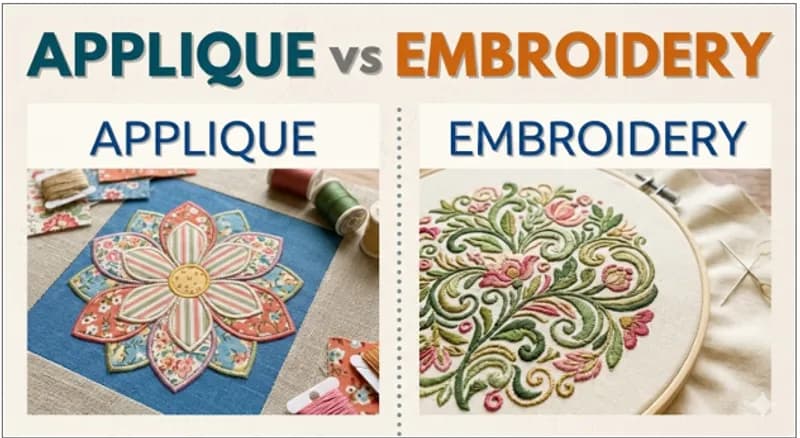
Standard embroidery (also called fill embroidery or stitch fill) creates designs by covering area entirely with thread. Every colour you see in the finished design is thread. The machine stitches back and forth across the design area until the thread completely fills the shape. This is sometimes called satin stitch (for narrow shapes) or tatami or fill stitch (for larger areas).
Applique vs embroidery in the technical sense means applique uses actual fabric pieces to fill design areas, with thread used only for the border and anchor stitching. You place a piece of fabric over the design area and the machine stitches it down and finishes the edge. The colour and texture you see in the finished design is fabric, not thread.
Both techniques produce embroidered results. Both use an embroidery machine. Both require digitizing files. The difference is in how large areas of colour are created. Thread vs fabric. That single difference has significant implications for stitch count, run time, cost, visual quality, and appropriate use cases.
Stitch Count and Run Time
This is where the practical difference between applique vs embroidery becomes most obvious for anyone producing work commercially.
A standard fill embroidery design for a logo covering a 10cm x 10cm area typically uses 15,000 to 25,000 stitches. A complex multi-colour design covering the same area might use 30,000 to 50,000 stitches or more. At a typical home machine speed of around 800 SPM (stitches per minute), a 25,000 stitch design takes roughly 31 minutes.
The same design done as applique uses fabric to fill the coloured areas and thread only for the placement stitch, tack-down, and satin border. Total stitch count for a 10cm x 10cm applique design might be 8,000 to 14,000 stitches. At 800 SPM, that's 10 to 17 minutes. For a commercial multi-needle machine running at 1,200 SPM, the time difference is even more pronounced.
Over a production run of 100 uniform shirts, that run time difference (roughly 15 minutes per piece) adds up to 25 hours of machine time saved. On a production embroidery setup where machine time is money, that's a significant cost difference that has nothing to do with thread cost.
Thread Usage and Material Costs
Thread costs are often overlooked in the applique vs embroidery comparison but they add up considerably for large or colourful designs.
A fill embroidery design uses thread to cover every square millimetre of the design area. For a large multi-colour logo, the thread cost per piece can be meaningful, especially on commercial production where thread costs are tracked precisely.
Applique uses fabric to cover those areas instead. The thread is used only for the border work. For a design with large solid colour areas (a company logo background, a team jersey number, a solid-colour star or shape), the thread savings from going applique vs embroidery standard fill can be 40 to 70 percent.
Against that, applique requires purchasing the applique fabric itself. For most standard cotton applique fabric, the cost per design is relatively low. For specialty fabrics like silk, metallic fabric, or HTV, the fabric cost is higher. Whether the fabric cost exceeds the thread savings depends on the specific design and materials involved.
For most large-format designs, applique is the lower material cost option by a meaningful margin.
Visual Quality and Appearance
This is where the applique vs embroidery choice gets genuinely subjective because different results aren't necessarily better or worse, they're different aesthetically.
Standard fill embroidery gives a consistently textured surface. Every part of the design looks like stitching because it is. The texture is uniform, the colour is consistent across the design area, and fine details can be reproduced very precisely using thin satin stitch or varying stitch directions to create shading effects. For photorealistic designs, portraits, detailed illustrations, and designs where subtle colour graduation matters, fill embroidery can produce results that applique simply can't match.
Applique gives a different visual quality entirely. The design area looks like fabric, because it is fabric. You get the texture, sheen, and visual character of whatever material you've chosen. A silk applique has the luminosity of silk. A denim applique has the casual texture of denim. A glitter HTV applique catches light in a way thread never can. For designs where you want a bold, dimensional, fabric-quality visual result, applique vs embroidery fill produces a more striking outcome.
Applique also has a clear advantage at larger sizes. Fill embroidery on large designs can look flat or visually heavy because the dense thread fill doesn't have the same visual lightness as fabric. A 20cm logo done as applique looks proportionally appropriate on a jacket back. The same logo done as fill embroidery can look overwhelming and stiff.
At smaller sizes, fill embroidery often has the advantage. For design elements under about 3cm, the tack-down and satin border of applique take up a proportionally large amount of the design area and fine details within the applique shape become difficult to read. Embroidery fill handles small detailed text, thin lines, and intricate design elements far better than applique.
Dimensional Quality
One of the aesthetic advantages of applique vs embroidery that's harder to describe without seeing it is dimensionality. Applique sits slightly raised from the base fabric because there's a layer of fabric between the base and the surface stitching. This creates a subtle three-dimensional quality that makes the design look like it's sitting on the garment rather than just being printed or stitched onto it.
Fill embroidery is essentially flat, sitting only as high as the thread layers above the base fabric. Very dense fill can have some dimensional quality but it's slight compared to applique.
For large bold designs on outerwear, bags, and uniforms where dimensional visual impact matters, this quality of applique vs embroidery standard fill makes a noticeable difference in perceived quality and visual presence.
Durability and Wash Performance
Both techniques are durable when properly digitized and sewn. But there are some durability differences worth knowing in the applique vs embroidery comparison.
Fill embroidery is highly durable because the thread is woven into the base fabric through thousands of penetrations. The design is essentially part of the fabric at the stitch points. Fill embroidery handles repeated washing, high-temperature laundering, and heavy use very well. The main failure mode is thread breaking or pilling on the surface from abrasion, which typically takes many years of heavy use to develop.
Applique is also very durable when the digitizing file is correctly built and the stitching is well executed. The satin border that holds the applique fabric down is the critical point. A well-built satin border with proper underlay stitching and appropriate density won't lift or fray even through hundreds of washes. The failure mode for poorly built applique is edge lifting, where the satin border wasn't dense enough or wide enough to fully anchor the fabric edge, and the applique fabric starts to pull away from the base over time.
For high-wash applications like sports uniforms that go through commercial laundry, both techniques are viable but the digitizing quality matters more for applique. A fill embroidery design with suboptimal digitizing still holds together reasonably well because the thread is woven in so many points. A poorly digitized applique with inadequate satin border can start lifting after 20 to 30 commercial washes.
When to Choose Applique
The choice of applique vs embroidery fill becomes relatively clear once you understand what each technique does well.
Choose applique when the design covers large areas of solid or simple colour. Large backgrounds, solid shapes, wide letters, and broad design elements are all better served by applique. The fabric covers the area visually and the stitch count stays manageable.
Choose applique when you want a bold, dimensional, visually impactful result at larger sizes. Jacket backs, large chest designs, full-size numbers on jerseys, and designs meant to be seen from a distance all benefit from the fabric quality and dimensional character of applique.
Choose applique when run time matters. For production runs of 50 pieces or more where the same design is being reproduced repeatedly, the run time savings of applique vs embroidery fill can be substantial over the course of a production run.
Choose applique when the visual texture of the fabric is part of the design intent. Metallic fabric applique, velvet applique, denim applique, glitter HTV applique. These visual effects simply aren't possible with standard thread fill.
Choose applique when thread cost is a consideration for large-format designs. For very large logos on workwear, the fabric cost of applique is usually significantly lower than the thread cost of equivalent fill embroidery.
When to Choose Fill Embroidery
Standard fill embroidery has clear advantages in the applique vs embroidery comparison for specific design types and requirements.
Choose fill embroidery for small or highly detailed designs. Text at small sizes, fine-line logos, intricate patterns, and designs with elements under 2 to 3cm in any dimension all reproduce more accurately and reliably with fill embroidery. Applique's border stitching at small scales takes up too much of the design area.
Choose fill embroidery when colour accuracy and consistency are critical. Thread is available in hundreds of precisely matched colours and the colour of a fill design is exactly reproducible across any number of pieces. Fabric colour can vary between dye lots even from the same manufacturer.
Choose fill embroidery for photorealistic or illustrated designs with shading, colour graduation, and fine detail. Portrait embroidery, wildlife designs, detailed badges, and anything that requires realistic colour mixing through thread direction and density choices is not achievable with applique.
Choose fill embroidery when the production process doesn't allow for the manual steps that applique requires. Applique needs operator attention at two points during the stitch-out (fabric placement and trimming). On fully automated commercial embroidery setups, this may not be feasible. Fill embroidery runs from start to finish with no manual intervention.
Choose fill embroidery for small logos on polo shirts, caps, and items where the design is a secondary element rather than the visual focus. Small chest logos, cap emblems, and small-scale branded elements typically look better and are easier to produce as fill embroidery.
The Combined Approach
Many professional designs use both applique and fill embroidery in the same design. This is called an applique and embroidery combination design and it's worth knowing about as a third option beyond the pure applique vs embroidery comparison.
A common approach is to use applique for the large colour background areas of a design and fill embroidery for the fine detail, text, and small elements that sit on top. A company logo might have the large background shape and primary colour block as applique fabric with the company name, fine lines, and small graphic elements as fill embroidery stitched over the top after the applique is complete.
This combination approach gives you the visual impact and run time efficiency of applique for the large areas and the precision of fill embroidery for the details. The digitizing for these combined designs is more complex, requiring careful planning of the sequence so fill embroidery elements land correctly on top of the applique fabric.
When ordering custom digitizing for a design that might benefit from a combined approach, tell your digitizer what the design will be used for and what visual effect you're looking for. A good digitizer will recommend whether a pure fill, pure applique, or combined approach produces the best result for your specific design. Digitizing Studio provides this consultation as part of every order at digitizingstudio.com.
Cost Comparison for Commercial Applications
For businesses ordering decorated uniforms and merchandise, the applique vs embroidery cost comparison is worth understanding clearly.
Digitizing cost is similar for both techniques. A professionally digitized applique file and a professionally digitized fill file for the same design typically cost in the same range. Applique digitizing may be slightly higher for complex multi-piece designs because the color stop sequencing is more involved.
Decoration cost per piece is where applique vs embroidery fill diverges. Applique requires more operator time per piece (fabric placement and trimming between stitch stages) but less machine time. Fill embroidery requires no operator intervention mid-run but more machine time. For commercial decorators, applique tends to work out at similar total production cost per piece to fill embroidery for large designs, with the advantage shifting toward applique as design size increases.
For large design areas (over 8cm in any dimension), applique consistently comes out at lower production cost per piece than equivalent fill embroidery when you account for both machine time and thread consumption. For small designs under 5cm, fill embroidery is typically lower cost because the manual steps of applique don't justify the modest stitch count savings.
How Digitizing Affects the Applique vs Embroidery Choice
The quality of the digitizing file matters in both techniques, but the failure modes are different and worth understanding.
A fill embroidery design with suboptimal digitizing typically produces results that look slightly unpolished. Density inconsistencies show as surface texture variations. Underlay problems show as stitches that look raised in the wrong places. These issues affect visual quality but rarely cause structural problems.
An applique design with suboptimal digitizing can cause structural problems in addition to visual ones. A file with the color stop sequence wrong means the machine stitches over where fabric should be. A file with the tack-down stitch type wrong means the fabric lifts before the border runs. A file with border density set incorrectly for the fabric produces puckering or lifting in the finished work.
This is why professionally digitized applique files matter more per-design than professionally digitized fill files. The margin for error is smaller in applique digitizing. For fill embroidery, a decent auto-digitized file is often adequate for simple designs. For applique, human digitizing from a service that builds files around your specific fabric and machine produces noticeably better results.
Digitizing Studio provides professional digitizing for both techniques. If you're unsure which approach is right for your design, describe it to us when ordering and we'll recommend the best approach. Order at digitizingstudio.com.
Summary
Applique vs embroidery is a choice between two different approaches to creating the same visual result: decorated textile. The right choice depends on your design, your production context, and what you want the finished item to look like.
Applique wins for large designs, bold visual impact, dimensional quality, run time efficiency on production runs, and designs where fabric texture is part of the visual intent. Fill embroidery wins for small designs, fine detail, photorealistic work, colour accuracy, and designs that need to run without manual operator steps.
For many commercial designs, the best answer is a combination of both, with applique handling the large areas and fill embroidery handling the detail. Understanding which approach is right for your specific design is something the team at Digitizing Studio handles as part of every order consultation at digitizingstudio.com.
Frequently Asked Questions
Q: Is applique better than embroidery?
A: Neither is universally better. Applique produces better results than fill embroidery for large designs, bold visual impact, and designs where fabric texture matters. Fill embroidery produces better results for small designs, fine detail, and photorealistic work. The right choice depends entirely on your specific design size, detail level, intended use, and production context. Many professional designs use both techniques in the same piece.
Q: Does applique last as long as fill embroidery?
A: Yes, when properly digitized and executed, applique is as durable as fill embroidery. Both handle regular washing, commercial laundering, and heavy use very well. The difference is in the failure mode. Fill embroidery's main failure is surface thread pilling or breaking from abrasion over very long use. Applique's main failure is edge lifting if the satin border wasn't digitized or stitched correctly. With a well-built digitizing file and proper technique, applique holds up for the same lifespan as fill embroidery.
Q: Which is faster, applique or embroidery?
A: Applique is significantly faster in machine run time for large designs. A 10cm logo as applique might take 10 to 15 minutes. The same logo as fill embroidery might take 25 to 35 minutes. However, applique requires two manual operator steps during the stitch-out (fabric placement and trimming) that fill embroidery doesn't need. For single pieces, the total time difference is modest. For production runs of 50 pieces or more, applique's machine time savings become significant even accounting for the operator steps.
Q: Can you do applique and fill embroidery in the same design?
A: Yes, and this is a common professional approach for complex designs. Large solid colour areas are done as applique fabric and fine details, text, and small elements are done as fill embroidery stitched on top of the applique after it's secured. This combination gives you the visual impact and run time efficiency of applique for the large areas and the precision of fill embroidery for details. The digitizing for these combined designs is more complex and benefits from being done by an experienced professional digitizer.
Q: Is applique cheaper than embroidery?
A: For large designs, applique generally costs less to produce per piece than equivalent fill embroidery. The thread savings on large fill designs are substantial, and machine run time (which translates directly to production cost) is shorter for applique. For small designs, fill embroidery is often lower cost because the manual operator steps of applique (placement and trimming) add time that isn't justified by the modest stitch count savings. The digitizing cost for both techniques is broadly similar.
Q: What designs work best for applique?
A: Designs with large areas of solid or simple colour work best for applique. Team logos with broad colour backgrounds, jersey numbers, large letters and monograms, bold graphic shapes, and brand marks with substantial fill areas are all excellent applique candidates. Designs with very fine detail, small text, or complex colour graduation are better suited to fill embroidery. As a general guide, if a design element is larger than 3 to 4cm in any dimension, applique is worth considering. If it's smaller, fill embroidery is usually better.
Q: Does applique look more professional than embroidery?
A: Applique and fill embroidery produce different looks, not better or worse. Applique looks dimensional, fabric-quality, and bold, particularly at larger sizes. Fill embroidery looks precisely stitched, consistently textured, and detailed. Both look highly professional when executed well. For large logos, team designs, and outerwear, applique often looks more impactful. For polo shirt chest logos, caps, and detailed badges, fill embroidery often looks more precisely professional. The perceived quality of either technique is most affected by digitizing file quality and execution rather than the technique choice itself.
Q: How do I choose between applique and embroidery for my logo?
A: Look at your logo and consider three things. First, how large will the design be on the finished garment? Designs over 8 to 10cm in any dimension almost always look better and cost less as applique. Second, how much fine detail does the logo have? If the logo has intricate detail, thin lines, or small text, fill embroidery handles those better. Third, what garment and placement is involved? Large outerwear designs benefit from applique's dimensional quality. Small chest or cap logos typically look better as fill. If you're ordering from Digitizing Studio, describe your logo and its intended use and we'll recommend the right approach.