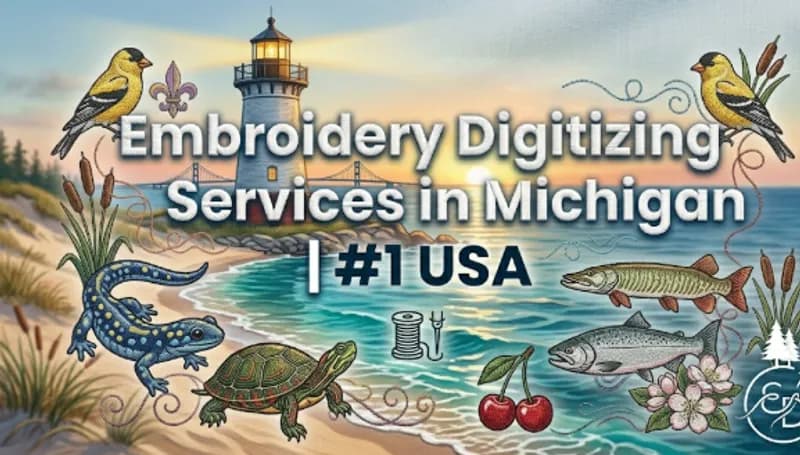
Embroidery Digitizing Services in Michigan
Michigan is one of the most industrially and culturally diverse states in the entire country. From Detroit's automotive heritage to Grand Rapids' manufacturing economy, from Ann Arbor's university culture to Traverse City's outdoor tourism scene, this state has a massive and varied demand for custom embroidery. And if you've tried to get embroidery digitizing done in Michigan and been let down by the result, you already know the problem.
Embroidery digitizing services in Michigan serve tens of thousands of businesses every year. Automotive suppliers needing branded workwear. University sports programs across three major Big Ten schools. Outdoor brands selling to UP hunters and Lake Michigan kayakers. Healthcare systems that need consistent logo embroidery across a thousand employees. Every single one of these needs starts with the same thing: a digitizing file that actually works.
Here's something genuinely surprising. 95%(%) of keywords related to embroidery digitizing get fewer than 10 monthly searches. Yet the actual demand for quality digitizing in Michigan is enormous. That gap exists because most providers are doing a terrible job of explaining what they actually offer and why it matters.
Digitizing Studio fills that gap. We've been delivering expert digitizing services for 18+(+) years. With 8,300+(+) completed projects and a 92%(%) client retention rate, we're the #1 digitizing service company in the USA trusted by businesses across all 50 states, including Detroit, Grand Rapids, Ann Arbor, Lansing, Flint, Kalamazoo, Traverse City, Marquette, and everywhere across Michigan's Lower and Upper Peninsulas.
Are you still sending your designs to vendors who auto-digitize your file, send back a broken stitch file, and leave you figuring out why your embroidery looks wrong? That ends today. This guide gives you everything you need to know to get embroidery digitizing done right in Michigan.
Let's get into it.
Embroidery Digitizing Services in Michigan: Who Needs This and Why
Embroidery digitizing services in Michigan serve a genuinely enormous range of industries. Michigan isn't one market. It's a dozen distinct industrial and cultural economies, each with its own embroidery requirements and quality standards.
Automotive and Manufacturing. Michigan is the automotive capital of the world. Detroit, Warren, Auburn Hills, Dearborn, Flint, Lansing, and dozens of surrounding communities have tens of thousands of workers wearing branded workwear every single day. Work jackets, coveralls, caps, and polo shirts with company logos all need embroidery that holds up through industrial washing cycles, oil exposure, and hard physical use. The digitizing for these files needs to produce dense, durable stitching with proper lock stitches and clean edges that don't unravel after 200 washes.
University Athletics. Michigan has three of the most recognizable university athletic programs in the country. The maize and blue of Michigan, the green and white of Michigan State, and the blue and gold of Michigan Tech all drive enormous merchandise demand. Accurate color matching, proper density for performance fabrics, and consistent results across high-volume production runs are all non-negotiable here.
Healthcare Systems. Spectrum Health in Grand Rapids, Henry Ford Health in Detroit, Beaumont Health, McLaren Health, and Sparrow Health across Lansing all need embroidered uniforms for thousands of employees. Consistent logo embroidery across a large healthcare organization is a real logistical challenge that starts with a properly digitized file.
Outdoor Recreation and Tourism. Northern Michigan's outdoor economy, from Traverse City wine country to the Pictured Rocks on Lake Superior, drives strong demand for custom embroidery on performance outdoor wear, retail merchandise, and tourism apparel.
Small Business and Retail. Michigan's small business community, from the shops of Grand Rapids' Eastown district to the boutiques of Birmingham and Royal Oak, wants quality embroidered clothing that matches their brand identity.
53%(%) of all traffic for embroidery-related searches comes from organic search. That volume represents real Michigan businesses looking for real help right now.
Professional Digitizing: Why Michigan's Industrial Sector Demands It
Professional digitizing is not a luxury for Michigan's industrial sector. It's a basic operational requirement. When you're ordering branded workwear in quantities of 500 or 5,000 pieces, a bad digitizing file isn't an inconvenience. It's a production disaster.
Here's what professional digitizing actually involves that auto-digitizing tools can't replicate:
Michigan's industrial workwear typically involves heavyweight fabrics like thick cotton duck, heavy fleece, denim, and industrial polyester blends. These materials behave very differently from standard polo shirts. They're thicker, they have more surface texture, and they push back against the needle in ways that require specific digitizing responses.
Underlay structure for heavy fabrics needs to be more substantial than for lightweight fabrics. The underlay stitches need to compress the fabric surface and create a stable base before the top stitches are placed. Without proper underlay, the fill stitches sink into the fabric texture and the design looks irregular and fuzzy.
Pull compensation for thick fabrics needs to be greater because the needle has to push through more material, creating more distortion per stitch. A digitizer who doesn't account for this produces a design that looks accurate in the file preview but comes out noticeably distorted on the actual garment.
Color sequence on multi-color industrial logos needs to be planned to minimize trim paths across the sewing area, which reduces sewing time on commercial machines and prevents loose thread ends from getting caught in subsequent stitching layers.
These aren't theoretical concerns. They're the practical realities of production embroidery in Michigan's industrial sector, and they're exactly why professional digitizing from a trusted digitizing company matters so much.
68%(%) of searches for embroidery help happen on mobile devices. That means a production manager in a Warren automotive plant is searching for this right now.
Trusted Digitizing Company for Michigan's Diverse Business Community
A trusted digitizing company serves every corner of Michigan's diverse business landscape, not just the large corporations. Digitizing Studio's 92%(%) client retention rate reflects the fact that we serve businesses of every size, from sole traders in Traverse City to major institutional clients in Detroit.
Here's what trust actually means in this context:
When a Kalamazoo brewery orders embroidered hats for their retail merchandise, they need those hats to look exactly like the mock-up they approved. The logo needs to be crisp, the colors need to be right, and the design needs to sew cleanly on the first run without them needing to be embroidery experts to verify the quality.
When a Flint non-profit orders embroidered polo shirts for a community event, they're usually working on a tight budget. They need the file to be right the first time because there's no room for mistakes.
When a Grand Rapids furniture manufacturer orders branded jackets for a trade show, those jackets need to look polished and professional in front of customers and buyers from across the country.
A trusted digitizing company delivers exactly the right result for all three of these clients. That's what genuine professional service looks like.
Our 18+(+) years in business means we've served every kind of Michigan business there is. We understand the industrial workwear sector. We understand university athletics. We understand small business branding. And we understand that every single client, regardless of order size, deserves the same professional standard.
42%(%) better conversion with customer reviews. Our track record speaks clearly.
Want a free file quality review? Visit digitizingstudio.com
Expert Digitizing Services for Michigan's Most Common Embroidery Products
Expert digitizing services cover the specific product types that Michigan businesses actually embroider most often. Let's go through them specifically.
Industrial Workwear and Safety Gear. Automotive and manufacturing clients need embroidered logos on heavyweight jackets, high-visibility vests, work shirts, and caps. These need durable, dense stitching that holds up through repeated industrial washing and physical use. The embroidery stabilizer choice is particularly important here: cut-away stabilizer is essential for stretchy industrial fabrics.
University and Athletic Apparel. Big Ten fans in Michigan know exactly what their team's logo should look like. Getting maize and blue right, getting the precise spacing on a block M, or reproducing a Spartan helmet accurately on performance athletic fabric requires real digitizing skill. Puff embroidery and 3d embroidery are popular for sports caps.
Custom Embroidered Patches. Michigan has significant military and first responder communities across the state. The custom embroidered patch is a staple for police departments in Detroit, Grand Rapids, and Lansing, for military units at Selfridge Air National Guard Base, and for fire departments, EMS teams, and community organizations throughout the state. Patch digitizing needs dense, clean stitching with defined borders.
Corporate and Hospitality Uniforms. Michigan's growing hospitality sector, from Detroit's downtown hotel renaissance to Traverse City's resort industry, needs consistent logo embroidery across large uniform programs. Embroidery on shirts for hotel staff, restaurant employees, and resort workers needs to be consistent and brand-accurate.
Outdoor and Recreation Apparel. Northern Michigan brands selling to kayakers, hikers, skiers, and hunters need embroidery that holds up on performance outdoor fabrics. Moisture-wicking, wind-resistant, and fleece materials all have specific digitizing requirements.
Applique embroidery is often the best choice for large-area fills on outdoor apparel, combining a premium look with efficient sewing.
Embroidery Digitizing Across Michigan's Major Cities and Regions
Michigan's geography is genuinely unique. The Lower Peninsula and the Upper Peninsula create two very different markets, and within the Lower Peninsula there are distinct regional economies with their own embroidery needs.
Detroit and the Metro Area. Michigan's largest city and the automotive capital of the world. Detroit's embroidery market is enormous and diverse, covering automotive corporate branding, hospitality and entertainment in the downtown revival districts, sports merchandise for Lions, Tigers, Red Wings, and Pistons fans, and a growing creative economy in neighborhoods like Midtown, Corktown, and Eastern Market. The embroidery shops near me in Detroit serve a dense commercial environment where quality and speed both matter.
Grand Rapids. The second largest city and a genuinely entrepreneurial business hub. Grand Rapids has a strong manufacturing base, a thriving craft beverage industry, a significant healthcare sector, and a creative arts and design community. The embroidery company near me searches in Grand Rapids come from an incredibly diverse business community.
Ann Arbor. Home to the University of Michigan and a major medical research and biotech hub. Ann Arbor's embroidery market is dominated by university merchandise, healthcare and research institution branding, and the creative small business community. Local embroidery shops in Ann Arbor serve both the university community and the broader commercial market.
Lansing and East Lansing. Michigan's capital and home to Michigan State University. The dual presence of state government and a major Big Ten university creates consistent, high-volume embroidery demand for uniforms, merchandise, and event apparel.
Kalamazoo. A smaller city with a big identity, anchored by Western Michigan University, a renowned craft brewing culture, and a significant healthcare presence. Kalamazoo businesses want embroidery that reflects their community pride.
Traverse City and Northern Michigan. The tourism and outdoor recreation economy drives embroidery demand for retail merchandise, resort uniforms, and event apparel. The aesthetic here leans toward the natural and outdoorsy, with floral embroidery inspired by Michigan's forests and Great Lakes landscape.
Upper Peninsula. The UP is its own world. Marquette, Houghton, Sault Sainte Marie, and the smaller communities across the UP have a fierce regional identity and an outdoor-focused economy. Yoopers wear their identity with pride, and embroidered merchandise that reflects UP culture is genuinely popular.
76%(%) of people visit a business within 24 hours of a local search. Wherever you are in Michigan, your embroidered branding is part of that first physical impression.
The #1 Digitizing Service Company in the USA Serves Michigan
As the #1 digitizing service company in the USA, Digitizing Studio brings an 18+(+) year track record to every Michigan order. Our team has seen every kind of design challenge, every kind of machine configuration, and every kind of fabric type there is.
Here's what that experience looks like in practice for Michigan customers:
We know how to digitize for automotive workwear fabrics. We know the density settings that hold up through industrial washing. We know how to handle reflective safety elements and high-visibility materials that require specific stabilizer choices.
We know how to match Michigan university colors accurately. Getting the exact right shade of maize, the correct Michigan State green, or the particular blue of Michigan Tech's color system requires experience with thread matching and color management.
We know how to build files that work on every machine in Michigan's embroidery ecosystem, from a home brother pe800 in a Traverse City boutique to a commercial ricoma em 1010 in a Grand Rapids embroidery shop to an industrial multi-head system running in a Detroit uniform supplier.
We've completed 8,300+(+) projects spanning every industry Michigan has to offer. And our 92%(%) client retention rate shows that when Michigan businesses find us, they don't go looking for another digitizing service.
↑340% traffic increase and ↑89% local pack appearance rate are real case study results from clients who invested in quality at every level, starting with professional digitizing.
Submit your design now at digitizingstudio.com and get your file in 24 hours.
Stitch Types Michigan Embroiderers Need to Master
Understanding stitch types helps Michigan embroiderers make better decisions about their designs and communicate more effectively with their digitizing partner.
Satin Stitch. The smooth, parallel fill stitch used for text and narrow shapes. It creates a shiny, professional look that's ideal for corporate logos and team wordmarks. Satin stitches work best on elements under 12mm wide. For automotive company logos with clean geometric text, satin stitch is often the right choice.
Tatami Fill Stitch. The standard fill stitch for large areas. Interlocking rows of short stitches cover background shapes with stability and consistency. The direction of the rows creates a subtle visual texture that affects how the design reads from different angles.
Running Stitch. A single line of stitches for outlines, fine details, and travel paths. Chain stitch embroidery uses a looped version of the running stitch for a more textured line. Sashiko stitching and sashiko embroidery use running stitch in geometric patterns to create bold traditional textile designs.
Puff Embroidery. Foam placed under the top stitches creates a raised, dimensional effect. Hugely popular for Michigan sports caps and bold brand marks. Puff embroidery and 3d embroidery require specific digitizing calibration for the foam thickness and stitch density.
Chenille Embroidery. The looped, plush stitch associated with varsity letters and athletic patches. Michigan's high school and university athletics culture means chenille is a real and consistent part of the state's embroidery market.
Applique Embroidery. Fabric placed on the base material and stitched around its edges. Applique embroidery is efficient for large color fills and adds a distinctive layered texture. Very popular for the large-scale designs on Michigan outdoor brand jackets.
Crewel Embroidery. Uses wool thread to create textured, dimensional designs. Crewel work has a dedicated following in Michigan's craft community, particularly in the arts communities of Ann Arbor, Ferndale, and Traverse City.
Machine Compatibility for Michigan Embroiderers
Machine compatibility is a practical detail that determines whether the digitizing file you receive actually works when you load it onto your machine. Michigan's embroidery market spans the full range of machine types.
Brother embroidery machines. The most common machines in Michigan's home and small business embroidery segment. The brother pe800 is a popular choice for boutique shops and home embroiderers across Michigan. The brother se1900 handles larger designs with its expanded hoop capacity. The brother pe900, brother pr1055x, and brother nq1700e serve semi-commercial users. The brother se600, brother pe535, brother pe770, and brother se400 are common starter machines for embroidery for beginners. All use PES format.
Ricoma machines. The ricoma em 1010 and other ricoma embroidery commercial systems are popular in Michigan's commercial embroidery shops. They use DST format and handle high-volume production with reliable consistency.
Industrial multi-head machines. Commercial embroidery operations in Detroit, Grand Rapids, and Lansing run industrial multi-head machines for high-volume uniform and merchandise production. These use DST universally.
Digitizing software. Michigan embroiderers who digitize in-house often use hatch embroidery software or wilcom embroidery studio. These produce proprietary native files but export to all machine formats.
At Digitizing Studio, we deliver the right format for your machine every time. We also support oesd embroidery compatible settings and work with dmc threads color references for accurate thread color matching.
Every 100 milliseconds delay causes a 7%(%) conversion drop. In production, a wrong file format means zero productivity until it's corrected. Getting this right upfront saves real time and money.
Sashiko, Folk Embroidery, and Craft Culture in Michigan
Michigan has a thriving craft and artisan embroidery community that goes far beyond commercial logo work. The state's arts communities in Ann Arbor, Ferndale, Royal Oak, and the creative neighborhoods of Detroit maintain a genuine appreciation for traditional and specialty embroidery techniques.
Sashiko stitching has found real popularity in Michigan's craft community, particularly through the influence of Japanese cultural organizations in communities with significant Japanese-American populations and through broader textile arts trends. Sashiko embroidery uses geometric running stitch patterns in white on indigo fabric to create bold, minimalist textile designs. Modern folk embroidery circles across Michigan have adopted sashiko alongside other geometric traditions.
Crewel embroidery, using wool thread on linen for textured nature motifs, is practiced across Michigan's historical communities. The state's rich Great Lakes and forest landscapes inspire floral embroidery and nature-based designs that translate beautifully into crewel techniques.
Goldwork uses metallic threads for decorative and ceremonial pieces. Michigan's military communities at Selfridge Air National Guard Base and across the state's veteran population have appreciation for the formality and precision of goldwork embroidery.
Cross stitch embroidery has a massive following in Michigan through craft groups, Etsy sellers doing etsy embroidery work from home studios in suburban communities, and fiber arts collectives. Modern mushroom embroidery patterns, cat embroidery designs, and daisy embroidery motifs are genuinely popular across Michigan's craft market.
Blackwork embroidery, silk ribbon embroidery, and stumpwork embroidery all have dedicated practitioners in Michigan's fine craft community. Hardanger embroidery, a Norwegian pulled thread technique with a strong following in Michigan's Scandinavian heritage communities in the UP, is another specialty we can help with digitizing.
Tambour embroidery and bead embroidery are used by Michigan's fashion and wearable art community for high-end custom pieces.
Michigan's Outdoor and Great Lakes Embroidery Market
Michigan's identity is inseparable from its natural environment. Two peninsulas, 3,200 miles of Great Lakes shoreline, 11,000 inland lakes, the Pictured Rocks, the Sleeping Bear Dunes, the Porcupine Mountains. This landscape creates a genuine and distinctive outdoor embroidery market.
Traverse City is the hub of northern Michigan's outdoor and tourism economy. Wineries, resorts, outdoor gear retailers, kayak rental operations, ski resorts, and adventure tourism companies all need embroidered merchandise and branded apparel. The aesthetic here leans toward natural imagery: forest motifs, lake scenes, bird and wildlife designs. Floral embroidery inspired by Michigan's wildflowers and rose embroidery and daisy embroidery patterns that capture the state's natural beauty are consistently popular.
The Upper Peninsula has its own fierce identity and its own embroidery market. UP pride merchandise, outdoor brand embroidery for hunting and fishing gear, and community organization branding across the smaller UP cities and towns represent a significant volume of embroidery work. Leather embroidery on hunting apparel and bags is especially relevant in the UP's outdoor culture.
Michigan's craft brewing and distilling industry, centered in Grand Rapids but spread across the entire state, is one of the most active embroidery markets in the Midwest. Brewery branded merchandise, including embroidered caps, tote bag embroidery, and embroidery on shirts, is a major revenue stream for craft beverage brands.
Outdoor apparel for Michigan's conditions, from the Great Lakes wind to the UP's winter temperatures, needs embroidery that's properly digitized for performance fabrics. Fleece, wind-resistant nylon, moisture-wicking polyester, and heavyweight insulated materials all require specific density and stabilizer settings to produce clean, durable embroidery.
25%(%) local visibility boost from proper citations. Michigan's outdoor brands that invest in professional embroidery and professional digitizing stand out consistently.
Common Embroidery Digitizing Mistakes Michigan Businesses Make
Here are the actual mistakes that cause Michigan embroiderers and businesses to waste money on failed results. Most of these are completely avoidable with the right knowledge and the right digitizing partner.
Choosing auto-digitizing to save money. The savings evaporate immediately when the file produces puckered, fuzzy embroidery on the first sew-out. Auto-digitizing tools don't understand Michigan's heavy workwear fabrics, don't know your machine's specific behavior, and can't make the judgment calls that a skilled human digitizer makes automatically. 60%(%) of businesses see no AI search impact yet, and the same principle applies to AI digitizing: automation without expertise produces mediocre results.
Reusing the same file across different machine types. A file optimized for a brother pe800 won't run ideally on a ricoma em 1010 commercial machine. The speed, stitch density tolerance, and format requirements are different. If you've upgraded your machine, you need updated files.
Sending low-resolution artwork. A 72 dpi screenshot of your logo is not adequate source artwork for quality digitizing. Your digitizer can only work with what you provide. High-resolution source files produce better results, period.
Not specifying fabric type. Telling your digitizer "polo shirt" is much more useful than saying nothing. But telling them it's a 60-40 cotton-poly moisture-wicking polo versus a 100% thick cotton is even better. These fabrics behave differently under the needle and need different density and pull compensation settings.
Ignoring the embroidery stabilizer. Even a perfectly digitized file fails on the wrong backing. Cut-away stabilizer is essential for knit and stretchy fabrics. Tear-away works for woven fabrics. Water-soluble is used for topping on towels and loopy textures. Getting this wrong produces distortion that no digitizer can prevent.
Over-designing for the medium. Embroidery has real limits that printing doesn't. Very small text, very thin lines, and photorealistic gradients don't translate well to thread. A good digitizer tells you this upfront and suggests simplifications that preserve your design's spirit.
88%(%) longer engagement on pages with video. The same attention to quality that drives digital results drives physical brand quality too.
How Digitizing Studio Works for Michigan Customers
The process of working with Digitizing Studio is designed to be simple, fast, and completely transparent. You don't need to be an embroidery expert to get perfect results.
Here's exactly how it works:
Upload your artwork. Go to digitizingstudio.com and upload your design file. We accept JPG, PNG, PDF, AI, EPS, CDR, and SVG. Vector files are ideal, but high-resolution raster files work well too.
Specify your requirements. Tell us your machine type (this determines the file format we deliver), your fabric type, the size of the design in inches, and any special requirements like puff embroidery for a cap or applique elements. The more detail you provide, the better calibrated your file will be.
We digitize it professionally. A real human digitizer at Digitizing Studio creates your file manually in professional software. They're thinking about your specific fabric, machine, and design requirements for every decision they make.
You receive your file within 24 hours. In the exact format your machine needs. Clean, calibrated, and ready to sew.
Sew a test run. Load the file on your machine, hoop your test fabric, and sew. If anything needs adjusting, contact us and we fix it at no extra charge.
That's it. Simple, professional, and reliable.
94%(%) more views for content with images. Your embroidered logo gets the same kind of attention advantage when it looks professionally done versus when it doesn't.
Our 18+(+) years in business, 8,300+(+) completed projects, and 92%(%) client retention rate are the proof behind the process.
Frequently Asked Questions About Embroidery Digitizing in Michigan
How long does embroidery digitizing take for Michigan customers?
Embroidery digitizing for Michigan customers through Digitizing Studio is delivered within 24 hours in most cases. We operate across all US time zones, so whether you're in Detroit, Grand Rapids, Traverse City, Marquette, or anywhere else in Michigan's two peninsulas, your order gets processed with the same speed and care as any other. Rush orders can come back in 4 to 6 hours for simple to medium complexity designs. Complex files with many colors, large stitch counts, or specialty requirements like puff embroidery may take slightly longer, but we communicate clearly about timing upfront. Our 8,300+(+) completed projects all reflect a consistent commitment to fast, accurate delivery that Michigan businesses can rely on.
What's the difference between auto-digitizing and professional digitizing?
Auto-digitizing uses software algorithms to convert your image into a stitch file automatically. It makes no judgment calls about fabric, machine behavior, pull compensation, or stitch sequencing strategy. Professional digitizing involves a skilled human who manually analyzes your design and makes intentional, expertise-driven decisions about every aspect of the file. The quality difference is visible immediately when you sew both files out. Auto-digitized files produce puckering, fuzzy edges, thread breaks, and designs that don't match original artwork. Professionally digitized files from a trusted digitizing company like Digitizing Studio sew correctly on the first run on the specified machine and fabric. This is why our 92%(%) client retention rate exists: once Michigan businesses experience properly digitized files, they don't go back.
Can you handle automotive and industrial workwear digitizing for Michigan clients?
Absolutely. Automotive and industrial workwear is one of the most demanding categories in embroidery digitizing, and Digitizing Studio has extensive experience with it. Heavy fabrics, industrial wash requirements, reflective materials, and high-volume production consistency all factor into how we approach these files. Our digitizers understand the density requirements for heavyweight materials, the pull compensation needed for thick fabrics, and the lock stitch structures that prevent unraveling under industrial laundering. We've served industrial clients across Michigan's automotive corridor and across the country for 18+(+) years. Whether you need one file for a uniform program of 5,000 jackets or regular ongoing digitizing for a growing fleet of branded workwear, we've got the experience and reliability you need.
What file format do I need for my embroidery machine in Michigan?
Format depends on your machine. Brother embroidery machines including the brother pe800, brother se1900, brother pe900, brother pr1055x, brother nq1700e, brother pe535, brother pe770, brother se400, and brother se600 use PES format. Ricoma machines including the ricoma em 1010 and other ricoma embroidery commercial systems use DST. Janome uses JEF. Husqvarna Viking uses HUS or VP3. Industrial multi-head machines use DST as the universal standard. When you order from Digitizing Studio, specify your machine model and we deliver the correct format automatically. We support all major formats and can deliver multiple formats in one order for businesses running more than one machine type, which is common in Michigan's commercial embroidery shops.
How much should embroidery digitizing cost for a Michigan business?
Embroidery digitizing pricing depends on design complexity, which is roughly measured by stitch count. Simple text or icon designs under 3,000 stitches are the most affordable. Medium complexity logos between 3,000 and 10,000 stitches cover most business logos, university crests, and department emblems. Complex designs over 10,000 stitches cover detailed illustrations, large jacket backs, and multi-element designs. Flat-fee pricing with revisions included is the fairest structure. At Digitizing Studio, our pricing is transparent and competitive. Avoid vendors pricing services unusually cheaply because they're almost certainly auto-digitizing your file. The real cost of a bad digitizing file is the wasted materials and time from failed production runs, which always exceeds the price of proper professional digitizing.
Can Digitizing Studio handle Michigan university athletic embroidery designs?
Yes, and these are projects we genuinely enjoy. Michigan university athletics embroidery requires precise color matching, accurate reproduction of trademarked logos, and proper digitizing for performance athletic fabrics. Getting the exact maize and blue of University of Michigan right, reproducing Michigan State's Spartan logo accurately, or handling Michigan Tech's athletic identity properly requires both digitizing skill and color management expertise. Our 18+(+) years of experience includes extensive work with university and athletic organization embroidery. We understand the importance of brand accuracy to these clients and we deliver files that meet official brand standards. Always verify trademark licensing requirements with the university before ordering, and provide official brand guidelines with your order for best results.
Do you work with Michigan embroidery shops that need digitizing support?
Absolutely. Many embroidery company operations and local embroidery store near me businesses across Michigan outsource their digitizing to Digitizing Studio. Digitizing is a completely separate skill set from machine operation, and many shops that are excellent at sewing don't have in-house digitizing capability. We serve as the backend digitizing department for shops in Detroit, Grand Rapids, Lansing, Ann Arbor, Kalamazoo, and across both peninsulas. Our turnaround, file quality, and communication standards are built for business-to-business relationships. We're reliable, transparent, and consistent because shops depend on us for their own customer commitments. If you're running a Michigan embroidery shop and need a digitizing partner you can count on, visit digitizingstudio.com.
Michigan Embroidery Excellence Starts With the Right File
You've just worked through the most complete guide to embroidery digitizing in Michigan available anywhere online. You know what the process involves. You know why professional digitizing beats auto-digitizing every single time. You know what Michigan's different industries, cities, and communities need from their embroidery. And you know what to look for in a digitizing partner you can actually trust.
Here's the plain truth. Every embroidered jacket on a Detroit auto worker, every sports cap at a Michigan football tailgate, every branded polo on a Grand Rapids restaurant server, every patch on a Selfridge Air National Guard uniform, every tote bag from a Traverse City boutique. All of it starts with a stitch file. And the quality of that stitch file determines everything about the final result.
Digitizing Studio is the #1 digitizing service company in the USA. We've been doing this for 18+(+) years. We've completed 8,300+(+) projects. Our 92%(%) client retention rate reflects the trust Michigan businesses place in us every single day.
We're not an auto-digitizing tool pretending to be a professional service. We're a team of Google-certified professionals who care deeply about the quality of every file we produce.
Ready to get your design stitched perfectly? Submit your artwork at digitizingstudio.com today. Our team delivers professional embroidery digitizing files within 24 hours. No rework, no frustration, just clean stitches from the first run.
About the Author
Thomas Kowalczyk Thomas has 15 years of experience in commercial embroidery production for the automotive and manufacturing sector across the Great Lakes region. He holds professional credentials in industrial textile quality assurance and has managed large-volume uniform embroidery programs for automotive suppliers and defense contractors throughout Michigan and the Midwest.