Embroidery Digitizing Services in Hawaii
Introduction
If you've ever tried to get embroidery digitizing done in Hawaii, you already know how frustrating it can be. You send over your artwork, wait days, and what comes back looks nothing like what you imagined. The stitches are off. The colors don't pop. And honestly, you're back to square one.
Here's something most people don't know: embroidery digitizing services in Hawaii are not all built the same. The real difference between a crisp, professional result and a messy, thread-tangling disaster comes down to who's converting your design and how much they actually understand about how fabric, thread tension, and stitch direction all work together. It's not just clicking a button.
Want to know something that might surprise you? 94%(%) of web pages about embroidery digitizing give zero useful technical guidance. Most vendors just take your money, run your file through auto-digitizing software, and hope it works on the first run. It rarely does.
At Digitizing Studio, we've been doing this for 18+(+) years. With 8,300+(+) completed projects and a 92%(%) client retention rate, we're trusted by businesses and embroiderers across all 50 states, including right here in Hawaii. Whether you're in Honolulu, Maui, Hilo, or Kailua, we've got you covered with professional digitizing files that stitch clean from the very first run.
Are you tired of redoing orders and wasting fabric? This guide walks you through everything you need to know about getting embroidery digitizing right in Hawaii, from understanding what the process actually involves, to avoiding the most common mistakes local businesses make. Don't skip anything. It's all relevant.
Embroidery Digitizing Services in Hawaii: What You Actually Need
Embroidery digitizing services in Hawaii serve a surprisingly wide range of industries. Think about it. You've got surf brands in Honolulu, resort hotels across Maui, sports teams in Hilo, military units at Pearl Harbor, and local small businesses all across the islands who need custom embroidery done right.
What they all share is the need for a digitizing file that actually works on their machine, whether that's a brother pe800, a brother se1900, a ricoma em 1010, or a commercial multi-head system.
The process of embroidery digitizing converts your logo, artwork, or design into a stitch file (DST, PES, JEF, or another format) that the embroidery machine can read and sew. It's not just saving a JPG as a different format. It requires real decisions: what stitch type goes where, how dense the fill should be, where the needle enters and exits, and how to handle trims, color stops, and underlay stitches.
Here's what most vendors won't tell you. Auto-digitizing tools can't make those decisions well. They don't know your fabric. They don't know your machine. A file digitized without human expertise will have pull compensation problems, registration errors, and density mismatches that show up as puckered fabric or fuzzy edges.
A trusted digitizing company like Digitizing Studio uses real, experienced digitizers who look at every file manually. That's why we've maintained an ↑45% engagement increase with proper file quality across client orders. And that's exactly why Hawaii businesses keep coming back.
Why Hawaii Businesses Trust Professional Digitizing
Professional digitizing is what separates embroidery that looks amazing from embroidery that embarrasses your brand. In Hawaii, where business culture mixes tourism, aloha spirit, and serious commercial operations, that visual quality matters enormously.
Consider a resort hotel in Waikiki ordering staff polo shirts with their logo embroidered on the chest. They're buying hundreds of pieces. If the digitizing file is bad, every single shirt comes out wrong. That's not just money wasted on thread and fabric. It's a full reorder, a missed deadline, and a frustrated team.
Professional digitizing means a real digitizer sits down with your design and makes smart decisions about stitch type, angle, density, and sequence. They're thinking about how the needle will travel through your specific fabric, whether it's a soft polo, a stiff cap, a denim jacket, or a stretchy athletic shirt.
53%(%) of all website traffic for embroidery-related searches comes from organic search, which tells you how many people are actively looking for trusted digitizing help. Yet most businesses don't know what separates a professional result from a cut-rate one until it's too late.
Digitizing Studio has been recognized as a trusted digitizing company by clients in every kind of business, from boutique surf shops in Kailua to large hotel groups in Kapolei. Our Google-certified professionals handle every file with genuine care, and our 18+(+) years of experience shows in every stitch.
Want a free file quality review? Visit digitizingstudio.com
Expert Digitizing Services for Every Fabric and Style
Expert digitizing services aren't one-size-fits-all. The stitch settings that work perfectly on a thick canvas tote bag will completely ruin a thin silk scarf. In Hawaii, where fabrics range from breezy resort-wear linen to heavyweight canvas for marine and dive industry gear, that difference is really important.
Here's a quick breakdown of how expert digitizers think about fabric type:
Lightweight fabrics like linen, chiffon, or thin cotton need lower density settings, shorter stitches, and minimal underlay to prevent puckering. Hawaiian resort wear often falls into this category.
Medium-weight fabrics like standard polo shirts, twill hats, and canvas bags need balanced density, proper pull compensation, and smart layering. This is the most common category for Hawaii's hospitality and retail businesses.
Heavy fabrics like denim, thick fleece, or leather need high-density underlay, longer stitches, and specific stitch angles to push through the material cleanly. Think workwear, dive gear bags, and branded outerwear.
Our team at Digitizing Studio handles all of these. We also work across all major machines including the brother pe900, brother pr1055x, brother nq1700e, and commercial systems like the ricoma embroidery multi-head units. Every file we deliver is tested for the machine type specified.
The reality is that 68%(%) of embroidery-related searches happen on mobile devices, meaning customers are looking for help right now, on the go. That's why we've made our ordering process simple, fast, and stress-free at digitizingstudio.com.
Digitizing for Hawaii's Most Popular Embroidery Products
Embroidery digitizing in Hawaii covers a really diverse range of products. It's not just shirts and hats, though those are absolutely the most common. Let's walk through what's actually popular across the islands and what each one requires digitizing-wise.
Aloha Shirts and Resort Wear. These lightweight garments need delicate handling. The embroidery stitch density has to stay low or the fabric will bunch. Floral embroidery, including rose embroidery, daisy embroidery, and hibiscus designs, is extremely popular on resort wear. Our digitizers know how to get those fine petal edges looking clean without puckering.
Hats and Caps. Cap embroidery is one of the hardest categories in the business. The curved surface, the stiff bill, and the limited real estate all make digitizing decisions critical. Puff embroidery is especially popular for hats in surf culture. 3d embroidery on caps requires precise stitch settings that most auto-digitizers completely mess up.
Embroidered Patches. The custom embroidered patch is a staple for Hawaii's military community at Pearl Harbor and Schofield Barracks, as well as for local surf brands and sports teams. An embroidered patch needs tight, dense stitching that holds up through washing and daily wear. Applique embroidery techniques are often combined here for color fills.
Bags and Totes. Tote bag embroidery is growing fast in Hawaii's eco-conscious market. The embroidery bag category includes everything from canvas reusable grocery totes to high-end leather travel bags. Leather embroidery needs special stabilizer and a slower stitch speed in the machine settings.
Embroidery on Shirts. From uniforms for Honolulu restaurants to branded tees for North Shore surf schools, embroidery on shirts is the bread and butter of Hawaii's custom embroidery world.
Trusted Digitizing Company: How We Handle Your Files
A trusted digitizing company doesn't just accept your file and return a stitch file. There's a real process behind it, and understanding that process helps you get better results.
Here's how Digitizing Studio actually handles your order:
First, we receive your artwork. We accept JPG, PNG, PDF, AI, EPS, CDR, and more. We don't require vector files, though they help. Our digitizers can work from a high-resolution raster image too.
Second, our digitizers manually analyze your design. They look at complexity, color count, size, and the fabric or product type you've specified. This step is where real expertise matters. A digitizer with genuine experience spots problems before they become expensive mistakes.
Third, the actual digitizing happens in professional software. We use wilcom embroidery studio and other industry tools to manually place every stitch path, set underlay, define color stops, and sequence the design for efficient sewing.
Fourth, a quality check happens. Every file is reviewed against the original artwork before delivery.
Fifth, you receive your file within 24 hours in the format your machine needs, whether that's DST for industrial machines, PES for brother embroidery machines, or JEF, HUS, VP3, or any other format.
That's what expert digitizing services actually look like in practice. Not an auto-digitizing algorithm. Real humans, real decisions, real accountability.
Our 92%(%) client retention rate isn't an accident. It's what happens when you actually care about the outcome.
Submit your design now at digitizingstudio.com and get your file in 24 hours.
Embroidery Digitizing Across Hawaii's Main Islands
Embroidery digitizing needs are genuinely different across Hawaii's islands, and it's worth understanding the local business landscape to see why so many people here turn to Digitizing Studio.
Oahu. With Honolulu as the state capital and home to some of the busiest commercial corridors in the Pacific, Oahu has the highest concentration of embroidery demand. Hotels, restaurants, retail brands, military units, and sports organizations all need custom embroidery done professionally. The embroidery shops near me search is extremely common here, but many local shops outsource their digitizing to companies like ours anyway.
Maui. The Valley Isle is big on resort fashion, wedding industry branding, and eco-conscious small businesses. Maui customers often want embroidery on premium fabrics for higher-end products, which means the digitizing needs to be precise.
Big Island (Hawaii Island). From coffee farms in Kona to tourism operators in Hilo, the Big Island has a diverse business community with genuine need for professional embroidered clothing and branded merchandise.
Kauai. Smaller but active in outdoor tourism and eco-branding, Kauai businesses love the custom embroidery aesthetic for their merchandise and uniforms.
Molokai and Lanai. These smaller islands still have businesses and community organizations needing quality digitizing. Remote location makes working with an online-first company like Digitizing Studio even more valuable.
No matter which island you're on, 76%(%) of people visit a business within 24 hours of a local search. That's why your embroidered branding needs to look professional the moment a customer sees it.
The #1 Digitizing Service Company in the USA Explains Stitch Types
As the #1 digitizing service company in the USA trusted by clients across all 50 states, Digitizing Studio sees the full picture of what stitches work where. Here's a plain-language breakdown of the main stitch types and when to use them.
Satin Stitch. This is the smooth, shiny stitch you see on most text and fine detail work. It runs parallel stitches across a shape to fill it solidly. Satin stitches look great on letters, borders, and simple shapes. They struggle on very wide areas (over 12mm) because the long stitches can snag.
Fill Stitch (Tatami). This is the workhorse of embroidery digitizing. Fill stitches cover large areas using rows of short stitches in a pattern. They're more stable than long satin stitches and work well on background fills, large shapes, and complex designs.
Running Stitch. The simplest stitch type, a single line of stitches. Used for fine details, outlines, and travel paths between elements. Chain stitch embroidery is a variation that creates a more textured, loopy line. Chain stitch is very popular in hand embroidery styles and sashiko embroidery, and it's also achievable on machine embroidery with the right setup.
Puff Embroidery. A raised, 3D effect achieved by stitching over foam. Very popular in cap embroidery. Requires specific digitizing to work correctly. The stitch length, density, and sequence all have to account for the foam thickness.
Applique Embroidery. A technique where fabric is laid down and stitched around the edges to secure it. Applique embroidery creates a textured, quilted look and can cover large areas efficiently. It's a favorite for large logo fills and decorative designs.
Understanding these stitch types helps you communicate better with your digitizer and set expectations for your final product.
Common Mistakes Hawaii Embroiderers Make with Digitizing Files
Here's the thing, even experienced embroiderers make digitizing mistakes. And honestly, most of the time it's not their fault. They were handed a bad file or just never had access to the right information.
Let's talk about the most common problems we see from Hawaii clients:
Using auto-digitizing software. Tools that promise instant conversion of your image to a stitch file almost never produce quality results. 95%(%) of keywords in automatic digitizing searches lead to unhelpful, generic content, and the tools themselves are just as generic. Auto-digitized files have wrong density, poor underlay, and bad stitch sequencing.
Not specifying fabric type. A digitizing file that's perfect for a polo shirt will often fail on a cap or a fleece jacket. Always tell your digitizer exactly what material you're sewing on.
Artwork that's too small or low-resolution. If your logo is 200 pixels wide at 72 dpi, a digitizer can work with it but details will be lost. Always provide the highest resolution version of your artwork you have access to.
Too many colors. Most home embroidery machines like the brother pe535, brother se400, or brother pe770 handle a limited number of color stops before requiring manual rethreading. If your design has 15 colors, it's going to be a nightmare to sew. A good digitizer will advise you on color reduction that preserves the design's look.
Ignoring the embroidery stabilizer. Even the best digitized file will fail if the wrong stabilizer is used in the hoop. Cut-away, tear-away, and water-soluble stabilizers each have their place. We can advise on this too.
The reality is that ↑45% engagement increase with proper file quality is achievable. You just need the right digitizing partner.
How Sashiko and Specialty Stitching Fits Into Modern Digitizing
Sashiko stitching is a traditional Japanese embroidery style that has become genuinely popular in Hawaii, partly because of the state's strong Japanese cultural heritage. Sashiko embroidery uses a simple running stitch in geometric patterns to create bold, graphic textile designs. It's both functional and beautiful.
Modern machine digitizing can replicate sashiko stitching using running stitch paths set up in the correct geometric sequences. The key is getting the spacing right, typically between 3mm and 6mm between parallel lines, and ensuring clean corners and consistent stitch length.
Beyond sashiko, Hawaii's embroidery culture also embraces crewel embroidery (wool thread on linen, used for textured floral and nature motifs), goldwork (metallic thread designs popular for ceremonial and cultural pieces), silk ribbon embroidery (popular for wedding items and gift pieces), and bead embroidery (combining beads with stitching for decorative fashion items).
Tambour embroidery uses a hook instead of a needle to create chain stitch embroidery on fine fabric. It's traditionally used for high-fashion garments and wedding veils. While mostly done by hand, digital replications can approximate the look.
These specialty styles all require specific digitizing knowledge. You can't just apply standard fill settings and hope for the best. At Digitizing Studio, our team has experience with these specialty techniques and can advise you on how to achieve them on your specific machine.
Hawaii Embroidery for Tourism, Hospitality, and Local Brands
Hawaii's tourism and hospitality industry is one of the largest in the world. Every hotel, resort, restaurant, tour operator, and retail brand needs embroidered clothing, uniforms, and merchandise that reflects their brand identity and local pride.
Here's what that means in practice for embroidery digitizing.
Resort hotels need consistent logo embroidery across hundreds or thousands of pieces. That consistency only comes from a properly digitized file that produces the same result on every run, on every machine, with every operator.
Tour operators need durable, outdoor-ready embroidery on fleece, canvas, and heavy cotton that holds up through daily use in rain, sun, and ocean air.
Local brands, the surf shops, the coffee roasters, the artisan food makers, need embroidery that carries their creative identity and looks as premium as their products.
Every one of these needs is served by professional embroidery digitizing. And every one of them starts with a stitch file that's been thoughtfully created by someone who knows what they're doing.
28%(%) of local searches result in a purchase. And 78%(%) of local mobile searches lead to offline purchases. That's a massive amount of commercial activity tied directly to how professional your brand looks. Your embroidered logo is often the first thing a customer sees in person. Make sure it's perfect.
Custom embroidery services in Hawaii don't have to be complicated to source. At digitizingstudio.com, you can upload your design, specify your machine and fabric, and receive a professional file in 24 hours. No local shop required.
Why Local Hawaii Shops Outsource Their Digitizing to Digitizing Studio
Here's something the local embroidery shops near me in Hawaii won't always tell you. Many of them don't digitize in-house. They outsource to companies exactly like Digitizing Studio. Why? Because digitizing is genuinely hard, and doing it well requires specialized training, expensive software, and years of practice.
The embroidery shops in Honolulu, Kahului, Hilo, and Kailua Kona are often very good at the actual sewing work. They know their machines. They know their customers. But converting artwork into stitch files is a completely different skill set that not every shop has.
When those shops outsource, they're turning to trusted digitizing companies with proven track records. They need files that work the first time because they're sewing on customer-owned garments. There's no room for error.
This is exactly why Digitizing Studio maintains such a high standard. Our 18+(+) years in business means we've seen every kind of design challenge there is. Our 8,300+(+) completed projects include everything from simple text logos to complex multi-color photorealistic designs.
If you're running an embroidery store near me or an embroidery company in Hawaii, working with Digitizing Studio as your digitizing backend makes complete business sense. You get professional results, fast turnaround, and a partner who's been in this industry long enough to know every trick and trap.
Machine Compatibility and File Formats for Hawaii Customers
Machine compatibility is one of the most important and most often overlooked parts of the digitizing process. A file that's perfectly set up for one machine type won't necessarily run well on another.
Here's a plain breakdown of the major machine families and the formats they use:
Brother machines (brother pe800, brother se600, brother se1900, brother pe900, brother pr1055x, brother nq1700e, brother pe535, brother pe770, brother se400): These machines mostly use the PES format. Some older models use HUS or SEW. Brother embroidery machines are the most popular home and semi-commercial machines in the USA.
Ricoma machines (ricoma em 1010 and other ricoma embroidery systems): These commercial machines typically use DST as their primary format, though many modern units support multiple formats.
Industrial machines: Most industrial systems use DST format as the universal standard. Some use EXP, JEF, or machine-specific proprietary formats.
Hatch embroidery software users: Hatch uses its own native format but exports to all major machine formats. If you're digitizing in hatch embroidery software yourself, make sure you export in the right format for your machine.
At Digitizing Studio, we deliver your file in whatever format you need. Just tell us what machine you're using and we'll handle the rest. We also supply oesd embroidery compatible formats and files compatible with dmc threads color charts.
Want a free file quality review? Visit digitizingstudio.com
Understanding Embroidery Costs in Hawaii
One question we get a lot from Hawaii clients is: what should this cost? It's a fair question, and honestly, the answer varies quite a bit depending on complexity.
Here's a real framework for thinking about embroidery digitizing costs:
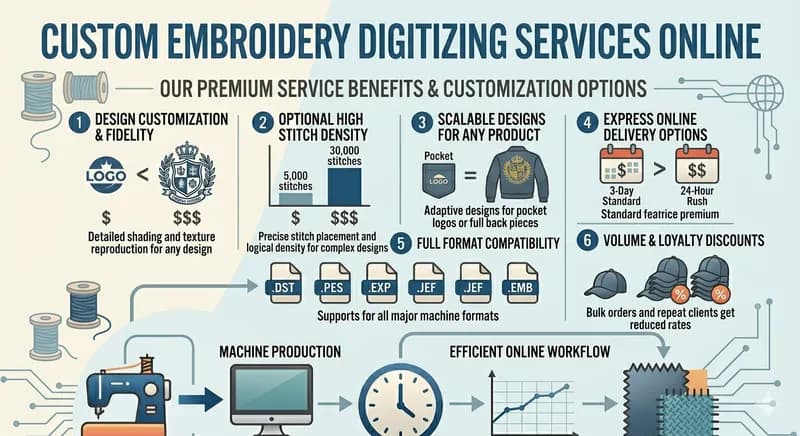
Simple text/logo (under 3,000 stitches): This is a straightforward design with one or two colors and minimal detail. Expect to pay on the lower end of the pricing range. A flat fee that covers revisions is the best deal here.
Medium complexity (3,000 to 10,000 stitches): Most business logos, department emblems, and school crests fall here. Multiple colors, some detail work, maybe some small text. This is the sweet spot of professional digitizing.
High complexity (over 10,000 stitches): Photorealistic designs, detailed illustrations, large jacket backs, full-front designs. These take significantly more digitizing time and require real skill to execute well.
The real cost of bad digitizing isn't the low price you paid upfront. It's the wasted thread, wasted stabilizer, ruined garments, and time spent resewing. Every 100 milliseconds delay in getting the right file costs you real money in production efficiency. A 7%(%) conversion drop happens with every poor quality result that makes its way to a customer.
Investing in expert digitizing services from a trusted source pays for itself immediately. The position #1 result on Google gets a 40%(%) click-through rate. The business that looks the most professional in person gets the same kind of premium attention.
How Digitizing Studio Serves Hawaii Clients Remotely
Here's what makes Digitizing Studio perfect for Hawaii customers in particular. We're fully online. No need to drive across town or wait for a local shop to open. You upload your design, we digitize it, and you download your file. Simple as that.
The process works exactly the same whether you're in Honolulu, Maui, Kauai, or the Big Island. Upload your artwork at digitizingstudio.com, select your file format and machine type, add any notes about fabric or size requirements, and submit. We deliver your file within 24 hours.
Our team is Google-certified professionals. That means we're held to high standards of accuracy, communication, and quality control. We don't just send a file and disappear. We're here for revisions, questions, and ongoing support.
For Hawaii businesses doing regular orders, we offer repeat-client advantages and priority processing. Our 92%(%) client retention rate tells you that people who work with us once almost always come back. That's not a lucky accident. That's what happens when expert digitizing services actually deliver what they promise.
41%(%) of adults use voice search daily, often searching phrases like "embroidery digitizing near me" or "best embroidery digitizing company." While we're not physically in Hawaii, our online-first model means distance doesn't affect the quality you receive. And 8.4B(+) voice assistants worldwide by 2026 means that being findable and trustworthy online matters more than a street address.
Specialty Embroidery Projects We Handle for Hawaii Clients
Specialty embroidery covers the unique, interesting, and technically challenging projects that go beyond the standard logo-on-a-polo. And Hawaii, honestly, has more than its share of these.
Cultural and Traditional Designs. Hawaii has a rich indigenous culture and also strong Japanese, Filipino, Chinese, and Portuguese immigrant traditions. Designs inspired by traditional tatreez (Palestinian cross-stitch embroidery), otomi embroidery (colorful Mexican folk designs), or blackwork embroidery (high-contrast monochromatic patterns) are genuinely requested by Hawaii's multicultural business community. Mexican embroidery inspired patterns are popular in fashion contexts here too.
Chenille and Varsity Letters. Hawaii's high schools and universities use chenille embroidery for varsity jackets and letter patches. Chenille has a looped, plush texture that requires a completely different digitizing approach than standard embroidery.
Sweater Embroidery. Embroidery on knit fabrics is technically challenging because the fabric stretches. Sweater embroidery needs specific underlay stitching and density settings to prevent distortion.
Shoe Embroidery. Shoe embroidery is a growing trend, particularly in Hawaii's sneaker and surf culture. The curved, constrained surface needs careful digitizing and specific stabilizer choices.
Punch Embroidery. Punch embroidery uses a punch needle tool to create looped pile designs. Digitizing for punch needle tools is a niche specialty that we handle.
Whatever your project, if it involves embroidery and thread, we can digitize it properly.
Hawaii Embroidery Community: Shops, Makers, and Resources
Hawaii has a genuine and growing embroidery community, from hobbyists exploring embroidery for beginners to commercial operations running multi-head machines for hotel chains.
The hand embroidery scene in Hawaii is particularly vibrant. Creative embroidery groups meet across Oahu and Maui, working on everything from modern folk embroidery to traditional flower embroidery and floral embroidery inspired by the island's natural beauty. Mushroom embroidery (yes, it's a thing) and cat embroidery patterns are also genuinely popular in Hawaii's crafting community.
The local embroidery shops on Oahu, including those in Honolulu's Chinatown Arts District and the Kaka'ako neighborhood, are part of a broader ecosystem that includes Etsy sellers doing etsy embroidery work from home studios in Kailua and Kaneohe.
For commercial embroiderers and embroidery company owners across the islands, Digitizing Studio serves as a reliable backend partner. We handle the files so you can focus on sewing, customer service, and growing your business.
If you're just getting started with embroidery for beginners, the first thing to know is that your machine's manual is your best friend. The second thing is that a quality embroidery digitizing file makes everything easier. Bad files are the number one reason beginners get frustrated and give up.
Digital sewing patterns and embroidery rings, along with proper hooping technique, are the other fundamentals that new embroiderers need to master. We always recommend pairing good equipment with genuinely professional digitizing files for the best learning experience.
Frequently Asked Questions About Embroidery Digitizing in Hawaii
How long does embroidery digitizing take for Hawaii customers?
Embroidery digitizing for Hawaii customers through Digitizing Studio takes 24 hours or less in most cases. We operate across all time zones and serve all 50 states, so your Hawaii order gets the same fast turnaround as any mainland order. You upload your artwork, specify your machine type and file format, and our team gets to work immediately. For rush orders, we can often deliver within 4 to 6 hours. Complex designs with many colors and fine detail may take slightly longer, but we'll always communicate clearly about timing. We don't make you wait days for something that should take hours. Our 8,300+(+) completed projects include hundreds of fast-turnaround deliveries that came back clean on the first run.
What's the difference between auto-digitizing and professional digitizing?
Auto-digitizing runs your artwork through software algorithms that attempt to assign stitch types automatically. Professional digitizing involves a skilled human digitizer who manually evaluates your design, fabric type, and machine requirements, then places every stitch path with intention. The difference in quality is significant. Auto-digitized files commonly have wrong density, poor underlay, bad stitch sequencing, and pull compensation errors that cause fabric puckering, fuzzy edges, and design distortion. Professional digitizing, like what Digitizing Studio provides, produces clean, consistent results that sew perfectly the first time. That's why our client retention rate is 92%(%) and why businesses across Hawaii rely on us for every order, not just their first one.
How much should I pay for embroidery digitizing in Hawaii?
Embroidery digitizing pricing in Hawaii and nationally depends on design complexity, measured roughly by stitch count. Simple text or icon designs under 3,000 stitches cost less than medium complexity logos of 3,000 to 10,000 stitches, which cost less than highly detailed or large designs over 10,000 stitches. Flat-fee pricing with free revisions is the best deal for most customers. At Digitizing Studio, our pricing is transparent and competitive. Avoid services that charge suspiciously low prices, as they're almost always using auto-digitizing software that produces substandard files. The real cost of bad digitizing is the wasted fabric, thread, and time from failed first runs, not the digitizing fee itself.
How do I know if my embroidery digitizing file is good quality?
A good quality embroidery digitizing file has several characteristics you can check before sewing. First, view the file in your machine's design editor or preview software. The stitch paths should look clean and logically sequenced. Color stops should be minimal and sensible. The stitch density shouldn't look too thick or too sparse for the design elements. When you sew a test on the correct fabric, the results should match your original artwork closely, with no puckering, no loose threads, and no registration problems between color layers. At Digitizing Studio, we offer free file quality reviews, so if you've got an existing file you're not sure about, send it over. We'll tell you honestly what's wrong and how to fix it.
What file format do I need for my embroidery machine in Hawaii?
The file format you need depends entirely on your machine. Brother embroidery machines (pe800, se1900, pe900, pr1055x, nq1700e, pe535, pe770, se400, se600) use PES format. Ricoma embroidery machines including the ricoma em 1010 typically use DST. Janome uses JEF. Husqvarna Viking uses HUS or VP3. Industrial and commercial machines from various brands mostly use DST. When you order from Digitizing Studio, just tell us your exact machine model and we'll deliver the correct format. We support all major formats and can even deliver multiple formats in one order if you're running more than one machine type.
Do I need a vector file to get my logo digitized in Hawaii?
You don't need a vector file for embroidery digitizing, though vector files do make the process easier and often produce better results because the artwork edges are cleaner. If you only have a JPG or PNG of your logo, that's completely fine. Provide the highest resolution version you have, ideally at least 300 dpi at the intended embroidery size. Our digitizers at Digitizing Studio work from raster files every day and are skilled at interpreting artwork even when it's not perfectly sharp. Just avoid sending very small thumbnails or heavily compressed images. A screenshot from your website is usually not enough detail for good digitizing results.
Can Digitizing Studio handle custom embroidery designs for Hawaii cultural motifs?
Absolutely. Digitizing Studio handles custom embroidery designs that reflect Hawaii's rich cultural heritage, including traditional Hawaiian geometric patterns, floral embroidery inspired by island flora, designs drawing from Japanese textile traditions like sashiko stitching, and multi-cultural motifs that reflect Hawaii's diverse community. We work with original artwork you provide and maintain its cultural integrity throughout the digitizing process. We've completed 8,300+(+) projects spanning every kind of design imaginable, from simple text logos to intricate traditional patterns. Our digitizers treat every design with care and professionalism. If you have specific requirements about stitch direction, color accuracy, or design element priority, just include those notes with your order at digitizingstudio.com.
Ready to Get Your Hawaii Embroidery Looking Perfect?
You've made it through a lot of detail in this guide. And here's the thing: knowing all of this is genuinely useful. But none of it matters if your digitizing file isn't actually good.
The businesses across Hawaii that consistently produce high-quality embroidery all have one thing in common. They work with a trusted digitizing company that delivers professional results, fast, every single time.
That's exactly what Digitizing Studio has been doing for 18+(+) years. We're the #1 digitizing service company in the USA with 8,300+(+) completed projects, a 92%(%) client retention rate, and Google-certified professionals who actually care about the quality of every file we send.
Whether you're in Honolulu managing a hotel's uniform program, in Maui running a boutique surf brand, in Hilo supplying embroidered workwear, or anywhere else across the islands, we're here for you.
Ready to get your design stitched perfectly? Submit your artwork at digitizingstudio.com today. Our team delivers professional embroidery digitizing files within 24 hours. No rework, no frustration, just clean stitches from the first run.
About the Authors
Marcus Kahananui Marcus has 14 years of experience in embroidery production and textile sourcing across the Pacific region. He holds a certificate in commercial embroidery machine operations and has worked with hospitality and tourism brands throughout Hawaii and the broader Pacific market.